























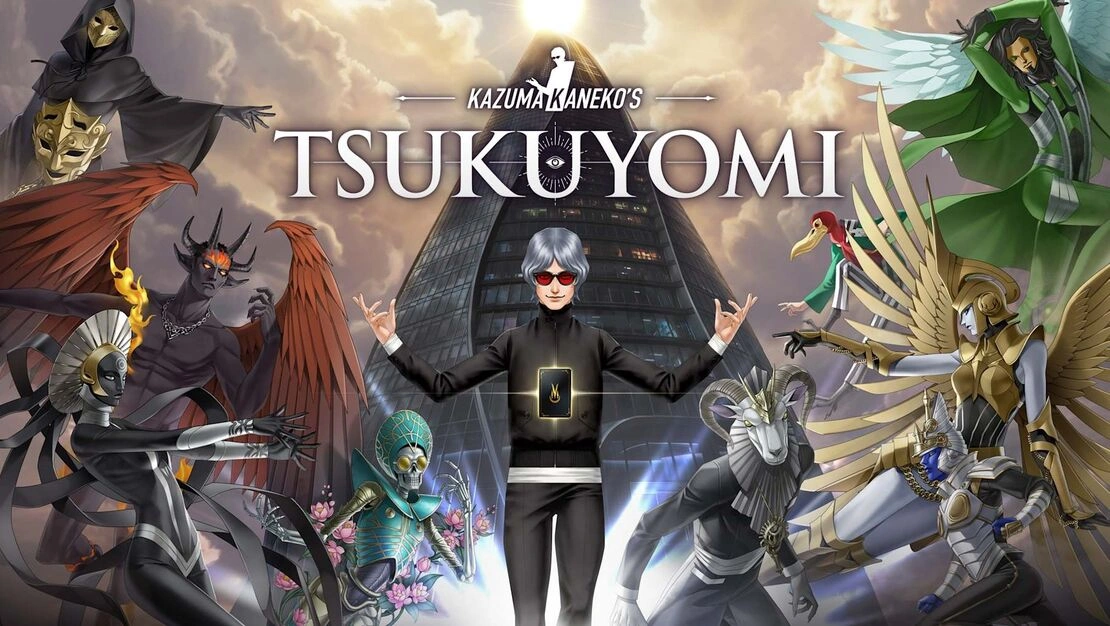

Kazuma Kaneko’s Tsukuyomi places a roguelike deckbuilder inside a near-future Tokyo where myth, technology, and occult dread collapse into the same urban nightmare. THE HASHIRA, a sealed high-tech tower, has become a demonic zone after Jinma escape and threaten the city. The player guides Tsukuyomi agents who summon captured demons through magical cards, turning folklore into a tactical resource.
Kazuma Kaneko’s name carries heavy cultural weight here. His demon designs helped shape how many players outside Japan encountered yokai, gods, and occult iconography through games. Tsukuyomi clearly understands that legacy. It pulls from Japanese myth, cyberpunk anxiety, dungeon RPG structure, and monster-collecting traditions that have traveled far beyond their original cultural frame.
The game began life on mobile and PC before arriving on Switch with revised presentation, quality-of-life changes, and extra content. That history is visible. The Switch version feels cleaner and fuller, yet the mobile roots remain in its grind, progression loops, and reward cadence. The result is a strange work: mechanically clever, rich in premise, and frequently magnetic, while also damaged by AI-generated art and a balance model that sometimes dulls its own tactical edge.
A Tower of Gods, Demons, and Thin Human Drama
The story is set in the year 20XX, after Jinma invade Tokyo and trap THE HASHIRA behind a barrier. The Tsukuyomi agents enter the tower to uncover the cause, prevent a ritual from endangering the city, and survive a structure that now feels like a ritual chamber built from glass, steel, and old nightmares.
That setting carries the game further than its character writing. Hangetsu, Izayoi, Magetsu, Shingetsu, and the unlockable Tomi Noriko each bring a distinct combat identity and a personal conflict, yet their personalities often land closer to symbolic roles than lived-in people. The alignment system, split across Vice, Virtue, and Nature, recalls the old moral architecture of Japanese demon RPGs, where ideology is worn almost like armor. It gives the game a recognizable spiritual grammar, particularly for players familiar with Law, Chaos, and Neutral paths.
The strongest writing appears in smaller encounters. A choice involving an obsessive girl searching for the perfect gift, for instance, works because neither response feels cleanly righteous or cruel. These moments suit the game’s gnostic atmosphere, where moral certainty feels less useful than self-knowledge.
Also Read






The larger plot is less graceful. Because the game frequently swaps protagonists and keeps most action inside the same tower, the story can feel like scaffolding between runs. THE HASHIRA is evocative, yet the people climbing it often fade behind the system that moves them upward.
Cards That Strike, Guard, and Shape Identity
The core loop combines first-person dungeon crawling with route-based roguelike progression. Each floor asks the player to choose paths leading to regular battles, elite encounters, shops, rest points, events, and boss fights. The structure is familiar, especially for anyone who has played modern deckbuilders, yet Tsukuyomi gives the format a specific Japanese RPG flavor through its demon cards, morality system, and character leveling.

Combat revolves around Jinma Cards. These cards can attack, defend, apply buffs, trigger special effects, or mix damage and guard values. Each turn gives the player Odo, the energy resource used to play cards. Odo refills at the start of the next turn, so the real question is rarely whether to spend it, but how far to push a sequence before leaving yourself exposed.
The defensive system is the game’s smartest mechanical wrinkle. Enemies target card slots, and cards with guard values can be positioned to block incoming attacks. A card is no mere action icon. It is a weapon, a shield, a body on the battlefield. Empty slots become vulnerabilities. Weak placement can turn a safe turn into a disaster. This gives combat a pleasing physicality, as if the deck itself has become a formation.
The Break mechanic adds another layer of tactical pressure. Certain enemy actions can be interrupted by meeting specific requirements, such as landing enough hits or dealing enough damage. A successful Break cancels the enemy attack and restores Odo, creating aggressive combo routes that reward careful planning. At its best, Tsukuyomi makes a turn feel like a ritual performed under threat: count the costs, read the omen, strike before the demon completes its chant.
Character design helps sustain variety. Izayoi is stable and defense-oriented, ideal for players who prefer control. Shingetsu builds long Odo chains through Virtue. Magetsu leans into status effects and self-damaging tactics supported by survival tools. Hangetsu blends parts of those two approaches. Tomi Noriko uses powerful, complex boss-themed cards that ask for greater familiarity with the system.
Progression is where the game’s RPG instincts become clearest. Characters gain experience across runs, unlocking higher HP, stronger starting decks, new gear, Tsukimono relics, consumables, and passive boosts. Creation Cards, granted through Okami’s gifts, persist into future runs and can become central pieces of a build.
That persistence is rewarding, but it also weakens the roguelike tension. Once strong deity cards enter the player’s collection, the smartest strategy often becomes building a thin, reliable deck around them. Random demon cards can start to feel like upgrade material rather than meaningful additions. Bosses sometimes force adaptation, which gives the main story a welcome push and pull. In freer post-game modes, balance swings harder. Some regular enemies feel nastier than elite fights, and certain bosses demand counters so specific that a run can feel decided by the matchup rather than player creativity.
The Uncanny Problem of AI Demon Design
The presentation is where Tsukuyomi faces its hardest cultural contradiction. This is a game sold under Kazuma Kaneko’s name, built around demons, gods, occult silhouettes, and the visual memory of Japanese myth filtered through modern design. Yet many cards and enemy images rely on AI-generated art trained on his style. That choice cannot be treated as a minor production footnote. In a game about summoning images of spiritual beings into tactical form, art is the language of the entire work.
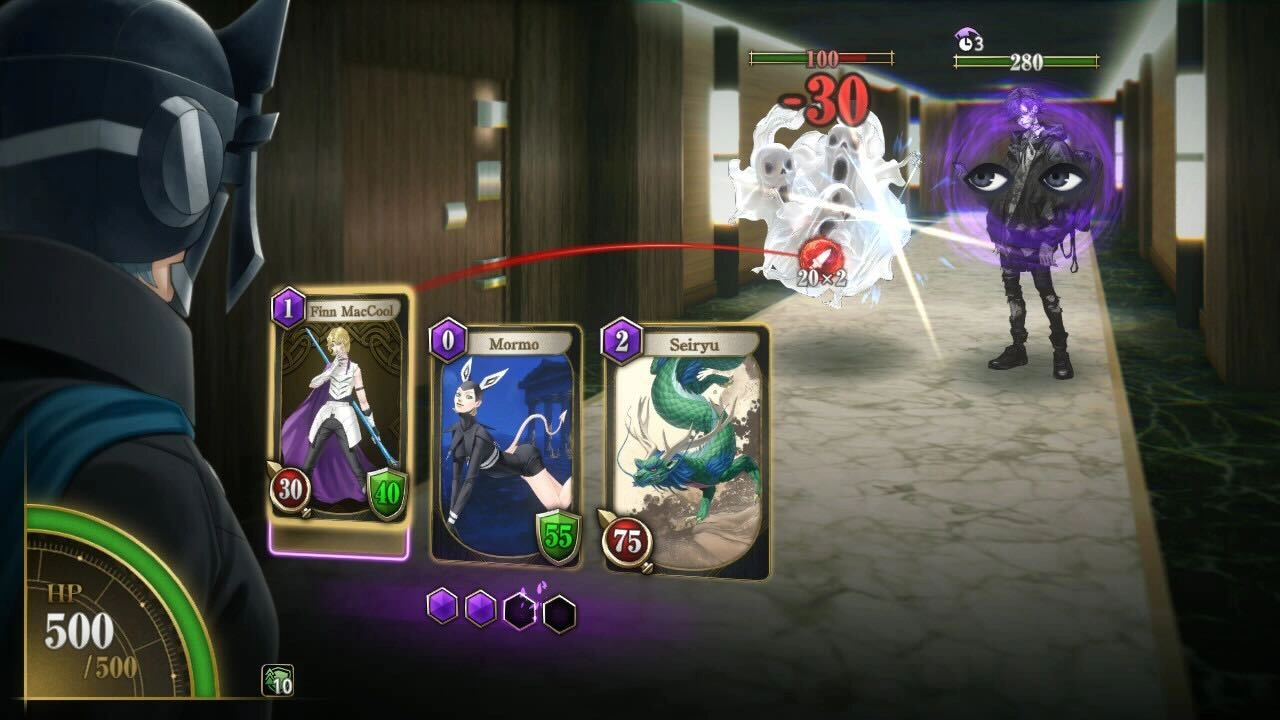
Some designs pass at a glance. Bosses often look stronger than standard enemies, and certain cards capture a sliver of Kaneko’s sharp unease: angular bodies, ritualistic poses, strange mixtures of flesh, armor, divinity, and machinery. Then the inconsistency creeps in. Many monsters have a glossy artificial finish.
Others seem mismatched beside one another, as if pulled from adjacent visual traditions without a guiding hand. The effect is especially harmful because the player spends so much time staring at cards. A weak texture or awkward design does not disappear into the background. It sits in the center of play.
The issue reaches beyond taste. Japanese demon design has a long history of translation, reinterpretation, and artistic mutation, from folklore scrolls to manga, cinema, and games. Kaneko’s finest work understood that tradition as a living conversation. Tsukuyomi gestures toward that lineage while replacing much of the human act of reinterpretation with automated imitation. The result can feel culturally flattened, even when the mechanical structure remains absorbing.
The soundtrack fares better. Its moody battle themes fit the occult-cyberpunk atmosphere, and the Switch version’s cleaner structure makes the game easier to approach than its mobile ancestry might suggest. Still, the presentation never fully escapes the unease created by its own methods. Kazuma Kaneko’s Tsukuyomi is a mechanically interesting deckbuilder with bold ideas about cards, demons, and spiritual technology, yet its most fascinating rituals are haunted by visual compromises and grind-heavy design habits.
The Review
Kazuma Kaneko's Tsukuyomi
Kazuma Kaneko’s Tsukuyomi has smart card combat, a striking occult-cyberpunk premise, and boss fights that can turn deck management into tense ritual work. Its systems shine brightest when positioning, Odo control, Break conditions, and character identity lock together. The problem is that uneven balance, grind-heavy progression, thin storytelling, and AI-heavy art weaken the spell. For a game carrying Kaneko’s name, the visual inconsistency hurts. Still, there is enough mechanical personality here to interest deckbuilder fans willing to accept its flaws.
PROS
- Clever card-based defense system
- Strong boss mechanics
- Distinct playable characters
- Moody occult atmosphere
- Satisfying Break and combo play
CONS
- AI-generated art feels inconsistent
- Story lacks depth
- Progression can feel grindy
- Creation Cards reduce run variety
- Enemy balance swings too sharply