

























![Kingdom Hearts Collection [I-III] Review](https://gazettely.com/wp-content/uploads/2026/10/Kingdom-Hearts-Collection-I-III-1-360x180.webp "Kingdom Hearts Collection [I-III] Review: KHII Holds Steady as Newer Entries Fluctuate 37")



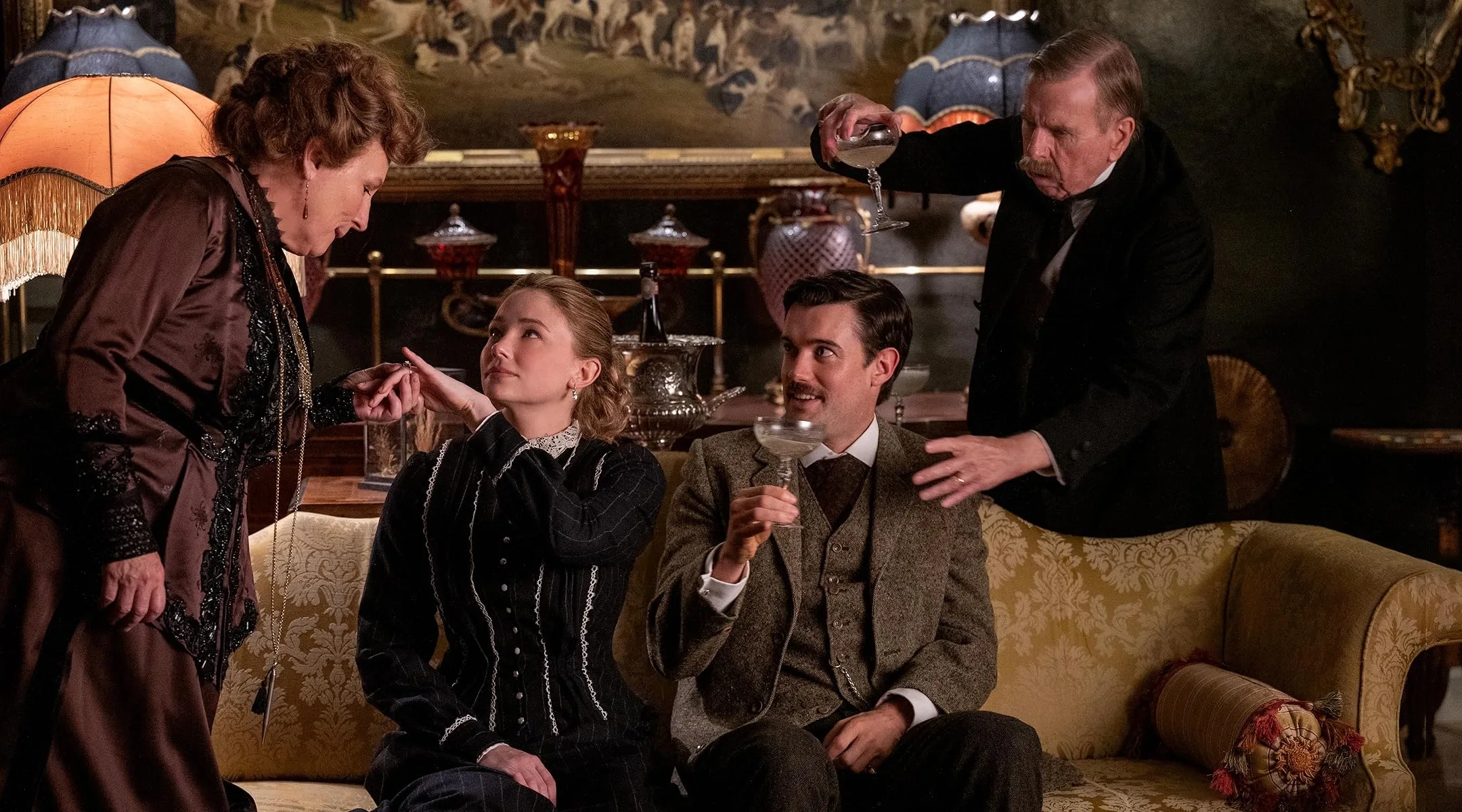

Tina Gharavi’s Virginia Woolf’s Night & Day takes Woolf’s 1919 novel and turns its social hesitations into a lucid period drama about intellect under supervision. Edwardian London arrives here with polished rooms, inherited reputations, stiff collars, and the quiet violence of good manners.
Katharine “Kit” Hilbery, played by Haley Bennett, lives inside privilege, yet the privilege comes furnished like a cage. Her passion is astronomy, a science that asks her to look upward while every man in her household seems determined to lower her gaze.
Kit wants to study mathematics and astronomy at Cambridge. Her father, played by Timothy Spall, would prefer a marriage plot with no messy academic footnotes. Around her circle are Jennifer Saunders as her literary-minded mother, Jack Whitehall as the foolish William Rodney, Lily Allen as suffragette Mary Dutchett, Misia Butler as Cyril, and Elyas M’Barek as Ralph Denham. The film is sincere, elegant, and emotionally plainspoken. Its weakness lies in that same clarity, since it can tidy away the very ambiguity that might have made its rebellion cut deeper.
Marriage, Mathematics, and the Politics of Looking Up
The film’s sharpest adaptation choice is its elevation of astronomy from a passing detail into Kit’s defining pursuit. This gives the drama a clean symbolic line: the heavens represent freedom, scale, pattern, and possibility, while Edwardian society offers drawing rooms, proposals, and permission slips. Kit’s mind seeks movement across vast distances. Her world keeps handing her etiquette.
Her engagement to William Rodney is less romance than tactical surrender. William, with his pompous literary opinions and inherited confidence, is a comic portrait of male entitlement in soft gloves. He is ridiculous, yet the society around him treats his mediocrity as destiny. Kit’s decision to accept him exposes a cruel bargain: marriage may be the only socially legible route to a private life of thought.
Ralph Denham creates a romantic disturbance, though the film never lets that relationship gather full dramatic force. He is present as possibility, less convincing as an emotional equal to Kit’s inner weather. The stronger charge comes through Mary Dutchett, whose suffrage politics give Kit’s private frustration a public language. Mary helps turn Kit’s yearning into argument, then argument into defiance.
The script often states its politics with little filtration. There are speeches about equality that carry moral urgency, yet they can flatten the scene around them. Still, the film understands something vital: the fight for education is never only about books or lecture halls. It is about who gets to imagine a future without apology.
Performances in a Room Full of Expectations
Haley Bennett gives the film its pulse. Her Kit is bright, restless, charming, and quietly unruly, a woman whose defiance often appears first as impatience. Bennett captures the contradictions without sanding them down. Kit is sheltered and sharp, romantic and wary, privileged and profoundly restricted. She knows enough to want freedom, yet not enough to see every cost attached to it.

That tension keeps the performance alive during talkier stretches. Bennett has a way of making thought feel physical. A glance toward a telescope, a clipped reply to paternal condescension, a flicker of embarrassment around Ralph: these details suggest a mind working faster than the room can tolerate.
Misia Butler’s Cyril gives the film one of its warmest and most quietly painful presences. Reimagined as a queer pacifist, Cyril reflects Kit’s dilemma from another angle. He knows the exhaustion of performing social acceptability and refuses the bargain with gentle firmness. His bond with Kit gives the story an emotional intimacy that the romantic subplot does not fully reach.
Timothy Spall plays Mr. Hilbery with force, though the character is drawn in broad strokes. He embodies patriarchal authority so directly that he sometimes feels like an institution wearing a waistcoat. Jack Whitehall’s William works better, partly because his vanity has comic texture. Jennifer Saunders brings wit and a touch of sadness to Kit’s mother, while Lily Allen’s Mary supplies a bright, modern directness that energizes the film, even when the role asks for bluntness rather than depth.
Silk, Static, and the Shape of Defiance
The film is handsomely built. Its pre-war London has bustle, polish, and social pressure in equal measure, while the interiors carry the weight of family legacy. The production design gives Kit’s world a sense of inheritance: rooms full of books, portraits, manuscripts, and expectations that have been mistaken for moral law.
Costume becomes one of the film’s most effective arguments. Kit and Mary in suits and trousers make resistance visible before anyone speaks. The image cuts through the manners of the period piece, turning fabric into attitude. These choices give the film a useful visual sharpness, especially when the dialogue grows too direct.
Gharavi also folds in modern accents: a synth-tinged score, contemporary-feeling songs, handheld movement, and Mary’s vivid red hair. The intention is clear. The past is not sealed behind glass. Its injustices still breathe in altered forms. Sometimes this connection lands with grace; at other points, the symbolism feels underlined in ink.
The pacing has a gentle, sometimes sluggish drift. Scenes of debate can stiffen into position papers, and the film’s emotional rhythm suffers when characters explain what the drama has already shown. Yet there is charm here: a dreamlike softness, a romantic eccentricity, and a sincere belief in Kit’s right to think beyond the life assigned to her. Virginia Woolf’s Night & Day works best as a polished, well-acted act of reclamation, carried by Bennett’s luminous resolve and by the simple, radical image of a woman looking at the stars and refusing to look away.
Virginia Woolf’s Night & Day is a romantic period dramedy that made its world premiere at the South by Southwest London festival on June 1, 2026. Set against the backdrops of Edwardian London and early 20th-century advancements, this lively literary adaptation follows Katharine Hilbery, a brilliant and headstrong woman who fights to protect her autonomy and pursue her passion for astronomy while resisting parental expectations of marriage. Following its festival debut, the feature film is slated for a widespread theatrical rollout across the United Kingdom starting June 19, 2026, with a theatrical release handled by Quiver Distribution scheduled for later in the year in the United States.
Where to Watch Virginia Woolf’s Night & Day (2026) Online





Full Credits
Title: Virginia Woolf’s Night & Day
Distributor: Vue Lumiere, Quiver Distribution, Westend Films
Release date: June 1, 2026
Rating: 12A
Running time: 95 minutes
Director: Tina Gharavi
Writers: Justine Waddell, Virginia Woolf
Producers and Executive Producers: Stephen Julius, Christopher Figg, Justine Waddell, Meg Thomson, Julie Link, Philipp Steffens, Margarethe Baillou, Jon Gosier, Chandler Heinz, Ian Hutchinson, Konstantin Korenchuk, Chandler Heinz Laun, Saskia Thomas
Cast: Haley Bennett, Timothy Spall, Elyas M’Barek, Lily Allen, Jack Whitehall, Jennifer Saunders, Sally Phillips, Misia Butler, Alex Macqueen, Simon Phillips, Frances Barber
Director of Photography (Cinematographer): Sebastian Edschmid
Editors: Hansjörg Weißbrich, Ben Wilson
Composer: Simon Goff
The Review
Virginia Woolf's Night & Day
Virginia Woolf’s Night & Day is a sincere, handsomely crafted period drama lifted by Haley Bennett’s radiant performance and its thoughtful focus on women’s education, autonomy, and social confinement. Its feminist message is clear and heartfelt, though the film sometimes states its ideas too plainly, leaving less room for Woolfian complexity. Still, its warmth, elegant design, and dreamlike flashes give Kit’s rebellion a graceful charge.
PROS
- Haley Bennett gives Kit wit, fire, and emotional texture
- Strong production design and period costuming
- Thoughtful focus on women’s education and social restriction
- Misia Butler’s Cyril adds warmth and quiet poignancy
- Modern score and visual touches give the period setting personality
CONS
- Dialogue can feel too speech-like
- Ralph and the romantic thread lack depth
- Some supporting characters are underused
- Pacing occasionally feels slow
- Patriarchal figures can feel broadly drawn







