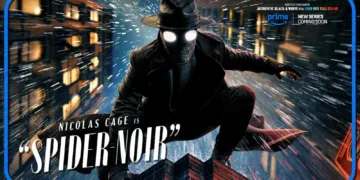













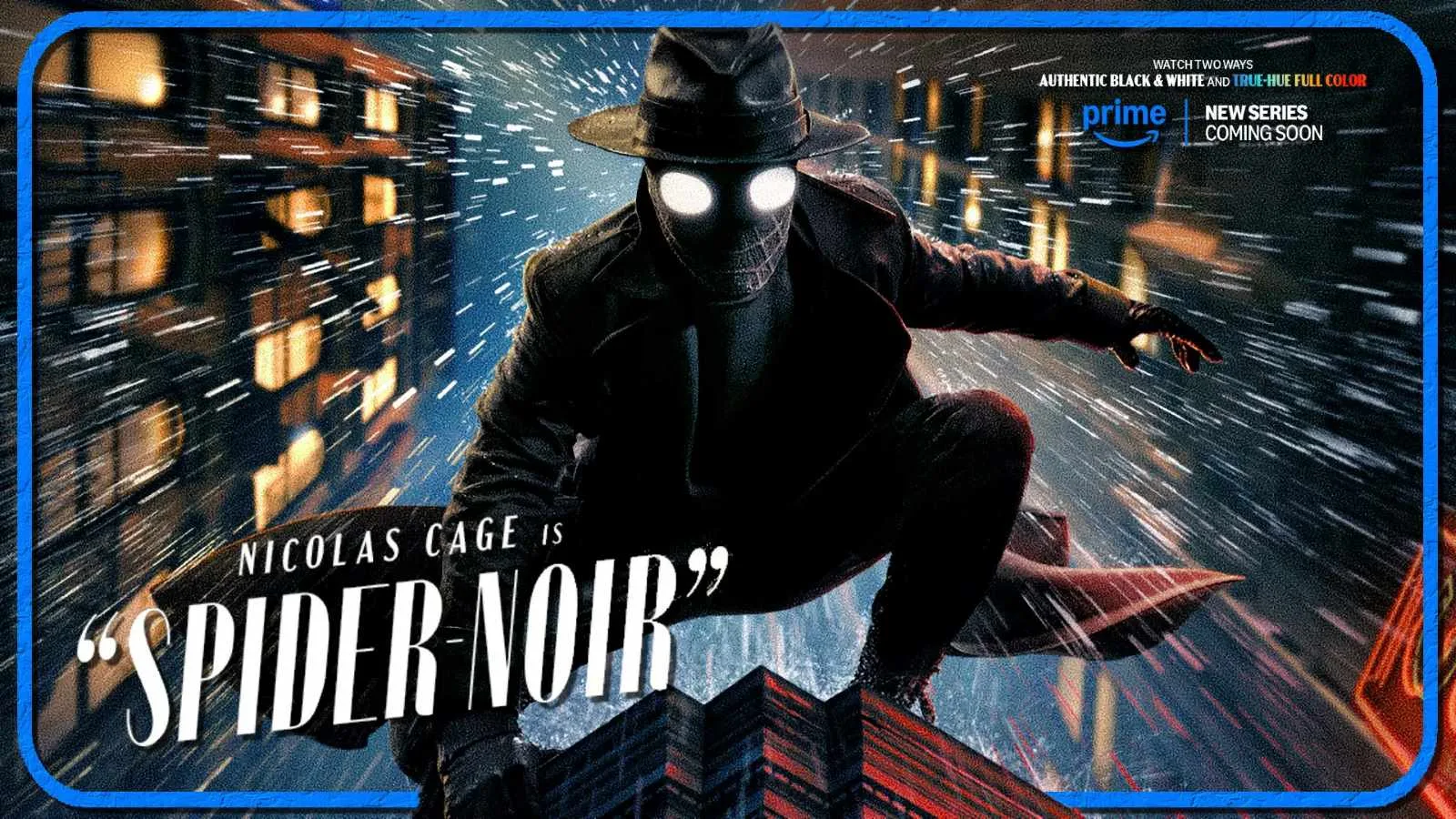

Spider-Noir arrives on Prime Video as one of the stranger bets in recent streaming memory: an eight-episode noir series set in Depression-era New York, built around a Marvel superhero who hasn’t done anything heroic in five years, starring an actor whose own career has followed a similarly erratic trajectory. The show, developed by showrunners Oren Uziel and Steve Lightfoot (with Phil Lord and Christopher Miller among the executive producers), is adapted from the 2009 Marvel Comics series by David Hine and Fabrice Sapolsky. It takes considerable pains to establish that it has nothing to do with the Spider-Verse animated films, and this disclaimer is welcome.
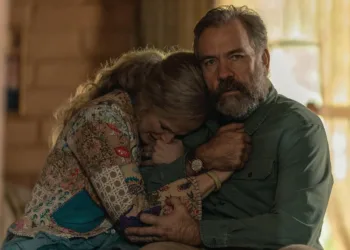
Ben Reilly (Nicolas Cage) is The Spider, or was. His fiancée was murdered, and he retreated into self-pity and whiskey, running a barely solvent detective agency in a city that has since forgotten him. When a routine surveillance case pulls him back into organized crime, political corruption, and something that looks disturbingly like superhuman mutation, the question the show poses is simple: can a man whose defining quality is guilt find any reason to be a hero again? Film noir was invented, in part, to process exactly that question. The marriage of genre and mythology here feels less like a gimmick than a reunion of long-separated cousins.
Shadows and Their Discontents
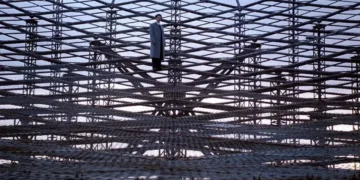
The visual grammar of Spider-Noir is, to put it plainly, gorgeous. Cinematographer Darran Tiernan (previously responsible for the grimly beautiful imagery of HBO’s The Penguin) treats 1930s Manhattan as an opportunity to quote liberally from the canon of classic film noir, and the results are consistently striking. Canted angles, split diopter shots, wafting cigarette smoke, dramatic backlighting that carves faces out of darkness: the visual vocabulary is so lovingly assembled that the series functions partly as a crash course in the aesthetics of a vanished Hollywood era. The climax owes a visible debt to Orson Welles’ 1947 The Lady from Shanghai. This is deliberate theft at the highest level, which is to say: the best kind.
Then there is the matter of the two versions.
Each episode is available in “Authentic Black and White” or “True Hue Full Color,” the color version digitally applied after the fact. The black-and-white is superior, and not by a small margin. The shadows have somewhere to go in monochrome; the canted angles carry a moral weight they partially lose in color, where they risk looking merely stylish. The color version earns its existence by revealing the production design in full. The costumes, the sets, and the meticulous period detail produce something closer to Edward Hopper made animate. Watch the black-and-white. Then watch an episode in color to appreciate what you were looking at.
The writing matches the visual register. Eight writers, including Uziel, deliver dialogue in what might be called compressed period authenticity: rat-a-tat exchanges carrying the genetic material of Raymond Chandler and Dashiell Hammett. The plot architecture follows hard-boiled tradition. What begins as an infidelity surveillance job spirals outward into arson, murder, wartime trauma, and eventually something stranger still.
The historical timeline is deliberately imprecise (the show references Depression-era 1933 and a 1936 James Cagney film in the same breath) and never apologizes for it. The setting is an alternate universe, and the anachronisms are features rather than errors. A world that feels like 1933 except when it doesn’t is, paradoxically, truer to noir’s spirit than strict period accuracy would allow. Noir was never really about history. It was always about a feeling.
The Web of Plot
The central mystery operates along cleanly established noir lines. Ben Reilly is hired under false pretenses to surveil Cat Hardy (Li Jun Li), a nightclub singer who turns out to be the effective prisoner of Silvermane (Brendan Gleeson), the Irish mob boss whose incinerated mansion sets the show’s criminal engine running. The conspiracy widens to encompass a corrupt mayor (P.J. Byrne), Silvermane’s enforcer Flint Marko (Jack Huston), and a network of individuals undergoing involuntary superhuman transformation. Journalist Robbie Robertson (Lamorne Morris) supplies investigative muscle and moral commentary throughout.
The eight episodes move without fat. This is rarer than it should be in streaming television, where the standard unit of storytelling has drifted toward the padded season. Spider-Noir’s tightest work is in its opening and closing thirds; the middle section loses momentum as the Silvermane conspiracy grows unfocused and certain subplots meander before finding their purpose.
The superhero layer is handled with greater ingenuity than expected. Classic Spider-Man villain analogues (Sandman, Tombstone, Megawatt) are transplanted into 1930s New York with varying success. Andrew Lewis Caldwell’s Shakespeare-quoting Megawatt charges every scene with excess theatrical energy. The mutation subplot, in which multiple characters are physically transforming in ways that echo the show’s horror-coded origin flashback, provides the conspiracy with its most genuinely disturbing dimension.
The one significant failure is the romance. Reilly and Cat Hardy are given a will-they-won’t-they arc the show intends as emotionally central, and the chemistry between Cage and Li never generates the required heat. This is partly a writing problem (their scenes are functional rather than charged) and partly a consequence of the show’s tendency to declare their connection rather than let the audience feel it. A noir romance lives or dies on electricity between leads. This one mostly sputters.
Cage, His Cast, and the Art of Imitation
Nicolas Cage described his approach to Ben Reilly as “70 percent Bogart and 30 percent Bugs Bunny,” which is either very helpful or completely accurate, depending on your perspective.
The performance is genuinely strange. Cage has built Reilly from the outside in: an exaggerated mid-century accent assembled from old movie dialogue (there is a scene where Reilly watches a James Cagney film and mouths every line, as if taking notes on how to be human); spider-like physical contortions that emerge when Reilly is injured; a spidey-sense rendered as something closer to a migraine than a superpower; sleeping positions that suggest a cockroach playing dead. The show’s shrewdest structural move is making these eccentricities canonical. Reilly is explicitly a man who has constructed his personality from cinematic raw material, his insect biology seeping through the performance at odd angles. This explains everything and justifies nothing, which is roughly the correct balance.
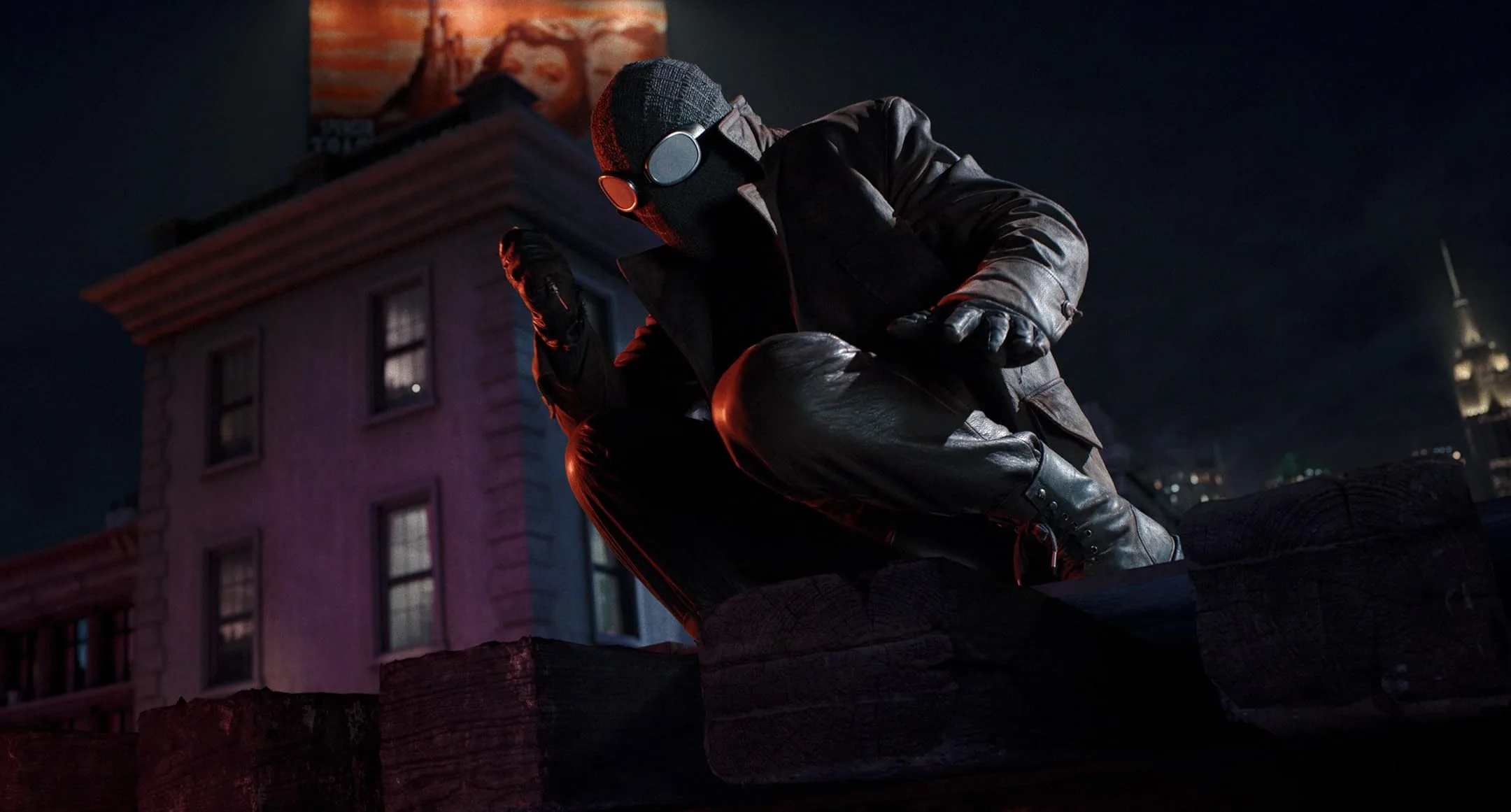
There are moments when Cage is genuinely electric, particularly in the horror-inflected episode and in sequences that lean into physical comedy. There are other moments when the performance tips into self-consciousness, when you sense the actor enjoying the role slightly past the point where enjoyment serves the character. His theatrical scale sits uneasily against the show’s demands for genuine vulnerability. The grief over his murdered fiancée occasionally gets swamped by the showmanship. Cage is always magnetic. He is not always moving.
His first major television lead role comes after a career that nearly bottomed out entirely before the slow, strange resurrection that began with 2018’s Mandy and his voice turn in Spider-Man: Into the Spider-Verse. It is worth pausing to appreciate what this represents: a once-derided Oscar winner, famous for straight-to-video obligations and eccentric life choices, arriving at a streaming series that requires him to carry eight episodes on his back. He mostly does it. The moments when the machinery is visible are outnumbered by the moments when it isn’t.
The supporting cast is uneven in its own instructive ways. Lamorne Morris, as Robbie Robertson, delivers the series’ most grounded work, speaking the heightened period dialogue as if it is simply how people talk, which is the hardest trick in this kind of material. Karen Rodriguez’s Janet is a scene-stealer in the grand tradition of the wisecracking secretary. Caldwell’s Megawatt is a theatrical delight. Jack Huston carries his Boardwalk Empire physicality into the period setting with ease.
Gleeson is the disappointment. He establishes Silvermane as imposing in the early episodes, then the character begins flipping between vile and avuncular on the script’s schedule rather than any internal logic. A performance needs foundation, and the foundation here is unstable. By the halfway point, the apex villain has somehow shrunk.
Spider-Man and the Portable Mythology
Spider-Man has survived so many iterations that the question of what is essential to the character has become genuinely interesting. Spider-Noir’s answer: guilt, responsibility, and loss are portable. Everything else is costuming.
Ben Reilly’s moral code is rooted in romantic grief rather than the death of a parental figure. “With great power comes great responsibility, and she was the greatest responsibility I had,” Reilly says in voiceover. “And I failed her.” This is a clean reorientation of Spider-Man’s origin thesis, and it fits noir precisely because the genre has always been about people who failed at love and are working out what that means about them.
The decision to sever Spider-Noir from franchise continuity turns out to be its most productive creative choice. The absence of homework (no MCU connective tissue, no Spider-Verse Easter eggs) gives the series room to function as a standalone work. The ending earns its closure, which is rarer in streaming superhero television than it should be.
The pulp horror elements are where Spider-Noir charts its most original territory. The origin flashback, when it finally arrives, is strange in a way no live-action Spider-Man adaptation has previously attempted. The Freaks-referencing episode sets a genuinely distinctive tone. The mutation storyline borrows from body horror as much as from superhero convention. These choices suggest a show that understands its source material was always weirder than the mainstream acknowledged. The 2009 Spider-Man Noir comic, after all, involved a spider-god and a rebirth via cocoon. The television series cannot go quite that far, but it is clearly straining in that direction.
The genre transplant works. The core emotional architecture survives the relocation from Queens to a rain-slicked Depression-era speakeasy. The experiment implicitly raises the question of replicability (Spider-Man in Southern Gothic? Italian neorealism?) and wisely declines to answer it.
Spider-Noir is a highly anticipated live-action superhero series that explores a gritty, noir-inspired alternate universe within the Sony’s Spider-Man Universe (SSU). Set in 1930s New York City, the story follows an aging, grizzled private investigator named Ben Reilly—the Spider—who must grapple with his past and past personal tragedies as he is drawn back into the world of heroics to solve a dangerous new case. The series, which marks Nicolas Cage’s first leading role in a television production, is notable for its unique visual approach, being released in both black-and-white and color versions. The eight-episode series is set to premiere on the MGM+ linear broadcast channel in the United States on May 25, 2026, and will be available to stream globally on Prime Video beginning May 27, 2026.
Where to Watch Spider-Noir Online



Full Credits
Title: Spider-Noir
Distributor: MGM+, Prime Video
Release date: May 25, 2026 (MGM+), May 27, 2026 (Prime Video)
Rating: Not explicitly stated (typically TV-MA for noir-style dramas)
Running time: 45 minutes per episode (8 episodes total)
Director: Harry Bradbeer (first two episodes)
Writers: Oren Uziel, Steve Lightfoot
Producers and Executive Producers: Oren Uziel, Steve Lightfoot, Phil Lord, Christopher Miller, Amy Pascal, Aditya Sood, Dan Shear, Harry Bradbeer, Nicolas Cage, Pavlina Hatoupis
Cast: Nicolas Cage, Lamorne Morris, Li Jun Li, Karen Rodriguez, Abraham Popoola, Jack Huston, Brendan Gleeson
Director of Photography (Cinematographer): Darran Tiernan
Editors: Tirsa Hackshaw, Eric Kissack, Jennifer Barbot
The Review
Spider-Noir
Spider-Noir is a flawed but genuinely bold experiment. Tiernan's cinematography is among the year's finest television work, Cage is magnetically strange, and the genre fusion earns its existence more often than it stumbles. The Silvermane subplot loses focus mid-season, the central romance never ignites, and Cage's theatricality occasionally overwhelms the vulnerability the role requires. Still, the show closes its books with integrity and proves superhero mythology can survive radical transplantation.
PROS
- Stunning black-and-white cinematography
- Bold, committed genre fusion
- Nicolas Cage gives an eccentric, often electric lead performance
- Lamorne Morris is consistently excellent
- Satisfying standalone ending, no cliffhangers
- Horror-inflected episodes are genuinely distinctive
CONS
- Central romance lacks chemistry
- Silvermane subplot grows unfocused mid-season
- Gleeson's villain diminishes as episodes progress
- Cage's theatricality sometimes undercuts emotional authenticity
- Color version feels unnecessary