






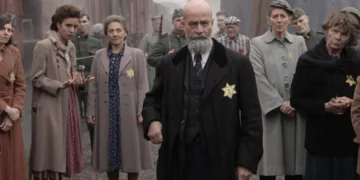














French cinema has rarely been eager to sit with its collaborators. The heroic narrative of the Resistance is tidier, more exportable, easier to frame on a wall. Emmanuel Marre, in his second solo feature, declines the tidy option. His subject is Henri Marre, the director’s own great-grandfather: a failed engineer, a self-published pamphleteer, a man who arrived in Vichy in September 1940 with a stack of his nationalist manifesto tucked under his arm and an eye for the main chance. He was no zealot. He was something harder to dismiss.
At the Cannes competition premiere of this 148-minute film, audiences encountered a protagonist who is neither monster nor martyr, but that most unsettling of figures: the careerist who simply goes along. Swann Arlaud plays him; Sandrine Blancke plays his semi-estranged wife, Paulette, whose real letters to the real Henri provide both structure and moral counterweight. The film is shaped by that correspondence, and by Marre’s evident discomfort with what those letters revealed. He does not let his ancestor off lightly. Nor does he let the audience off either.
Flash Photography in the Free Zone
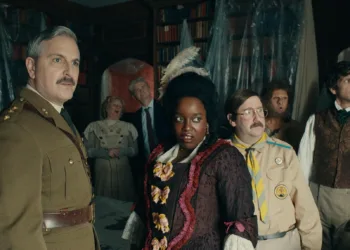
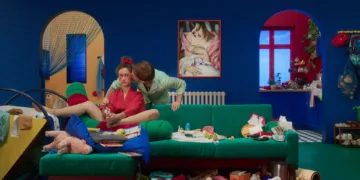
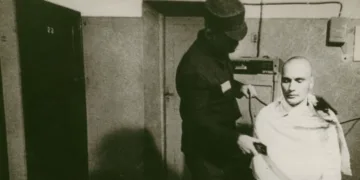
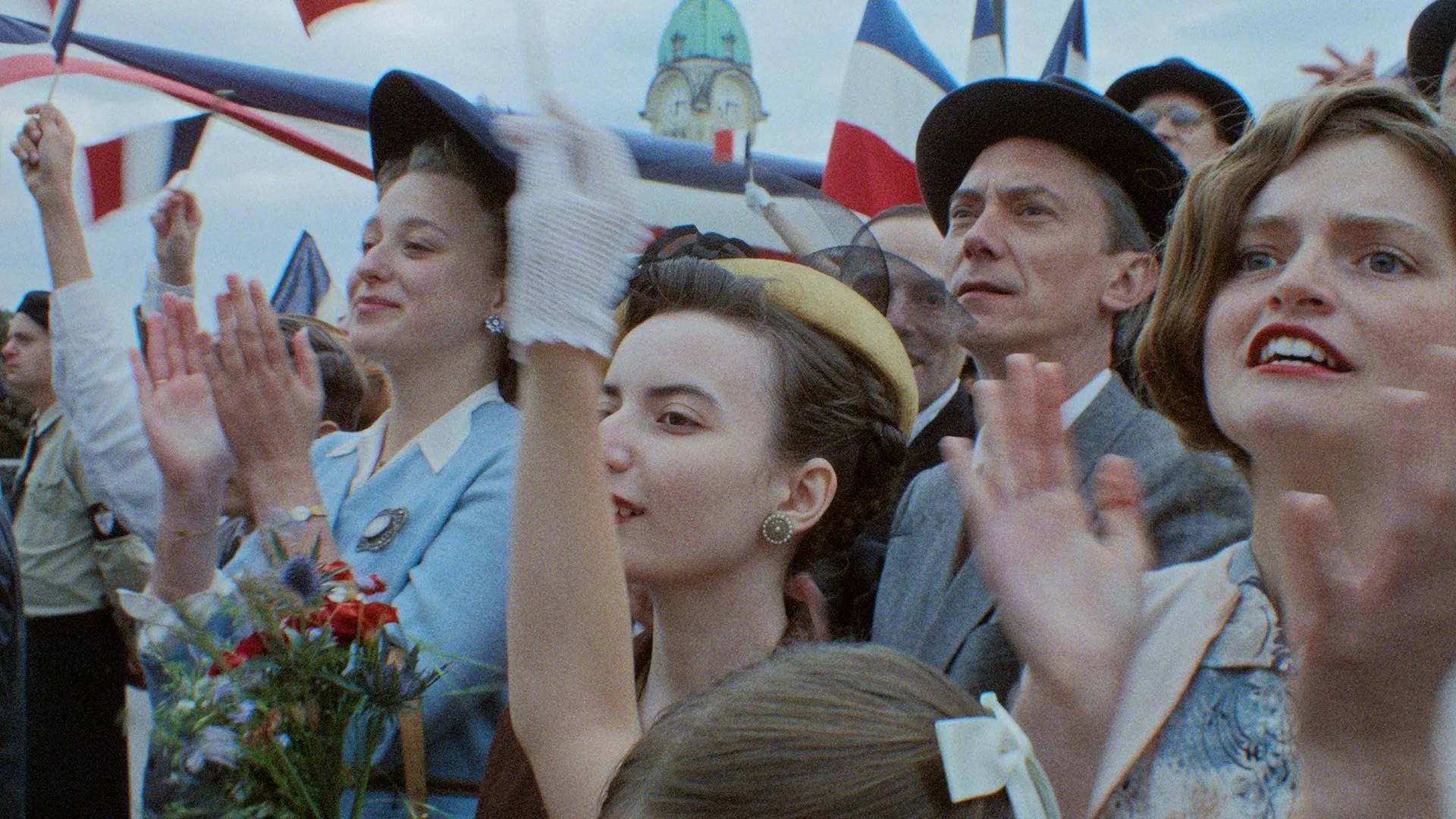
Marre’s most provocative decision is to refuse the visual grammar of the period drama entirely. DP Olivier Boonjing shoots on grainy handheld with harsh on-camera flash, particularly in the film’s social and party scenes. Faces bloom in sudden overexposed light, then dissolve into pools of shadow. The effect lands somewhere between a crime-scene photograph and a particularly ill-advised Instagram story.
It is, in other words, completely wrong for 1940. That wrongness is the point. The aesthetic colonizes the vintage setting with a jarring contemporaneity, stripping the past of its antique varnish. History, the camera insists, is not safely behind glass. Editor Nicolas Rumpl stitches black-and-white sequences into the color footage with quiet matter-of-factness, as though nothing unusual is happening, which sharpens the disorientation considerably.
The anachronistic music operates on a similar principle, though it takes things further. Rather than laying tracks over scenes, Marre embeds them within the diegesis. Characters at Vichy soirées dance to “Popcorn” by Hot Butter. Opus’s “Live Is Life” soundtracks montages of Henri’s provincial ascent. The effect is not whimsy. It is a structural argument: the social machinery that produced collaboration was recognizable, even ordinary, and its rhythms are not so different from the ones we move to now. When a line in the English subtitles references “making France great again,” the anachronism sheds all pretense of subtlety. Marre wants his viewers to feel the ground shift beneath their feet.
Much of the dialogue was reportedly improvised after actors were discouraged from learning the script, and the film carries that caught-in-the-act texture throughout. It resembles newsreel footage that somehow acquired color and opinions. Chiaroscuro as an expressionistic tool has a long noir lineage, but Boonjing’s flash photography is something different: less shadow as moral metaphor, more light as sudden accusation.
The Man Too Small for His Boots
Arlaud brings none of the warmth that characterized his earlier screen work. Henri is sly, slightly rodent-like, perpetually overreaching. He hawks his manifesto at cocktail parties with the glazed determination of a man who has long confused self-promotion with self-worth. The performance is built around a specific kind of insufficiency: Henri expends enormous energy and gets, at best, middle management. He is appointed to oversee a regional unemployment office in Limoges. The Vichy regime does not especially need him, and will not especially miss him. He is a cog.
The film’s quietest and most devastating moment arrives when Henri receives a query about train carriages. He pauses. It is a fractional hesitation, barely a beat. Then he signs. He knows precisely what those carriages are for. That pause is the film’s moral center, the hinge on which everything turns. Whatever ambiguity surrounded Henri until that point evaporates in a single, almost invisible gesture.
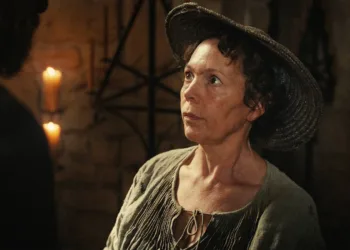
Blancke, as Paulette, is given less screen time but perhaps more moral complexity. Her letters, read in voiceover, carry resentment, exhaustion, and a reluctant complicity. She, too, practices a form of willful blindness, confronted most acutely when she discovers their comfortable Limoges house once belonged to a Jewish family. Her response is not shown. It does not need to be.
Bureaucracy as Horror Film
The film’s central philosophical argument is structural as much as thematic. Henri’s administrative work at the unemployment office is rendered in the register of office comedy. There is a hapless secretary. There are interminable meetings about procurement and efficiency. The horror lies in that tonal dissonance. The gears of atrocity, Marre suggests, were operated by men who found the paperwork tedious. The workplace-comedy framing is genuinely unsettling precisely because it is accurate.
The contemporary resonance is explicit and intentional. Vichy, in Marre’s rendering, is familiar: a government of cynics and opportunists navigating a far-right political settlement, staffed by men like Henri who were not true believers but found belief convenient. The film asks, with persistent and uncomfortable directness, what you would have done. Henri’s trajectory is not exceptional. That is the argument.
That is also why, at nearly two and a half hours, the film occasionally tests the patience it is trying to disturb. The bureaucratic scenes enact the banality they describe, which is clever in theory and wearing in practice. There is a point at which the method and its subject become difficult to distinguish.
A Man of His Time is a French-Belgian drama that premiered in competition at the 2026 Cannes Film Festival. Directed by Emmanuel Marre, the film is loosely inspired by the life of the director’s great-grandfather, Henri Marre. Set in 1940, the story follows Henri (played by Swann Arlaud) as he arrives in Vichy, hoping to secure a position within the new administration during the early days of the Vichy government. The film explores themes of moral compromise and administrative survival during wartime. Currently, the film has premiered at the Cannes Film Festival and will see a theatrical release in France and Belgium later in 2026.
Full Credits
Title: A Man of His Time (Notre Salut)
Distributor: Condor Distribution (France), Cinéart (Belgium)
Release date: May 20, 2026 (Cannes Film Festival premiere)
Rating: Not yet rated
Running time: 155 minutes
Director: Emmanuel Marre
Writers: Emmanuel Marre
Producers and Executive Producers: Alexandre Perrier, Sébastien Andres, Alice Lemaire
Cast: Swann Arlaud, Sandrine Blancke, Mathieu Perotto, Harpo Guit, Mathilde Abd-El-Kader, Jean-Baptiste Marre
Director of Photography (Cinematographer): Olivier Boonjing
Editors: Nicolas Rumpl
The Review
A Man of His Time
A Man of His Time is a genuinely bold piece of filmmaking, anchored by Arlaud's precisely calibrated performance and Boonjing's provocative cinematography. Marre's refusal to aestheticize collaboration, or excuse it, produces real moral unease. The film's formal audacity earns its place. Its runtime does not. Two and a half hours in the company of a man defined by his smallness demands more disciplined editing than Marre provides. The strengths are considerable and the ambition is real. The film simply outstays both.
PROS
- Arlaud's controlled, unsentimental lead performance
- Daring cinematography and anachronistic aesthetic strategy
- Morally serious without being didactic
- Blancke's quietly complex supporting work
- Thematically urgent contemporary resonance
CONS
- Runtime strains patience significantly
- Pacing sags in the second half
- Bureaucratic scenes overextend their thematic purpose
- Henri's motivations remain underexplored