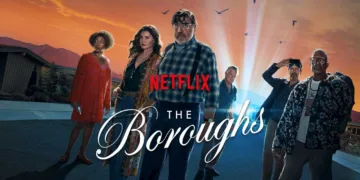





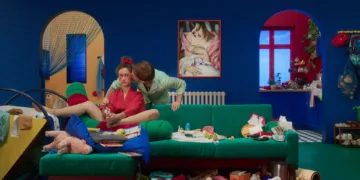



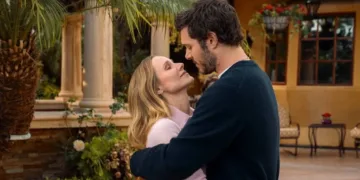
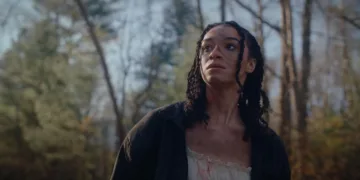









There is a particular cruelty in the way society treats its elderly: having spent decades accumulating the wisdom, patience, and hard-won perspective that younger people spend their whole lives chasing, they are rewarded with systematic irrelevance. Netflix’s The Boroughs takes this quiet social injury and builds a sci-fi horror dramedy around it, with results that are frequently wonderful and occasionally frustrating in equal measure.
Created by Jeffrey Addiss and Will Matthews (The Dark Crystal: Age of Resistance) and executive produced by Matt and Ross Duffer, the eight-episode first season follows grieving widower Sam Cooper (Alfred Molina), a retired aeronautical engineer who reluctantly moves into an idyllic New Mexico retirement community after his wife’s death. What he finds there, beneath the pastel architecture and patronizing cheerfulness, is monstrous in more ways than one.
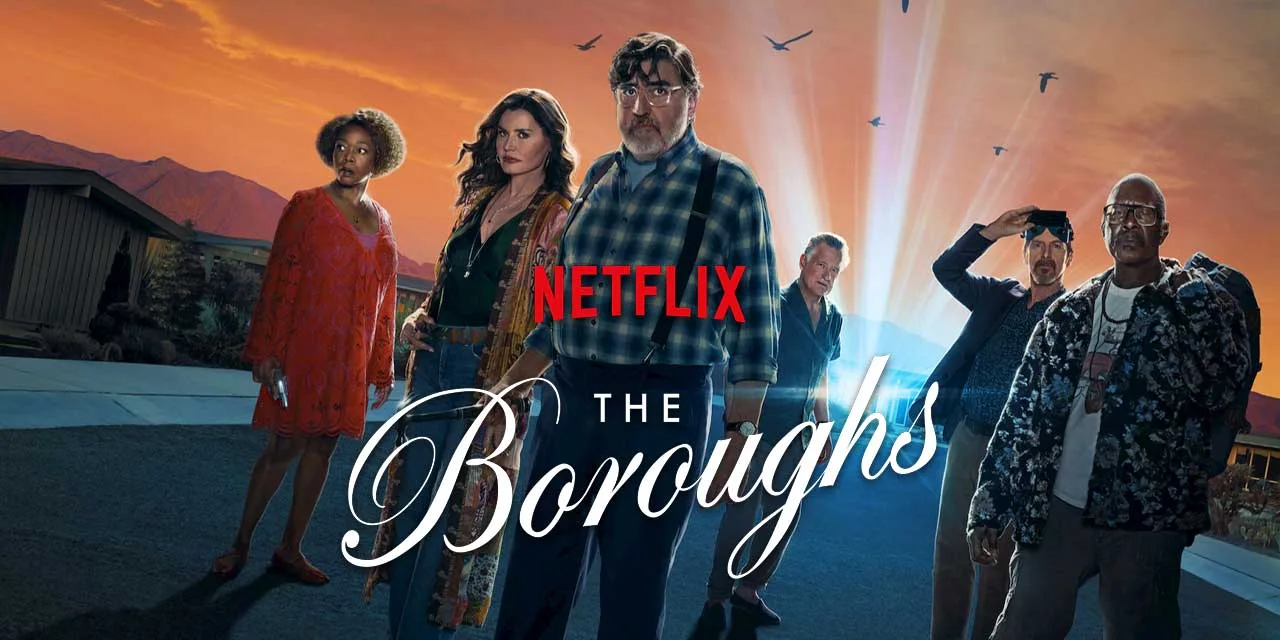
Sam and a misfit crew of fellow residents become the only people capable of seeing the threat for what it is, largely because they are the people everyone else has already stopped listening to. The Duffer Brothers’ fingerprints are visible throughout, though The Boroughs earns its own identity, one rooted less in adolescent wonder than in the specific, hard-earned clarity of people who have already survived most of what life could throw at them.
A Cast That Knows Exactly What It’s Doing
Alfred Molina is the load-bearing wall of this production, and he carries the weight without apparent effort. Sam Cooper is, on paper, a familiar archetype: the curmudgeon softened by circumstance. In practice, Molina makes him something richer. His grief is not performed in speeches but expressed through physical texture, the way Sam stomps through rooms, refuses eye contact, and flinches at kindness as though it were an insult. His late wife Lily (Jane Kaczmarek, seen in flashbacks) arranged the move to The Boroughs before her death, locking Sam into both the contract and a new life he never chose. His adult daughter Claire (Jena Malone) and son-in-law (Rafael Casal) hover at the edges of his story, their concern shading into the particular anxiety of adult children watching a parent grieve, convinced the grief is becoming something clinical.
The cul-de-sac ensemble is, frankly, a luxury problem. When a show assembles this much talent, the question stops being whether the performances will be good and starts being whether the writing will deserve them.
Mostly, it does. Denis O’Hare’s Wally, a former doctor dying of Stage 4 prostate cancer, is the season’s comedic and emotional MVP simultaneously. He arrives at a covert mission toting granola bars and a meat cleaver in a tote bag. He consults a YouTube tutorial to pick a lock at a funeral parlor. He is, in short, a delight, and O’Hare never once lets the comedy blunt the underlying awareness that Wally is a man who spent his career fighting death and is now losing that particular fight himself.
Clarke Peters’ Art is a marijuana enthusiast who claims to be golfing each morning but is really tending hallucinogens in the desert and cultivating a meaningful relationship with a crow. His solo spiritual arc into the desert is the season’s quietest thread, and Peters makes it worth following. Alfre Woodard’s Judy, a retired journalist who compulsively researches each new resident, carries grief for a dead former lover while her 45-year marriage to Art frays along seams that have been weakening for years. Geena Davis as Renee is glamorous, quick, and given the season’s most purely enjoyable subplot: a budding romance with young security guard Paz (Carlos Miranda) that carries genuine rom-com warmth, and a Thelma & Louise homage that goes gloriously, campily overboard.
Bill Pullman’s Jack is Sam’s social gateway into the community, delivering the line “Grief makes your past feel too close to your future” with the ease of a man who has thought about it for a long time.
The show’s management figures, CEO Blaine Shaw (Seth Numrich) and his wife Anneliese (Alice Kremelberg), are conspicuously too clean, too calm, too fond of old black-and-white films (Double Indemnity among them) to be trusted. Ed Begley Jr.’s Edward, an early resident whose deterioration foreshadows the community’s darker reality, haunts the season’s edges. A handful of supporting performances strain under the weight of expository dialogue, landing lines that the leads would have made sound natural.
But when this ensemble is allowed to simply occupy the same space together, the show achieves something rare: it makes you feel the specific pleasure of genuinely interesting people enjoying each other’s company.
What the Monsters Are Actually About
The show’s most pointed provocation is structural. The people best positioned to identify and fight the supernatural threat are the ones the community, and by extension society, has already classified as unreliable. Report a monster and you are transferred to The Manor, the long-term care facility where complex needs are managed and dissenting voices are contained. Ageism, The Boroughs argues, is not merely condescending. It is a mechanism of control, and in the show’s world, a literally lethal one.
This is sharp social commentary delivered through genre, which is historically the most effective delivery method for ideas people might otherwise resist. Horror has always functioned as a pressure valve for anxieties too large to address directly.
Sam defines grief in a way the show keeps returning to: the loss of a person, yes, but also the slower grief of a body breaking down, of waking each morning to inventory what no longer works quite right. Wally carries the particular grief of a physician who spent the AIDS crisis watching people die preventably, and now faces his own mortality with the bitter expertise of someone who knows exactly what is happening to him. Art and Judy’s marriage is strained by decades of accumulated silence and diverging needs, a grief for the partnership they once had.
Then there is the show’s most ambitious thematic move. The sci-fi conceit builds, across the season, toward a question about the cost of extending life beyond its natural arc. The Boroughs treats the seduction of immortality with genuine seriousness, framing it as understandable and wrong. Life, the show suggests, derives meaning partly from its finitude. To circumvent that finitude is to corrupt it. This is not an original philosophical position, but it is expressed here through plot mechanics that earn the idea fresh weight, and it gives the season’s final stretch a gravity that its more conventional creature-feature moments do not always match.
Pastel Dread: The Design of a Perfect Prison
The Boroughs retirement community is designed as a 1950s fantasy of neighborliness: identical pastel homes, manicured communal spaces, staff who address residents in the practiced, slightly raised tones one uses with very young children or the very confused. Every home is fitted with Seraphim, a hard-wired communication device with a HAL-inflected quality that suggests warmth while quietly monitoring everything. The community’s unofficial motto, “You’ll have the time of your life!,” is recited by staff with the conviction of the genuinely indoctrinated.
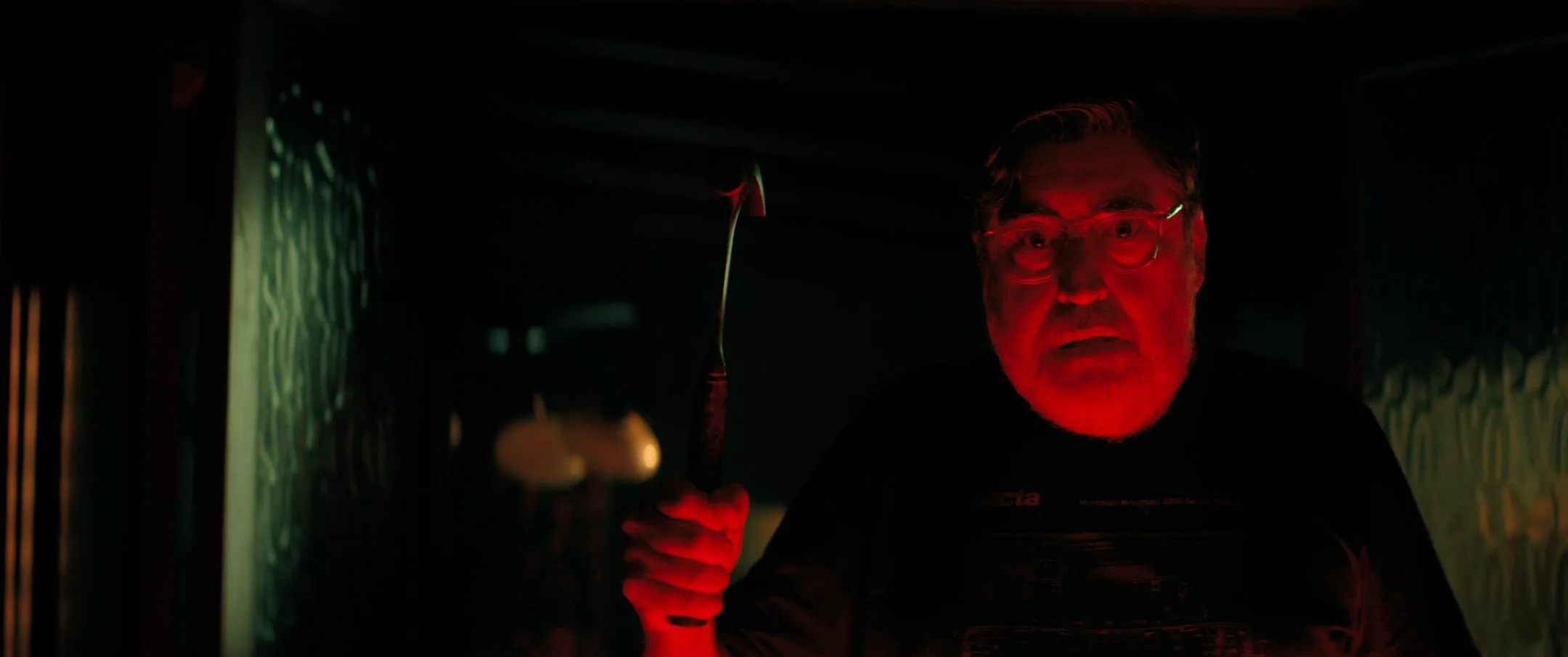
The visual tension between the sun-bleached desert surface and what lies beneath (hidden tunnels, dark rooms, secret shafts under the golf courses and swimming pools) is the show’s most consistent formal achievement. Light as threat. Cheerfulness as camouflage.
The creature design draws on ’80s sci-fi and horror conventions without plagiarizing them. Steven Spielberg’s influence is the most legible: Close Encounters of the Third Kind’s sense of ordinary life concealing cosmic strangeness, The Truman Show’s perfect-community-as-existential-trap. These are references that feel organic because the story requires them. A show about people who came of age in the ’70s and ’80s, confronting the uncanny in their twilight years, should carry those cultural textures.
A persistent weakness is the Netflix house aesthetic: flat lighting and color grading that drains outdoor sequences of atmosphere. A desert sunset should carry visual weight. Several of the season’s most potentially striking images, glowing particles scattering across the night air, vast open skies at dusk, are rendered in the muddy, diffident palette that the platform seems to apply by default. It is a technical failure that the show’s ambition does not deserve.
The Ceiling You Can See but Never Quite Reach
The barbecue scene in the first episode is the best single scene in the season. The cul-de-sac crew gathers at Jack’s house, drinks beer, gossips about their other neighbors with the seasoned precision of people who have been observing human behavior for six decades, and trades medical anecdotes of increasing outrageousness. It is warm, funny, and alive with the specific pleasure of watching exceptional actors find their rhythm together.
The season never fully returns to that register, and this is The Boroughs’ central problem.
O’Hare’s Wally lands every note. Davis and Miranda generate real chemistry. Peters makes Art’s solitary desert wandering worth following on the strength of sheer screen presence alone. The thematic architecture, monsters literally stealing time from people who have the least of it remaining, is elegantly conceived, the supernatural premise and the human drama pulling in the same direction.
But the mystery mechanics run out of momentum well before the answers arrive. Clues surface and lead nowhere. The midpoint shift in the nature of the threat, from a clear creature-feature antagonist to something more morally ambiguous, deepens the show’s ideas while muddying its narrative drive. A simpler good-versus-evil structure might have felt less intellectually ambitious and considerably more satisfying to watch.
Sam’s grief flashbacks to Lily are well-performed and disproportionate. The backstories of Wally (the AIDS crisis), Renee (a former career in music management), Art, and Judy are gestured at rather than inhabited, which feels like a misallocation given how much each actor could do with the material. The season could absorb one or two additional episodes without losing pace, and the ensemble would be the chief beneficiary.
Some supporting performances cannot keep up with the leads, and the gap is audible whenever a secondary character has to make expository dialogue sound like something a human being would actually say.
What The Boroughs gets right, it gets very right. What it misses, it misses in ways that make you aware of what was possible. That particular species of disappointment, frustration adjacent to admiration, is reserved for shows with genuine ambition and real talent, shows that glimpse their own potential clearly and then, for reasons structural or budgetary or simply narrative, fall slightly short of it.
The Boroughs is a science fiction supernatural series that premiered on Netflix on May 21, 2026. Set in a seemingly picturesque retirement community in the desert, the story follows a group of unlikely heroes—a ragtag crew of elderly residents—who discover a dark, otherworldly conspiracy lurking beneath the surface. As they realize a malevolent force is stealing the one thing they lack—time—they must band together to uncover the truth and stop the threat. You can watch all eight episodes of the first season exclusively on Netflix.
Where to Watch The Boroughs Online


Full Credits
Title: The Boroughs
Distributor: Netflix
Release date: May 21, 2026
Rating: TV-MA
Running time: Approximately 40–55 minutes per episode
Director: Ben Taylor, Augustine Frizzell, Kyle Patrick Alvarez
Writers: Jeffrey Addiss, Will Matthews, Jose Molina, Julie Siege, Keith Sweet II, Tom Hanada, James Schamus, Our Lady J
Producers and Executive Producers: The Duffer Brothers (Matt and Ross Duffer), Hilary Leavitt, Ben Taylor, Jeffrey Addiss, Will Matthews
Cast: Alfred Molina, Geena Davis, Alfre Woodard, Clarke Peters, Denis O’Hare, Bill Pullman, Jena Malone, Carlos Miranda, Seth Numrich, Alice Kremelberg
Director of Photography (Cinematographer): Matthew Jensen, Michelle Lawler
Editors: Noëmi Preiswerk, Jonathan Alberts, Cindy Mollo, Christopher Nelson, Misha Syeed
Composer: John Paesano
The Review
The Boroughs
The Boroughs is a genuinely ambitious piece of television, anchored by extraordinary performances and a thematic core with real philosophical weight. Molina, O'Hare, Davis, Woodard, and Peters are worth every minute. The show's critique of ageism is sharp, its creature-feature premise cleverly serves its human drama, and its best scenes are among the year's finest. A sagging mystery, uneven character depth, and the platform's aesthetic limitations prevent it from fully delivering on its early promise.
PROS
- Exceptional lead ensemble performances
- Thematically rich exploration of aging, grief, and mortality
- Strong tonal balance between horror, warmth, and wit
- Clever social commentary woven naturally into genre mechanics
- Tight eight-episode structure with no filler
CONS
- Mystery mechanics lose momentum in the second half
- Sam's backstory receives disproportionate screen time over the ensemble
- Some supporting performances are noticeably weak
- Netflix's flat visual aesthetic undermines key atmospheric moments
- Character backstories for Wally, Renee, Art, and Judy underdeveloped