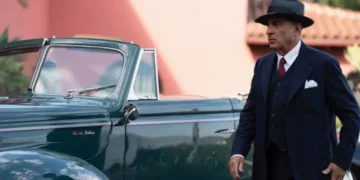




















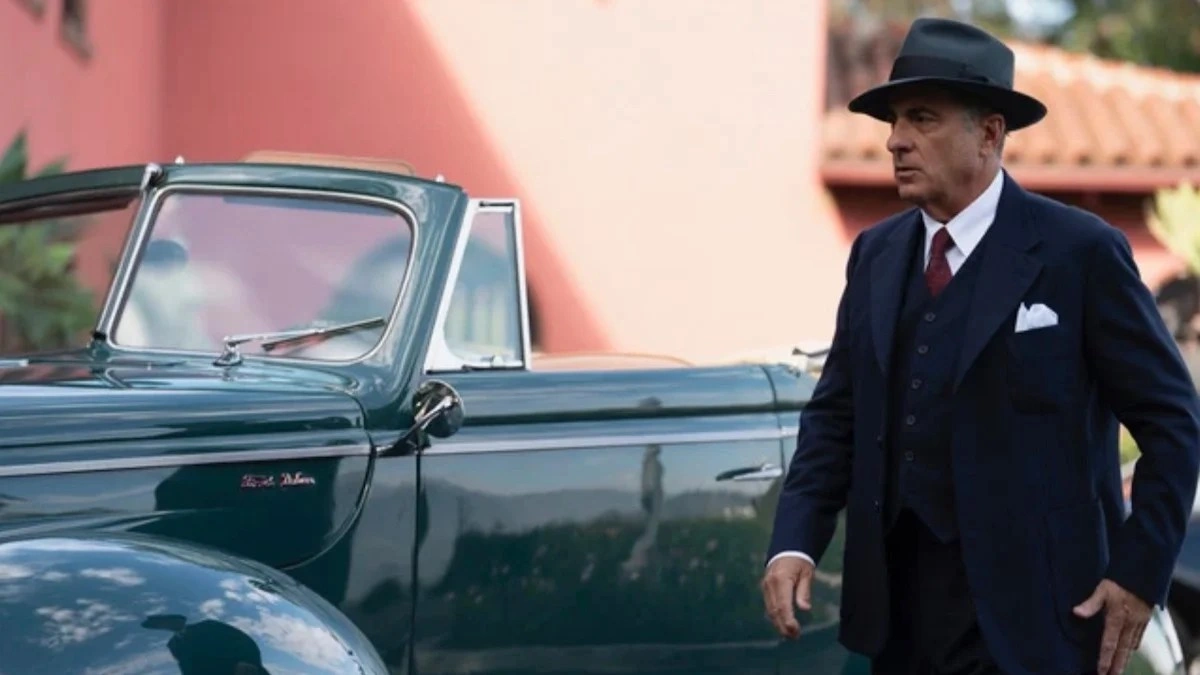

A solitary figure stands preserved in the amber light of a simulated past, enacting a morning ritual with the solemnity of a small private ceremony. We see the exact fold of a pocket handkerchief, the measured polish of leather shoes, the chosen business card that names him Joe Diamond, Private Investigator.
He places a fedora on his head and leaves an old brick building for the white glare of downtown Los Angeles, entering a world that has slipped beyond the grammar of his chosen era. The spell breaks at once. A driverless Waymo vehicle moves across the pavement and almost hits him.
Andy Garcia, who spent fifteen years shaping this project as writer, director, lead actor, and co-composer, sets a human soul fixed in 1942 against a city ruled by digital automation. Diamond works through the street instincts of old detective fiction and accidentally becomes a social media urban legend. The story begins when Sharon Cobbs, an elusive wealthy widow played by Vicky Krieps, hires him to examine the mysterious death of her husband, with the authorities already treating her as the main suspect.
The Architecture of Escapism
The film’s structure reveals its true nature through patient movement, spreading across a full two-hour runtime with deliberate calm. Garcia resists the usual machinery of a contemporary thriller. He builds a story where the murder inquiry becomes a surface on which people drift, confess, joke, withhold, and vanish.
The investigation proceeds with a wandering rhythm that weakens familiar expectations of suspense. Citywide corruption and hostile authorities appear as genre signals, then soften into conversational passages. Early on, the film locates its rhythm in Diamond’s comic estrangement from modern life, through scenes where he fails to understand smartphones, digital selfies, and TikTok followers.
This fish-out-of-water pattern shapes the first half, giving the film a gentle haze of nostalgia and play. As the mystery gathers weight, the tone darkens. The narrative moves from genre imitation into a mournful study of solitude. The third act reveals a severe psychological trauma from Diamond’s past, clarifying the meaning of his antique wardrobe, vintage Ford convertible, and hard-boiled language.
His retro identity becomes a subconscious shelter, a fragile refuge built against a reality his mind cannot bear in open daylight. The script turns a stylistic game into a meditation on grief, asking why a person may choose fantasy after the present becomes spiritually uninhabitable.
Shadows in the Ensemble
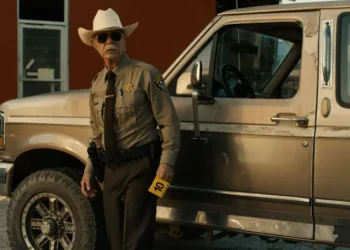
Garcia carries Diamond with physical control and emotional fatigue, giving the character a vivid inner fracture. His posture and voice belong to a pulp detective, full of tough-guy rhythm and old charisma. Beneath that performance lives a sadness that keeps surfacing through the cracks.
The large ensemble around him fills this altered Los Angeles with different registers of theatricality, each figure pulled into the orbit of Diamond’s private gravity. Vicky Krieps gives Sharon Cobbs an airy distance, inhabiting the outline of the femme fatale with a quiet interior opacity that deepens her position as a suspect.
The supporting cast moves between comic exaggeration and emotional grounding. Brendan Fraser gives LAPD detective McVicar a smug bureaucratic arrogance, making him an authority figure irritated by Diamond’s old methods and drawn to them. Brief appearances by veteran performers give the social world extra texture. Bill Murray plays Jimbo, the pseudo-sage bartender.
Dustin Hoffman brings eccentric levity to a joke-loving coroner who bends rules. Danny Huston radiates a calculated coldness that calls upon his own screen lineage. In the final movement, the emotional weight gathers around Rosemarie DeWitt’s Angel, a mysterious regular at Diamond’s local haunt. DeWitt gives the character a deep, restrained humanity after her first appearance suggests a familiar genre figure. Her quiet chemistry with Garcia steadies the tragic force of the denouement.
Light, Brass, and the Frozen City
The film’s form becomes a melancholy love letter to the architecture of a changing city. Cinematographer Tim Suhrstedt makes strong use of natural light and practical interior sources, evoking the lonely realism of Edward Hopper and the street photography of Fan Ho.
Los Angeles appears suspended between centuries. The production design gives priority to real historic landmarks, placing key scenes inside the bright ironwork of the Bradbury Building and the preserved rooms of Cole’s restaurant. These locations become islands of stopped time, spaces that reflect Diamond’s inward condition.
Deborah L. Scott’s costume design strengthens that sense of separation. Diamond’s carefully tailored 1940s wool suits and crisp fedoras stand against the casual modern clothing worn by the people around him. The soundscape, co-composed by Garcia and jazz veteran Arturo Sandoval, deepens his psychological exile. Muted trumpet lines and classic jazz cues drift through downtown like a private weather system.
The score becomes the pulse of Diamond’s inner world, an acoustic shield against the digital noise pressing in from the present. Through image, fabric, architecture, and brass, the film creates a city outside ordinary time, a beautiful and sorrowful monument to longing.
Diamond is an indie crime drama passion project that made its world premiere out of competition at the Cannes Film Festival on May 19, 2026. Set against the backdrops of preserved historic downtown landmarks, this stylized feature showcases a detective attempting to function outside of his own timeline. Viewers can experience this cinematic love letter to prewar storytelling as it continues its festival run, with broader theatrical distribution and streaming availability options expected to follow later in the year.
Full Credits
Title: Diamond
Distributor: Black Cap Pictures, CineSon Entertainment, Shrink Media
Release date: May 19, 2026
Running time: 118 minutes
Director: Andy Garcia
Writers: Andy Garcia
Producers and Executive Producers: Andy Garcia, Frank Mancuso Jr., Paul Soriano, Jai Stefan
Cast: Andy Garcia, Vicky Krieps, Brendan Fraser, Rosemarie DeWitt, Bill Murray, Dustin Hoffman, Demián Bichir, Danny Huston, LaTanya Richardson Jackson, Yul Vazquez, Robert Patrick, Rachel Ticotin
Director of Photography (Cinematographer): Tim Suhrstedt
Editors: Emma E. Hickox, Sandra Montiel
Composer: Andy Garcia, Arturo Sandoval
The Review
Diamond
Diamond functions as an uneven yet deeply earnest tribute to the Golden Age of cinematic noir. While the middle portion suffers from structural fragmentation and a noticeable loss of narrative momentum, the venture is ultimately rescued by its formal beauty and the unexpected psychological depth of its final movement. It remains a fascinating experiment in genre escapism that is difficult to completely resist.
PROS
- A deeply charming, layered leading performance that balances vintage charisma with profound emotional sadness.
- Gorgeous, evocative cinematography utilizing natural lighting that transforms downtown Los Angeles into a painterly dreamscape.
- An atmospheric, nostalgic jazz score that brilliantly mirrors the internal isolation of the protagonist.
- A stellar, highly collaborative supporting ensemble that adds distinct personality and textures to every scene.
CONS
- The narrative pacing falters considerably during the middle act, leading to a sluggish progression.
- The detective mystery itself lacks tension, functioning as a loose framework rather than a tight procedural thriller.
- Certain dialogue sequences involving modern digital culture feel somewhat clunky and rely on strained humor.