






























Some games grab your attention through spectacle. Others win you over slowly, through warmth and intention. Little Rocket Lab, developed by Teenage Astronauts and published by No More Robots, belongs firmly in the latter category. This cozy automation sim asks you to step into Morgan’s shoes as she returns to St. Ambroise, the seaside mining town where she spent her childhood.
A decade has passed since her mother’s death forced her to leave, and the town has suffered in her absence. The family’s ambitious rocket project sits abandoned, and St. Ambroise itself has faded into rust and silence. Morgan’s mission is straightforward: revive her mother’s dream and breathe life back into the community that raised her.
What makes Little Rocket Lab distinctive is how it reframes the automation genre. Games like Factorio and Satisfactory treat factory-building as an exercise in optimization under pressure. Little Rocket Lab strips away the intensity and replaces it with something gentler. There are no countdown timers, no hostile forces threatening your progress. The game is available on Steam, Xbox, and Game Pass, making it accessible to players who want to experience automation without the stress that typically defines the genre.
Building Systems That Breathe
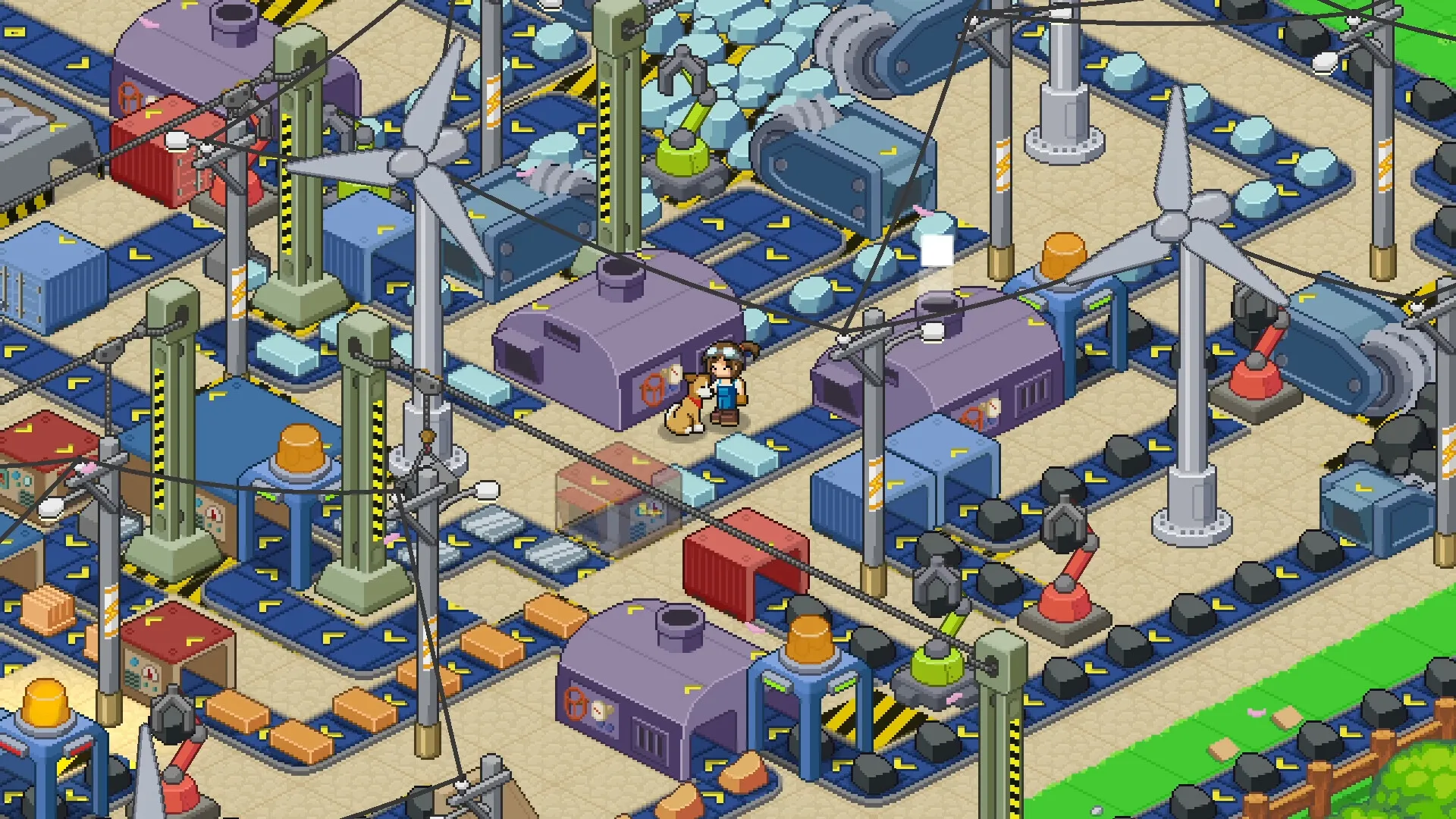
The core gameplay loop revolves around resource gathering, processing, and assembly. You’ll start by breaking down derelict machinery scattered around town or mining ore deposits directly from the ground. These raw materials feed into furnaces that require coal and ore to produce ingots. From there, assemblers transform refined materials into components. Conveyor belts connect each piece of machinery, creating production chains that hum with satisfying rhythm.
The progression feels natural. Early hours involve simple setups: a few furnaces feeding into basic assemblers. You might turn steel plates into gears or refine copper bars into wire. Before long, you’re combining multiple components to create motors, which themselves become ingredients for even more sophisticated parts. The game introduces new machinery through a research system centered at the university. Initially, you’ll hand-deliver the required components. As quantities climb into the hundreds, you can run conveyor belts directly to ports in the university building.
The technical design shows careful attention to balance. Furnaces produce 45 ingots per minute, while the next stage in most production chains requires 90 ingots per minute. Link two furnaces together, feed them with three miners producing 30 ore per minute each, and everything runs at peak efficiency. These clean numbers make planning easier than in more hardcore automation games.
Spatial considerations add an interesting wrinkle. Little Rocket Lab uses an isometric grid layout, and conveyor belts can’t cross each other directly. Instead, you’ll need underpasses that let items pass beneath other conveyor lines. Tier-2 machines complicate matters by requiring multiple inputs, which means accounting for at least five grid squares of empty space behind them just to route the input conveyors properly.
The game excels at making experimentation feel safe. Deleting and replacing machinery costs nothing, and placing a new conveyor over an existing one instantly replaces it without consuming resources. Days last long enough to accomplish meaningful work, and there’s no energy bar forcing you to ration your activities. The choice is yours, and the game never punishes you for taking time to perfect your systems.
Community Among the Conveyors
St. Ambroise sprawls across six major zones with additional indoor spaces, each populated by characters who follow their own schedules. Morgan’s aunt Ilonka serves as an emotional anchor, but you’ll meet plenty of other residents as you explore. Some run shops that close on specific days, requiring you to plan around their hours. Others simply go about their lives, offering friendship if you’re willing to invest time. Affection meters track your relationships, and you can boost them through gifts ranging from manufactured components to flowers and fruits. Toastie, a rideable robotic toaster, stands out as a particularly memorable companion.
The town board posts side jobs that offer money and resources. Money isn’t strictly necessary for progression, but it lets you purchase furniture to decorate your home or expand your base to reduce clutter in town. The port becomes accessible after you repair it, unlocking daily electronic waste deliveries you can scavenge for components.
Your automation work feeds directly into the town’s revival. Production lines often serve dual purposes: advancing your projects while supplying items that help the community. As you progress, St. Ambroise transforms. Streets fill with activity, new amenities appear, and the town recaptures some of its former energy. The rocket project at Ilonka’s silo represents the main story goal, demanding hundreds of components to inch closer to completion. The narrative unfolds through conversations and environmental storytelling rather than cutscenes.
The balance between automation and life sim elements feels carefully calibrated. Social interactions remain unobtrusive and optional. If you want to focus purely on factory planning, you can. The game never pressures you to rush through story beats or maximize relationship meters.
Pixels, Performance, and Polish
The pixel art style radiates warmth through soft edges and a painterly color palette. Subtle bloom effects create a nostalgic glow, making even industrial machinery look inviting. Visual clarity remains strong even when your screen fills with interconnected production lines. Emoji speech bubbles pop up during dialogue, adding a lighthearted touch.

Audio design complements the visuals beautifully. Gentle guitar melodies and chill beats form the musical foundation, while ambient sounds give the world texture. The soundtrack shifts dynamically, moving between calm exploration themes and more focused compositions when you’re deep in factory planning.
Performance holds up well across platforms. The game runs smoothly on PC and console, and it shines particularly on Steam Deck. The handheld format suits Little Rocket Lab’s pace perfectly. Game Pass availability gives Xbox players easy access without upfront cost.
A few rough edges do surface. The cave system includes slime enemies and basic combat mechanics that feel underdeveloped. The title menu fades in slowly at startup and defaults to “New Game,” creating a risk of accidentally starting over. Factory layouts can become awkward when space constraints collide with the underpass system.
These issues are minor compared to what the game accomplishes. Little Rocket Lab succeeds as an entry point for players curious about automation but intimidated by genre staples like Factorio. Fans of Stardew Valley, Spiritfarer, and My Time at Sandrock will find familiar comfort here, while automation veterans looking for a more relaxed experience can appreciate the satisfying factory-building without the usual stress. The game respects your time, encourages experimentation, and delivers that “just one more day” compulsion. You start by fixing old machines, and somewhere along the way, you realize you’ve helped rebuild an entire community.
The Review
Little Rocket Lab
Little Rocket Lab transforms automation from a stressful optimization puzzle into something genuinely comforting. The balance between mechanical tinkering and community connection creates a refreshing take on the genre, one that welcomes newcomers while still offering depth for veterans. Minor issues like simplistic combat and spatial constraints barely diminish the experience. This is a game that understands the satisfaction of watching systems work while caring about the people around them. For anyone seeking a gentler entry into automation or a cozy game with genuine substance, Little Rocket Lab delivers.
PROS
- Accessible automation mechanics without overwhelming complexity
- Forgiving design encourages experimentation and creativity
- Charming pixel art with warm, inviting atmosphere
- Excellent soundtrack that complements the cozy gameplay
- Meaningful town revival that ties automation to community
- Runs beautifully on Steam Deck
CONS
- Unnecessary combat feels underdeveloped
- Spatial constraints can create awkward factory layouts
- Underpass system for crossing conveyors can be fiddly
- Slow title menu fade-in creates navigation issues