

























![Kingdom Hearts Collection [I-III] Review](https://gazettely.com/wp-content/uploads/2026/10/Kingdom-Hearts-Collection-I-III-1-360x180.webp "Kingdom Hearts Collection [I-III] Review: KHII Holds Steady as Newer Entries Fluctuate 37")





Brock Harris’s Cottonmouth, which he co-writes and directs, stages a genre experiment: Western mythic violence collides with the suffocating pressure of a prison story. Set in Oklahoma Territory in 1895, the film frames itself as a thought exercise, asking how the Old West’s harsh justice looks once filtered through the machinery of a territorial penal institution.
The story follows Ed Dantés (Martin Sensmeier), a cowhand betrayed on his wedding day and falsely locked inside a brutal facility run by the aptly named and sadistic Warden Victor Cain (Ron Perlman). Ed’s ordeal requires that he refashion himself as an outlaw, a moral compromise treated as the price of freedom and revenge.
The film gestures toward ideas about power, dehumanization and frontier-era corruption. Ed’s interrupted wedding, a symbol of social belonging and personal peace, gives way to the isolation of the punitive state, which turns a private ritual into the opening move of institutional cruelty.
The Tyranny of Haste
The film suffers from a pacing problem, a kinetic flaw I call “The Accelerant Setup.” Ed’s life collapses within the opening minutes: the betrayal unfolds, the wedding implodes, the prison gates close immediately. This rush to reach the incarceration stage treats the emotional basis of the revenge plot, Ed’s loss, as paperwork to be processed. The viewer receives no real pause to absorb the shock or build a connection with him before the punishment starts. The later campaign of vengeance feels like a genre obligation, a step required by convention, and the tragedy never feels fully developed.
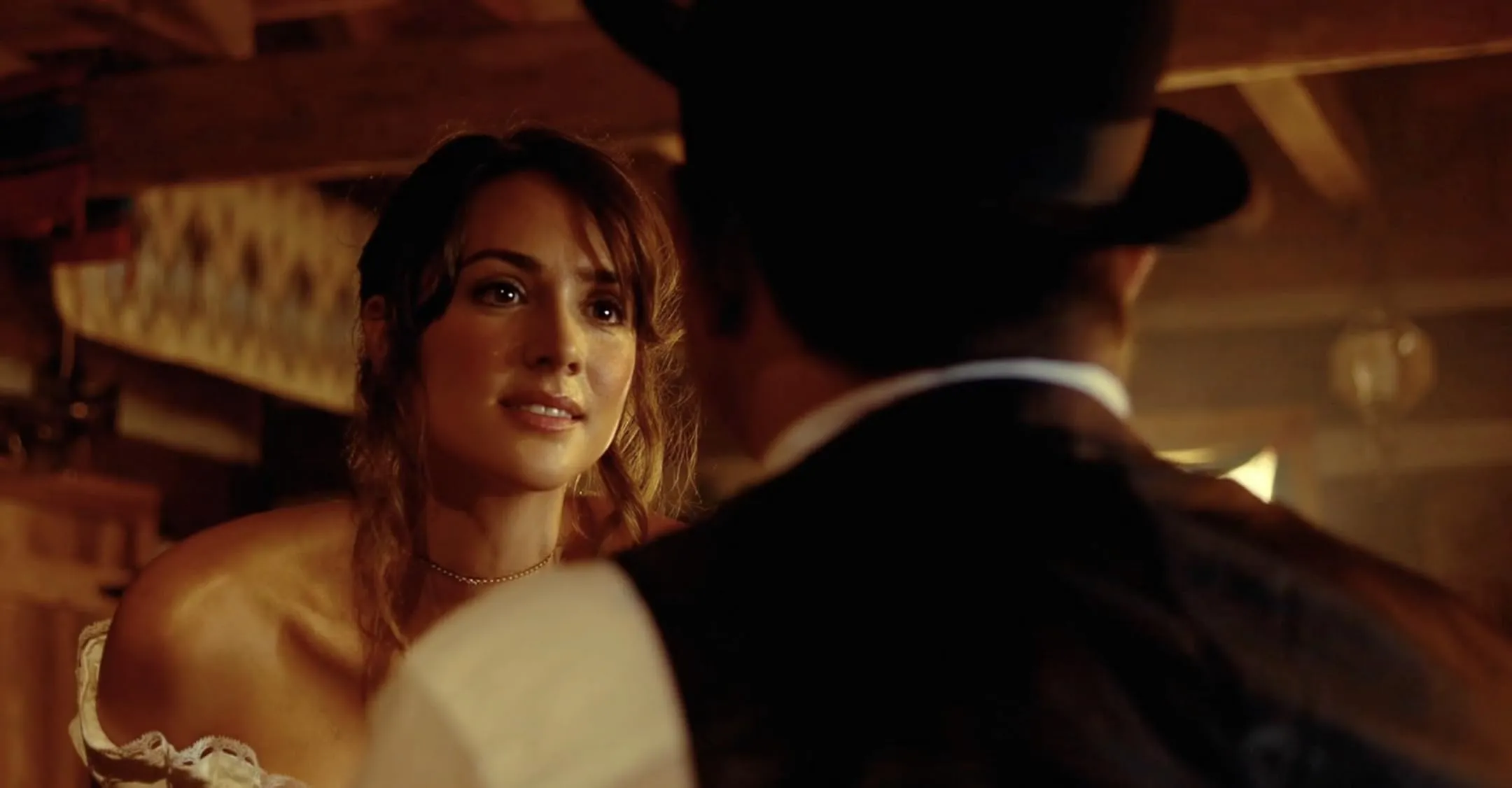
The prison passages aim for psychological torment and a study of institutional cruelty, yet they arrive as isolated sketches. Individual acts of sadism appear with little sense of directorial rhythm or mounting dread, so tension rarely accumulates. The film moves from one incident to the next without a clear structure, which weakens sustained engagement with its serious themes.
The plot follows a familiar outline, essentially a Western-flavored echo of The Count of Monte Cristo. An experienced viewer can map out each step before it happens: the false accusation, the brutal initiation, the inevitable escape. That familiarity drains surprise from the viewing experience. The film repeats themes it borrows without finding a fresh way to express them, and the predictability works like a narrative sedative.
Performance as Tonal Anchor
The acting in Cottonmouth exposes a central uncertainty about tone. Ron Perlman, as Warden Victor Cain, gives the film its steadiest point of reference. His gravel-heavy voice and physically imposing presence turn the warden into a figure of near-mythic monstrosity. He holds the frame whenever he appears and supplies a seasoned, professional villainy that rises above the limits of what often feels like a thin script. His work gives the project a pulse it rarely finds elsewhere.
That energy does not carry over to the protagonist. Martin Sensmeier, in the role of Ed Dantés, offers a performance that plays as muted. The part calls for a deep internal shift, a visible movement from hope to despair to hardened resolve, yet the portrayal never acquires the weight needed to make his suffering or his drive for revenge feel vivid.
The supporting antagonists intensify the tonal confusion. Eric Nelsen’s Billy Dunne is written as the ultimate betrayer, but the performance often tips into broad, cartoon-style exaggeration. That style sits uneasily beside the grim seriousness of the prison material and feeds the sense of a scattered project. Esai Morales and Jonathan Lipnicki hint at something sharper. Lipnicki, confined for only a short stretch of screen time, reveals surprising emotional force that points to potential Harris cannot fully shape into a coherent whole. When performers seem uncertain about the reality they occupy, the blame eventually lands on the direction, which has failed to define a stable world.
Misogyny and Technical Missteps
On a technical level, Cottonmouth often feels like a production assembled in separate rooms. The editing has a jagged quality, cutting between important beats without clear logic or attention to rhythm. The orchestral score rarely deepens the mood; it sits in the background as generic noise and contributes little to the Western horror atmosphere the film seeks. Every so often a striking visual idea appears, such as the cool framing of the scene where Ed is dragged by a horse, and that shot hints at a brief, more commanding cinematic vision that the rest of the feature cannot sustain.
The treatment of women in the story demands serious criticism. Sophia and Valentina function almost entirely as conduits for male suffering and motivation. They are defined through betrayal, pain and the need to spur the hero forward. This regressive pattern, even with the late nineteenth-century backdrop, marks a failure of the writing. The script turns what could have been fully realized people into emotional tools, and that choice undercuts any attempt at a layered drama about love and endurance. The objectification that shapes these characters gives the film cultural impact mainly as a cautionary case study in screenwriting.
The Western feature film Cottonmouth premiered at the 2025 Mammoth Film Festival and was released in the United States on Video on Demand (VOD) and digital platforms by Cineverse on November 4, 2025. Set in 1895 in Indian Territory (Oklahoma), the movie follows the revenge quest of Ed Dantés, a cowhand framed and condemned to a brutal territorial prison, who must learn the ways of the outlaw to survive his confinement under the sadistic Warden Victor Cain and exact justice. Since today is November 30, 2025, the film is currently available to watch on digital platforms.
Full Credits
Title: Cottonmouth
Distributor: Cineverse
Release Date: November 4, 2025 (VOD/Digital Platforms)
Running Time: 93 minutes
Director: Brock Harris
Writers: Brock Harris, Jared Bonner
Producers and Executive Producers: Talia Bella, Randy Wayne
Cast: Martin Sensmeier, Ron Perlman, Esai Morales, Eric Nelsen, Jonathan Sadowski, James Landry Hébert, Alyssa Wapanatâhk, Jonathan Lipnicki, Kimberly Guerrero
Director of Photography (Cinematographer): Axel Lanzenberg
Editors: Chris Roldan
Composer: Daniel Clive McCallum
The Review
Cottonmouth
Cottonmouth is a missed opportunity. Its ambitious blend of Western fatalism and prison horror is undermined by jarring tonal shifts and a narrative that moves too quickly for its emotional stakes to settle. While Ron Perlman delivers a scene-stealing villain, the film is ultimately defined by its generic plot structure and regressive characterizations. It promises intellectual grit, but delivers an experience that is hollow and instantly forgettable.
PROS
- Commands attention and elevates the warden role.
- The fusion of Western revenge and dark prison drama has potential.
- Features a few moments of effective cinematography.
- Esai Morales and Jonathan Lipnicki add gravitas in limited roles.
CONS
- The setup is too fast, preventing emotional investment.
- Borrows heavily from genre clichés (e.g., The Count of Monte Cristo).
- Unsettled direction creates jarringly flat or cartoonish performances.
- Women serve merely as suffering motivations for men.
- Editing is choppy; score is generic.







