




















![Kingdom Hearts Collection [I-III] Review](https://gazettely.com/wp-content/uploads/2026/10/Kingdom-Hearts-Collection-I-III-1-360x180.webp "Kingdom Hearts Collection [I-III] Review: KHII Holds Steady as Newer Entries Fluctuate 37")





The French Savoie region, with its Alpine vistas, carries a reputation for beauty and endurance, yet it also carries the memory of La Belle Étoile, a Catholic correctional facility in Mercury that cast a long shadow over the mid-20th century. Director Clémence Davigo’s documentary The Lost Boys of Mercury (Les Oubliés de la Belle Étoile) returns to that shadow and holds it in sharp, unflinching light. The film follows three elderly men, André (Dédé), Michel, and Daniel, who lived through years of systematic physical and sexual abuse, starvation, and humiliation at the institution, run with an iron grip by Abbé Garin from the 1950s into the 1970s.
The result is an intensely intimate portrait of survival. Her film observes the extraordinary moral and physical courage these men display as they come together, break a silence that lasted decades, and begin to seek institutional acknowledgment. The documentary treats the first spoken words of their shared story as the starting point for a fight for justice, rooted in the difficult act of telling the truth.
Shared Memory: The Architecture of Enduring Trauma
Davigo avoids the standard talking-head format and places the men in conversation with one another. This narrative decision turns individual case histories into a collective memory. They gather in a rural house that functions as a refuge, close to the school’s distant yet ever-present peak.
The peaceful, sunlit garden outside that house sits beside the horror of their past in a way that feels almost physically jarring. As they share food and drink, recollections surface: accounts of relentless beatings that left lasting injuries, cold-water baths, sleep deprivation, and sexual abuse. These memories arrive with raw, immediate detail that feels grounded in lived experience and avoids the tone of an abstract accusation.
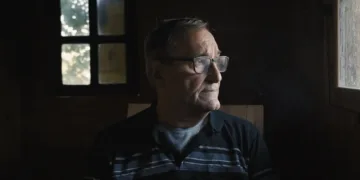
The film traces how La Belle Étoile shaped the men’s adult lives. André (Dédé), tall and direct, spent 35 years in prison and links his criminal path to stealing food during his time in the institution. His struggle to study as a child later left him shut out of work. Michel, emotionally open and drawn to cooking as a form of comfort, describes a deep fear of police, whom he connects to the authority figures who sent him to the facility.
Daniel, who endured sexual abuse from a priest, now runs marathons and uses that physical exertion as a way to clear his mind of remembered terror. Their shared testimony carries a powerful charge; speaking together becomes a first, fragile step toward lifting a weight of silence that has pressed on them for most of their lives.
The Quest for Accountability: Facing Institutional Walls
The film’s second movement follows the men’s slow and often discouraging efforts to secure formal recognition from the Catholic Church. They seek acknowledgment and restitution for the harm they suffered, without a claim for financial gain. This part of the documentary unfolds like a quiet confrontation with institutional power and reflects wider unease about how religious and state authorities respond to abuse.
The survivors begin by meeting members of the diocese’s support unit, a married couple who work as family counsellors. The counsellors say they have never heard of the abuses at La Belle Étoile, a response that immediately raises questions about what the Church has chosen to record and remember.
Davigo’s film underlines the problem of missing evidence. Boarding school archives have vanished or been destroyed, so the survivors’ detailed, collective memory stands as the only surviving record of their time at the institution. Tension also exists within the group. André and Michel differ on the scope of responsibility, with one convinced that the institution carries blame and the other focused on specific individuals. That disagreement complicates their attempt to secure a single, unified apology from Church leadership.
Their efforts lead to a tense meeting with Archbishop Philippe Ballot. He expresses sympathy and concedes that “wrongs were done,” yet the survivors leave without a formal admission of institutional guilt or a concrete promise of reparations. The scene suggests that, for the hierarchy, addressing historic abuse still sits low on the list of public priorities.
Cinematography and Score: A Study in Intimacy
Davigo’s direction forms the spine of the documentary. She maintains a calm, observant presence that avoids intrusion and refuses to sensationalize the men’s pain. She resists the urge to push for reaction and lets key moments arrive at a patient pace, which gives viewers time to sit with what the men say and how they hold themselves.
The film’s craft supports that approach. François Chambe’s cinematography adds a rich layer of context by dwelling on small, telling details. Close-ups linger on hands and faces, on lines and spots that record the passing of time, and those images underscore the youth and childhood taken from the men by the institution.
Certain images carry symbolic weight. Daniel’s measured climb up a local mountain becomes a quiet visual metaphor for his struggle with trauma. Benjamin Glibert’s score deepens the sense of intimacy through careful sound design. The music relies on a trio of instruments: double bass, clarinet, and percussion, a small ensemble that subtly echoes the presence of the three protagonists.
The restraint in the score avoids excessive emotional nudging and leaves space for the men’s voices. By the end, the documentary stands as an essential work of testimony, a record of human connection that shows how shared, honest speech can confront institutional silence.
The Lost Boys of Mercury is a 2023 French documentary that premiered at the Visions du Réel film festival. The film made its UK streaming debut on the True Story platform on November 7, 2025. Directed by Clémence Davigo, the documentary follows the emotional journey of three elderly men—André, Michel, and Daniel—who were victims of systemic abuse decades ago at a church-run correctional facility in the Savoie region of France. The film captures their reunion and subsequent difficult attempts to obtain acknowledgment and justice from the Catholic Church.
Full Credits
Title: The Lost Boys of Mercury (Original title: Les Oubliés de la Belle Étoile)
Distributor: Andana Films (International Sales), True Story (Streaming platform for UK release)
Release date: 2023 (World Premiere at Visions du Réel), November 7, 2025 (UK streaming release on True Story)
Running time: 106 minutes, 107 minutes
Director: Clémence Davigo
Writers: Clémence Davigo, Anne Paschetta
Producers and Executive Producers: Alter Ego Production (Production Company)
Cast: André Boiron, Michel Guibourt, Daniel Rabiah, Jean-Claude Creps, Marie-Josèphe Creps, André Bovagnet, Philippe Ballot (Archbishop)
Director of Photography (Cinematographer): François Chambe
Editors: Nobuo Coste
Composer: Benjamin Glibert
The Review
The Lost Boys of Mercury
The Lost Boys of Mercury is an essential, deeply moving documentary powered by the moral fortitude of its subjects. Davigo creates an intimate, reflective space for these men to finally break decades of institutional silence. It’s a beautifully crafted film that trades simple answers for profound, honest reflection on the enduring personal cost of systemic abuse and the difficulty of finding official acknowledgment. The film is a powerful, humanizing testament to survival.
PROS
- Clémence Davigo’s patient, observational approach builds deep empathy without sensationalizing the trauma.
- The film provides a vital platform for survivors of systemic abuse, contributing to a necessary cultural dialogue.
- Excellent cinematography and a highly effective, restrained score (limited to three instruments) underscore the film’s serious tone.
- The narrative centers on the men's collective strength and the act of sharing, rather than just the investigation of the crime.
- It offers a stark, honest look at the church hierarchy’s reluctant response to historical abuse claims.
CONS
- The film is intensely painful and can be challenging for viewers sensitive to topics of child abuse and trauma.
- The documentary accurately reflects the frustrating reality that the men do not receive formal justice or a full admission of guilt, which some viewers may find unsatisfying.