

























![Kingdom Hearts Collection [I-III] Review](https://gazettely.com/wp-content/uploads/2026/10/Kingdom-Hearts-Collection-I-III-1-360x180.webp "Kingdom Hearts Collection [I-III] Review: KHII Holds Steady as Newer Entries Fluctuate 37")





Holiday films often retreat to domestic interiors, reaffirming winter rituals around hearth and home. An Alpine Holiday reorients that pattern through a narrative built on dislocation. The film frames a festive, family-focused romantic comedy that consciously leaves behind the familiar North American seasonal backdrop and situates its story in the French Alps.
The Alpine destination operates as a structural device for the script, not a decorative postcard. The film focuses on the fractured bond between estranged sisters Faith and Kelly Green, played by Ashley Williams and Laci J. Mailey, whose emotional standstill breaks under a directive issued after death.
The emotional trajectory begins with a final request from their grandmother Rebecca, whose will instructs the sisters to follow a carefully scheduled route through the mountains. The trip recreates the significant tour Rebecca once took with her late husband Albert, ending with his proposal on Christmas Eve at Mont Blanc.
Their appointed guide is Frédéric (Julien Samani), a local mountaineer who mediates between American visitors and French terrain. The climb through steep Alpine paths doubles as an extended metaphor for their internal ascent. This unfamiliar physical experience drives confrontation, pushing the sisters toward buried resentment, generational wounds, and long-suppressed fears as they move across the peaks and test the possibility of repair and new romance.
The Dichotomy of American Identity Abroad and the Topography of Grief
The film locates its heaviest emotions in the split between the sisters’ personalities, a divide shaped by early loss and the feeling of abandonment. Faith embodies one version of a free-spirited, spontaneous American ideal. Her work as a yoga teacher mirrors a personal philosophy of fluidity and non-attachment. She sidesteps commitment and avoids major decisions, a pattern captured in her reaction to a boyfriend’s proposal, which she meets with sudden escape.
Her sense of self links to distance, movement, and open possibility. Kelly, the younger sister, stands as the planner: a structured, detail-oriented magazine photographer. She represents a contemporary conventional figure who holds tightly to routine and security, shaped by the fact that she stayed with their grandmother after their grandfather died. That responsibility deepens her resentment toward Faith for leaving.
The film treats this sibling clash with striking clarity, far from stock movie hostility. Their constant push and pull and their inability to speak honestly feel credible for two people altered by shared trauma and different coping styles. The tension rests on Kelly’s sense of being left behind and Faith’s belief that Kelly surrendered the adventurous dreams of their childhood. The sharp rise and fall of their arguments produces credible tearjerker moments and gives the story a sturdy emotional base that carries it past routine holiday storytelling.
Rebecca’s carefully plotted itinerary operates as a narrative device that continues to guide the story after her death, almost like an unseen character directing movement from scene to scene. Her letters and planned stops convert travel into a shared ritual of mourning and closure. The sisters follow a map that doubles as their grandparents’ love story, using that recorded past to process their own grief.
The structure echoes an idea familiar in comparative literature, where written traces of earlier lives offer a blueprint for repair across generations. One especially striking passage arrives when they meet Frédéric’s grandmother, who once guided Rebecca and Albert. The encounter links two families and three generations, with the French setting framing an exchange between cultures. The Alpine environment starts to feel like an active force in the restoration of the sisters’ relationship.
The physical ordeal, especially the sequence in which Faith heads out alone toward a climb during an active storm, supplies the central dramatic pressure. This severe, life-threatening situation jolts them into immediate reassessment, pushing their connection ahead of ingrained resentment. The peak confrontation underlines a central idea that their sisterhood exceeds any individual hurt and requires cooperation for basic survival. The film arrives at the view that genuine progress for either woman depends on re-establishing their relationship.
The Performative Synergy and Character Evolution
The effectiveness of the film rests on the rapport and conviction that Ashley Williams and Laci J. Mailey bring to the screen. Their connection keeps the family relationship in clear focus and keeps the romantic material from taking control of the emotional center.

Williams shapes Faith with quick, playful line readings layered over steady glimpses of vulnerability. The character’s fear of abandonment and heartbreak sits just beneath her spirited exterior and gives dimension to her free-spirited image. She conveys an infectious enthusiasm for life that powers much of the film’s momentum. Mailey supplies the balancing presence, grounding Kelly’s tightly wound, highly organized persona. She renders Kelly’s resistance credible and traces the internal conflict with care, especially in scenes where the character shrinks or falters during difficult exchanges with Faith.
Julien Samani’s Frédéric enters as a distinctly cross-cultural romantic figure. His early scenes lean on a French charm that registers as casually forward, and Kelly’s refusal to accept that behavior gives their early exchanges a welcome edge. The film then allows him to grow into a credible guide and reader of the landscape, central to uncovering Rebecca’s history. The attraction between Kelly and Frédéric builds at a steady pace through proximity and shared difficulty on the mountain. The supporting ensemble, with Véronique Frumy as Frédéric’s grandmother, brings local detail into the story and ties present-day events to the earlier Alpine trip that shaped Rebecca and Albert.
By the end of the trip, each of the three principal characters undergoes clear personal change. Kelly, who begins with firm resistance to spontaneity, reconnects with her enthusiasm for photography and exploration and confronts her constant fear of losing people. Faith, whose adult life has unfolded in motion, stops treating commitment as something to outrun and prepares to establish a more stable existence at home. Frédéric also gains something from his role as guide, using the experience to return to his neglected musical interests. The film presents the Alpine experience as a mutual exchange that offers growth to guests and host alike.
Visual Narrative, Direction, and the Global Aesthetic
The production leans into location work, treating the European setting as an active narrative element. The French Alps, Chamonix, and Saint-Gervais-les-Bains create a striking, internationally framed backdrop that suits the escapist appeal of the destination holiday film. The wide outdoor images stand apart from the insulated interiors favored by many seasonal titles and give the story a feeling of open scale.
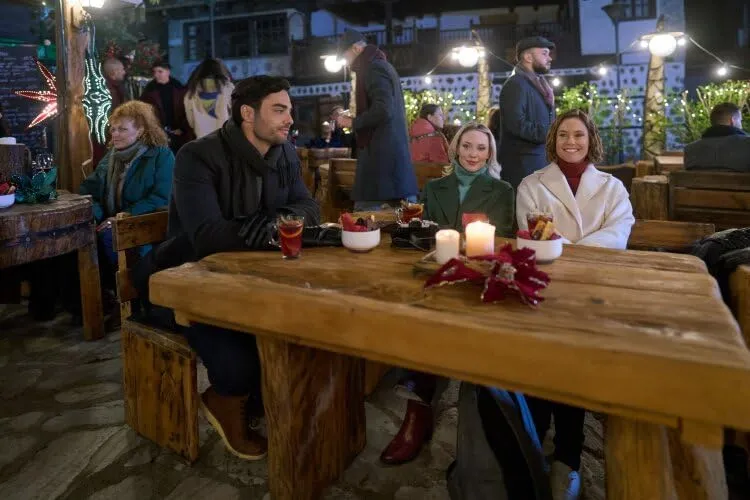
The visual design balances cozy holiday detail with images that invite the viewer into a fantasy of winter travel. The cinematography highlights the stark, imposing qualities of the mountains, which mirrors the scale of the sisters’ emotional effort.
Director Lucie Guest makes careful use of exterior locations so that the setting enlarges the emotional dimension of the story and avoids feeling like simple scenery. Blaine Chiappetta’s screenplay displays a clear sense of structure. The script assigns primary importance to the sisters’ relationship and allows Williams, a recognizable lead, to occupy a secondary romantic storyline. That choice gives family ties priority over short-term attraction. Comic touches such as Rebecca’s strategically placed notes and the sharply observed sibling exchanges work as devices for revealing character shifts and the slow work of repair.
Thematic Depth: Healing, Tradition, and the Holiday Formula
The film concentrates on personal change, healing, and the willingness to risk a new step, and this focus gives the story weight. It tells a tale of emotional return that depends on a balance between familiar ritual and the frightening pull of adventure. The script affirms many forms of love and treats lasting family connection as the condition that allows romantic affection to grow.

The film works inside a familiar holiday template yet invests that framework with attention to grief, direct conversation, and a believable portrait of sibling friction. By placing the characters in a foreign European environment that carries a strong romantic image, the story turns geography into a tool for emotional repair.
The disruption of daily routine and the experience of temporary dislocation create space for self-examination and change. This idea, recognizable from comparative literature and travel writing, shapes the intellectual frame around the sisters’ emotional path. The trip that Rebecca designs forces Faith and Kelly to revisit their history, face who they have become, and look ahead with a renewed sense of hope.
An Alpine Holiday offers light seasonal pleasure and pairs it with genuine emotional content. The film delivers a warm story about honoring memory and holding on to the lessons that shape a life while stepping toward change. It stands as a holiday title that rewards attention through committed performances and an emotional throughline that feels surprisingly candid.
An Alpine Holiday is a picturesque romantic holiday film that premiered on the Hallmark Channel on November 29, 2025, as part of its annual Countdown to Christmas event. The story follows two estranged sisters, Faith and Kelly, who are forced to reunite in the French Alps to fulfill their late grandmother’s last wish: to retrace a meticulously planned, sentimental journey her grandparents took decades earlier. While navigating the challenges of the majestic alpine setting and their complicated relationship, one of the sisters finds an unexpected connection with their handsome French guide, Frédéric. The movie, which has a running time of approximately 84 to 90 minutes and is rated TV-G, can be streamed on the Hallmark+ platform.
Full Credits
Title: An Alpine Holiday
Distributor: Hallmark Media
Release date: November 29, 2025 (Premiered on Hallmark Channel)
Rating: TV-G
Running time: 1 hour 24 minutes (or 1 hour 30 minutes, depending on source)
Director: Lucie Guest
Writers: Blaine Chiappetta
Producers and Executive Producers: Margret H. Huddleston, Stephanie Slack, Jamie Goehring, Shawn Williamson
Cast: Ashley Williams, Laci J. Mailey, Julien Samani, Véronique Frumy, Gergana Todorova, Robert Chapman, Diana Hardcastle
Director of Photography (Cinematographer): Ryan McMaster
The Review
An Alpine Holiday
An Alpine Holiday is a compelling holiday film that successfully uses its breathtaking French Alps setting to facilitate a profound emotional journey. The movie distinguishes itself through the authentic, complex portrayal of sisterhood and the strength of its lead performances, lending depth to the familiar genre structure. It offers a warm, well-acted examination of grief, healing, and the necessity of personal change, making it a highly rewarding destination piece.
PROS
- The emotional tension and eventual reconciliation between Faith and Kelly feel genuine and earned.
- The French Alps setting (Chamonix, Mont Blanc) is visually stunning and serves as a vital component of the narrative.
- Excellent chemistry and nuanced acting from both Ashley Williams and Laci J. Mailey.
- Effectively explores themes of grief, personal growth, and healing through the use of the grandmother’s itinerary.
CONS
- Frédéric's first interaction with Kelly is somewhat reliant on cliché regarding his cultural background.
- Despite its depth, the overall romantic comedy structure remains broadly predictable.
- Faith's underlying romantic plot feels less developed compared to Kelly’s.







