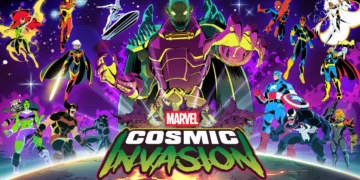


























The side-scrolling beat ’em up has a reputation for readable design, and Marvel Cosmic Invasion asks what happens when that template absorbs the hectic structure of a tag-team fighter into a cooperative brawler. The game commits to the look and cadence of 90s Marvel comics and avoids cinematic interpretations, and it frames its campaign around a galactic war built on the Annihilation Wave, led by the primary villain Annihilus.
That focus carries through to the roster, which pairs household names such as Iron Man and Wolverine with characters like Phyla-Vell and Beta Ray Bill, so the cast reflects familiar icons and deeper pulls from the catalog. Striking pixel art and strong voice performances communicate personality in every frame, so the screen reads like a comic book world from the opening moments.
Tag-Team Combat and Systemic Depth
The combat engine sits on a dual-character tag-team foundation, which gives every encounter a layer of tactical structure beyond straightforward brawling. The roster of 15 playable heroes supports this design choice because every character brings a distinct move list that reshapes spacing and tempo.
Rocket Raccoon, for instance, rules mid-range fights with artillery-style projectiles, while other heroes move into close quarters with speed-focused kits that reward aggressive positioning. Lineup diversity matters, since players assemble duos that cover gaps in mobility or reach, such as combining a slow, heavy bruiser with a partner who flies or excels at aerial pressure.
Each hero follows a clear ruleset. They chain basic combos, trigger a special attack, and hold a charged breakout move. Defense has its own depth curve through dodges, blocks, and a precise parry window that can flip momentum instantly. Focus energy defines resource management, feeding the high-cost Super attack and tying big payoffs to careful meter awareness.
The tag system functions as the core mechanic that ties this toolkit together. A single button press swaps characters on contact, which doubles as a defensive escape from throws or holds. Players can also summon the partner as an assist during a combo from the on-screen hero, and that interaction turns tag actions into an expressive combo system that sits closer to competitive fighters than traditional beat ’em ups.
Assist calls extend juggles, create cross-up situations, and reward players who learn different assist input variations and how they link into ground and air strings. The system reaches its peak in the two-character Super, a dramatic dual attack that drains maximum Focus from both heroes and punctuates long sequences with a single, spectacular payoff.
Mechanical ambition collides with weak communication. The tutorial barely outlines the toolset, so key ideas like special throw inputs or strict timing windows only appear after trial, error, or outside research. Feedback during play also falls short. The combo counter hides in the corner of the screen and does little to celebrate complex routing. Tag actions share similar visual and audio language, which makes it hard to read partner behavior in the chaos of a crowded fight or to judge Focus expenditure in real time. High-level play drifts toward memorizing opaque systems, and clear, legible cues rarely guide the action, which creates a problem for combat that aims for speed and expressiveness.
Modes, Progression, and Challenge Scaling
Marvel Cosmic Invasion structures its content around two main modes. Story Mode presents a campaign that moves across a branching map, giving players modest control over the route they take. Stage selection ties directly into roster choice, since every mission begins with a fresh duo, and optional Challenges reward that rotation by nudging players toward wider team experiments that sometimes echo the story situation of a given level.

Progress rests on a light RPG layer, where stage completion grants level-ups, and those levels translate into higher power and health for the heroes who participated. Progression never diverges by character, though, so raises in stats feel identical across the cast and do not create distinct long-term builds or trade-offs.
Arcade Mode strips this away for a leaner experience. Players choose a duo at the outset and keep that team for the length of a shortened, stage-based route that drops progression systems entirely. The format aims at runs that feel like a classic arcade brawler, with emphasis on survival and score-chasing.
Difficulty tuning represents the most significant structural flaw. On the default Medium setting, generous health pickups and fast resource recovery drain tension from the Story campaign. Boss fights introduce unique patterns, yet they often fall to simple button mashing because failed attempts carry little threat and survival rarely hinges on precise use of defensive tech or higher-end tag options. The disconnect between intricate mechanics and forgiving damage models means many players can clear the mode without engaging deeply with dodge timing, parry windows, or assist synergy.
Hard Mode changes that relationship. This setting only appears after players earn Cosmic Cubes through repeated runs and spend them on nodes in the Cosmic Matrix, a large unlock grid that holds character modifiers, color palettes, and the difficulty toggle itself. Once active, Hard Mode reshapes the combat experience by insisting on disciplined play, and defensive tools such as the parry become vital to basic survival. Incoming damage climbs, enemy patterns hit harder, and the same systems that felt ornamental on Medium support a tense, expressive combat loop that matches the ambition of the tag mechanics and cooperative structure.
Aesthetic and World-Building
Marvel Cosmic Invasion excels as a visual object. Its detailed pixel art and fluidly animated sprites give punches, energy blasts, and movement real weight, which reinforces the satisfaction of routine encounters. The dedication to comic-book character designs and set-pieces gives every stage a consistent identity that differs from familiar cinematic versions of these heroes.

Sound design supports that consistency. The soundtrack leans into a retro, high-energy style that mirrors the visual philosophy, and the voice work lands with similar confidence. The cast sells personality through line reads, from Wolverine’s rough delivery to the constant quips of Spider-Man, and the opening animated sequence and theme song stand out as polished pieces that set an adventurous tone.
The roster curation reflects a clear respect for the Marvel canon. Galactus and Thanos appear as larger-than-life antagonists, while heroes such as Phyla-Vell and Beta Ray Bill sit alongside more conventional headliners and broaden the sense of the universe. Long-time comic readers gain a chance to play with favorites from different corners of that history, and new players receive a guided tour of characters they might not have encountered.
Constant, rapid-fire joke writing becomes the one major misstep. Banter rarely slows down, and material built around characters who address the audience or comment on the fiction too frequently falls back on predictable punchlines, which dulls character voice and slowly eats away at the strength of the world-building elsewhere.
The Review
Marvel Cosmic Invasion
The game successfully translates complex fighting mechanics into the brawler format, boasting a deep tag-team system and stunning pixel art that faithfully honors the comic aesthetic. The structural flaw of extremely poor default difficulty balancing critically undercuts the enjoyment of these mechanics, requiring players to actively unlock Hard Mode for the systems to function as intended. Despite this hurdle and the lack of mechanical feedback, the game offers a refreshing and deep experience for beat 'em up fans willing to invest in its challenging side.
PROS
- Deep, multi-layered tag-team combat system.
- Gorgeously detailed comic-accurate pixel art.
- Large, varied roster that demands experimentation.
- Transformative and engaging Hard Mode difficulty.
- Commitment to niche Marvel canon characters.
CONS
- Default difficulty is too easy, making the campaign mundane.
- Static character progression system lacks player choice.
- Combat feedback (combo counter, tag cues) is insufficient.
- Repetitive humor occasionally undermines the tone.
- Threadbare tutorial for complex mechanics.