





























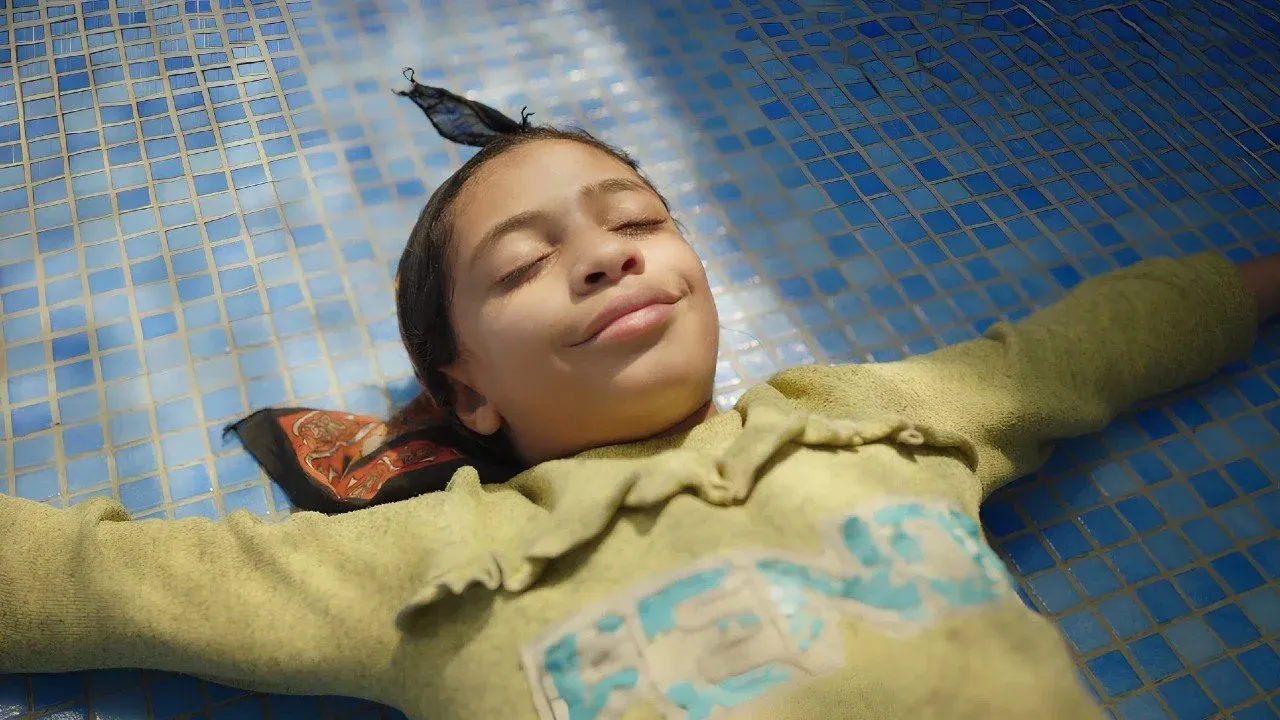

Happy Birthday introduces Egyptian-American filmmaker Sarah Goher as a feature director, with a script co-written with Mohamed Diab. The film focuses on Toha, played by Doha Ramadan, an eight-year-old working as a maid in an affluent Cairo household. Her life revolves around Nelly, portrayed by Khadija Ahmed, the daughter of her employer Laila.
Nelly’s ninth birthday party becomes the central event, a marker of privilege that Toha longs to touch. Toha commits herself to making the celebration perfect, believing effort can narrow the social distance between them. The film studies child labor and Egypt’s class hierarchy through a child’s view that remains clear and disquieting.
Class, Privilege, and the Illusion of Belonging
The film speaks across cultures through its examination of class, connecting its Egyptian setting to concerns familiar in Latin American cinema and European storytelling. Goher and Diab chart economic and spatial divisions with precision.
Nelly’s family lives in a guarded, upscale enclave that looks modern yet contains emotional fracture and isolation, with Laila facing separation and a potential move. That sleek quiet stands against Toha’s crowded home on the city’s edge, where scarcity and communal sharing set the terms of daily life. The contrast functions as a map of social rank and a guide to the characters’ limits.
Toha’s life is shaped by work that displaces school and play. Her hope for a simple birthday wish, promised by Nelly, stands in for the childhood she has missed. It channels her need for acceptance and the freedom she associates with Nelly’s world. The film treats Laila, played by Nelly Karim, with layered attention.
Laila offers moments of kindness, including a defense of Toha in a shopping mall, yet she employs a minor and benefits from the arrangement. As the party nears, Laila keeps Toha at a distance out of social caution and concern for appearances. That choice exposes the comforts of privilege and the routine nature of exclusion. Acts of care sit beside the machinery of advantage that the household continues to run.
Visual Storytelling and Narrative Symmetry
Goher’s direction and the script’s structure work in concert, aligning form and theme. The tone stays delicate and exact, childlike in perspective and emotionally direct, without slipping into melodrama or caricature.
The story plays out across a single decisive day, shaped into clear stages: Toha’s tasks in the wealthy home, her short return to her struggling family, and the meeting of those worlds during the party. Key adult matters, including the strain in Laila’s marriage, surface in overheard conversations while Toha moves through rooms as someone present yet seldom acknowledged.
Cinematographer Seif El Din Khaled frames scenes from an eager, low vantage that mirrors Toha’s height, especially in spaces that promise wonder and risk, such as the mall. The approach keeps the viewer inside her sensory field and gives scale to ordinary objects that feel out of reach.
The craft emphasizes environmental contrast: the polished suburban compound against lively, traditional streets where buses and toktoks crowd the frame. Space guides fate, and each location presses characters toward choices that match their station. Mina Samy’s score supports the shifts in feeling and carries the story’s weight without smothering it.
The Power of the Lead Performance
Doha Ramadan centers the film as Toha. Her performance captures a child with sharp perception and a deep need to belong. She plays innocence, resolve, and private yearning with restraint, allowing small changes in expression to track Toha’s growing recognition of social limits.
The final movement brings technical and emotional control to a peak. Toha arrives at the party, and the scene turns into an extended single shot that holds on her face. The moment compresses conflict and hope into silence and breath. It registers the impact of a social wall that refuses to move. The sequence lands with a clarity that ends the wish she carried through the day.
The supporting work by Nelly Karim as Laila and Khadija Ahmed as Nelly adds shading, especially in scenes that sketch a sibling-like bond between the girls, a bond that falters under the weight of money and status. Ramadan’s performance lifts the film’s portrait of inequality into a study of dignity and endurance shaped by a system that rewards some and confines others.
Happy Birthday is a 2025 Egyptian coming-of-age drama film that premiered at the 24th Tribeca Film Festival on June 5, 2025. It tells the story of an eight-year-old child maid named Toha in Cairo who becomes engrossed in preparing for the birthday party of the wealthy family’s daughter. The film, directed by Sarah Goher, received several awards at its premiere, including Best International Narrative Feature, and was selected as Egypt’s entry for the Best International Feature Film at the 98th Academy Awards. While the film has been screened at various international film festivals, including Tribeca and El Gouna, its general theatrical release or streaming platform availability is not yet widely specified.
Credits
Title: Happy Birthday
Distributor: Skylimit Production
Release date: June 5, 2025
Running time: 96 minutes
Director: Sarah Goher
Writers: Sarah Goher, Mohamed Diab
Producers and Executive Producers: Ahmed Abbas, Ahmed Badawy, Ahmed El Desouky, Jamie Foxx, Datari Turner, Mohamed Diab (Executive Producer)
Cast: Nelly Karim, Doha Ramadan, Hanan Motawie, Sherif Salama, Khadija Ahmed, Ali Sobhi, Hanan Youssef, Jomana Ibrahim, Fares Mohamed
Director of Photography (Cinematographer): Seif El Din Khaled
Editors: Ahmed Hafez
Composer: Mina Samy
The Review
Happy Birthday
Goher’s debut is an emotionally intense piece of filmmaking. It uses the intimate story of Toha, the child maid, and a simple birthday party to critique Egypt’s deep class divides. The narrative structure, focused on a single day, aligns perfectly with the visual storytelling to create profound social commentary. Doha Ramadan’s performance is exceptional. She carries the film’s weight, culminating in a devastating final sequence that is both technically brilliant and emotionally shattering. This is a powerful, essential work of international cinema.
PROS
- Excellent central performance by Doha Ramadan.
- Powerful social critique of class and child labor.
- Precise synergy of visual storytelling and narrative structure.
- Technically brilliant, devastating single-shot climax.
CONS
- Some background narrative elements (Toha's employment arrangement) are left unsaid, potentially challenging for non-Egyptian viewers.
- The tone can occasionally appear naive when depicting Toha's discovery of adult injustices.