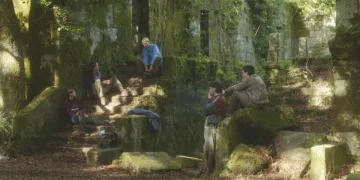


























Gabriel Azorín’s feature debut, Last Night I Conquered The City Of Thebes, approaches its subject with care and intent. The film unfolds at the Aquis Querquennis Roman bath ruins in Galicia, Spain, a site that looks like it could sit on an RPG overworld map.
Its design turns on a temporal echo: two groups of young men, separated by two millennia, share the same thermal waters and speak candidly about their lives, their fears, and the difficult maintenance of friendship. Azorín folds observational attention to the location into precise, scripted dialogue. He concentrates on water, earth, light, and the steady passage of time to probe human vulnerability. The result reads like a lyrical study of constancy across centuries, with feeling as the throughline.
The Architecture of Intimacy
The Bande Roman ruins operate as more than a setting, functioning as a monumental presence that shapes behavior. This large military settlement spends part of the year under an artificial lake, which brings a strong sense of impermanence and memory to every frame. Cinematographer Giuseppe Truppi opens with a commanding overhead drone shot that establishes the scale of the archaeological site, then tightens the frame to faces and torsos at the tubs, where bodies and stone share the same weight in the image.
The film builds its mood in low light. A phone screen in the present and an oil lamp in the past cut through steam and shadow, which creates a steady charge of mystery. Editor Ariadna Ribas sets a calm tempo, relying on long silences that allow breath and glance to carry meaning.
The bath reads as a threshold space, a spiritual shelter, and a temporary release from the world beyond the pools. Pressures from war or from major life choices fall away in this pocket of night, which the film treats as continuous time. The unbroken darkness joins separate eras into one span and supports the idea that the place itself lets hours and centuries speak to one another.
Echoes of Friendship and Betrayal
The film frames its theme through a first group of young Portuguese men. Their early chatter about streamers and video games, including an online take on the Battle of Thermopylae, ties modern speech to the language of conflict. From there the focus narrows to António, played by Santiago Mateus, and Jota, played by António Gouveia.

The dramatic center arrives when António addresses Jota in a long, unbroken confession. The single take invites the viewer to sit with the full length of feeling. António speaks about shifts in their friendship and about the way he reads Jota’s recent choices as a retreat into conformity that sidesteps earlier ambitions.
Later, Roman soldiers step into the same ritual space. Aurelius, played by Oussama Asfaraah, and Pompey, played by Pavle Čemerikić, extend the pattern. Aurelius recognizes change in a friend he admires and voices a strong wish to desert in order to return to his family. The dialogue, delivered in Latin for authenticity, carries the same fear of losing an essential bond.
The film concentrates on platonic male closeness and on the rare clarity that comes when young men speak plainly about dread, desire, and the risk of drift. The crosscut of eras brings these concerns into alignment, which strengthens the sense that the baths surface the same truths across time.
The Power of Stillness in Narrative Pacing
Performance anchors the film. Santiago Mateus gives António a clear, open presence during the extended confession, where a steady gaze and measured cadence keep the scene alive. Antonio Martim Gouveia’s Jota meets that confession with a darker quiet that holds back and watches. The balance can feel intentionally uneven. Jota’s muted reception underlines how hard it is to absorb a direct outpouring, which leaves the core relationship suspended in uncertainty.
Azorín builds structure around extended conversations. The film places these exchanges at the center and lets sequences like the approach to the site or the group’s early talk play as lighter scaffolding. The method requires patience and rewards attention.
The camera’s stillness and the repetition of gestures carve out a deeper look at what keeps these characters steady and what threatens to pull them apart. Viewers who prefer quicker cutting patterns may feel a test of stamina, yet the choice sets a clear artistic stance. The director marks his debut with care for duration, tone, and the emotional constants that persist across centuries.
The design works like a game system that privileges conversation as its core mechanic. The rules are simple: two bodies in hot water, a low light source, and time to speak. The location supplies a persistent map, the two eras play like distinct modes, and the long take serves as an unbroken turn. Stakes arise from confession and response rather than from plot escalation.
The Roman and the contemporary threads mirror each other in structure, which tightens the connection between theme and form. When António pours out his fears in one breath and Aurelius voices his wish to leave the ranks in another era, the film shows how a single mechanic can support two narratives and reach the same emotional beat.
Light and sound participate in that system. Steam softens edges, screens and lamps pick out faces, and silence becomes a resource that characters draw upon to continue or halt a conversation. Editing respects that economy by letting scenes play through, which turns the viewer into an active listener. The bath space behaves like a hub where each group returns to test friendship and loyalty. The calm rhythm grants room for reflection, which heightens the emotional charge when words finally land.
The early chatter about streamers and the Thermopylae game also earns a structural role. It frames modern talk about conflict as a surface layer that slips away once the bath demands honesty. That shift echoes the Roman scenes, where a soldier’s duty gives way to family needs once the water and quiet allow him to speak. The parallel reveals how performance of toughness dissolves in a space designed for rest. The baths ask for stillness, and the film listens to what rises in that stillness.
Across its runtime, Last Night I Conquered The City Of Thebes treats conversation as action and presence as plot. The camera stays close to skin and stone, which brings texture to every exchange. The submerged settlement’s cycle across the year, the drone’s scale, the cut to intimate framing, the Latin dialogue, and the single-take confession all serve one design. They tie feeling to setting and timing, then let that design carry meaning across two thousand years. Azorín emerges as a careful stylist with a clear interest in how steady pace and focused talk can reveal loyalty, fear, and the fragile work of holding a friendship together.
Last Night I Conquered the City of Thebes is a Spanish-Portuguese co-production that made its world premiere at the Venice Film Festival in 2025. It’s a slow-paced, lyrical film set in the ruins of an ancient Roman thermal bath in Galicia, Spain. The story explores themes of male intimacy, friendship, and the constancy of human emotion by interweaving conversations between two sets of young men, one in the present day and one in Roman times. It’s an arthouse film that has also screened at festivals like the New York Film Festival and is handled internationally by MoreThan Films. As of now, it’s an international film festival title and is not widely available for streaming or general release.
Credits
Title: Last Night I Conquered the City of Thebes (Original Title: Anoche conquisté Tebas)
Distributor: MoreThan Films (International Sales), DVEIN Films, Filmika Galaika, Bando a Parte (Production Companies)
Release date: World Premiere: August 2025 (Venice Film Festival)
Running time: 111 minutes or 112 minutes
Director: Gabriel Azorín
Writers: Gabriel Azorín, Celso Giménez
Producers and Executive Producers: Carlos Pardo Ros (Producer), Beli Martínez (Executive Producer)
Cast: Santiago Mateus, António Gouveia, Oussama Asfaraah, Pavle Čemerikić, Patrice Lerouzic
Director of Photography (Cinematographer): Giuseppe Truppi
Editors: Ariadna Ribas
The Review
Last Night I Conquered The City Of Thebes
Gabriel Azorín's debut is a patient, artistic exploration of male vulnerability across time. Its strength lies in the evocative Roman bath setting and the script's commitment to raw, single-take conversations. The slow-cinema pace demands dedicated engagement, but the film rewards viewers with a powerful, timeless echo of human anxieties. It's a visually stunning, meditative work that successfully frames the enduring nature of friendship and emotional honesty. This is a must-see for fans of contemplative, European arthouse cinema.
PROS
- Evocative and unusual use of the Roman bath ruins as a setting.
- Masterful atmosphere created by lighting, steam, and sound design.
- Strong commitment to the theme of platonic male intimacy and vulnerability.
- Powerful single-take monologue serving as the emotional centerpiece.
- The dual narrative structure across two millennia is thoughtfully executed.
- Stunning aerial cinematography that establishes the location's scale.
CONS
- The deliberate, slow-cinema pace will be demanding for some viewers.
- Conversations and visual compositions can occasionally feel repetitive.
- Initial setup material (banter, early scenes) feels less developed than the central dialogues.
- The central emotional dynamic can feel uneven at times due to Jota's muted reaction.