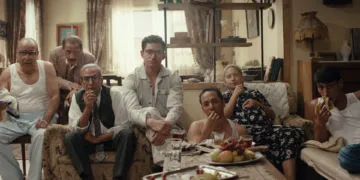






























Director Abu Bakr Shawky’s The Stories opens inside a cramped Cairo apartment, a space ruled by disorder and a near-constant expectation of failure. The family that fills this home clings to a perpetually losing soccer team, and their unwavering loyalty to that club works as a clear metaphor for a life shaped by recurring disappointment. Shawky builds a decades-spanning feature that follows an Egyptian family from the late 1960s onward and builds its long arc around Ahmed (Amir El-Masry), a gentle yet driven presence.
Ahmed is a gifted classical pianist who treats his musical talent as a possible exit route from the apartment’s crowded confines. His only tangible link to the world beyond those walls is a pen-pal exchange with Elizabeth (Valerie Pachner) in Vienna. The film leans fully into a heightened sentimental register and finds a steady rhythm in the organized chaos of a loud, tightly bound household. Shawky frames the family with obvious affection, acknowledging the constant strain in their lives while emphasizing how often they endure and keep moving.
History as a Resident: Structure and Context
The film’s handling of history functions as its key narrative design choice. Shawky divides the story into chapters that resemble a family chronicle and explicitly ties those chapters to different decades in the country, running from the 1960s through the 1990s. These markers appear on screen as clear timestamps, and the events they signal press directly into the characters’ routines.

The Wars with Israel, the major social unrest of 1977, and the 1981 presidential assassination appear as national turning points that never stay distant. Their impact reaches the apartment. Ahmed’s twin brother, Hassan, is conscripted into the army, while their father, a civil-service bureaucrat, spends his days in fear of losing his job, a fear that intensifies after an embarrassing appearance on national television. The film keeps the country’s anxiety present at the dinner table and treats the overlap between national crisis and domestic worry as the story’s defining weight.
Inside the apartment, the film builds a dense sense of community and everyday culture. Relatives, neighbors, and elusive uncles pour into the living room, forming a tightly knit clan whose emotions arrive fast, loud, and volatile. The film presents this urgency and visible feeling as central to the world it depicts. Through staging and framing, the cramped layout feels tangible, yet the energy of the scenes keeps them from collapsing into pure claustrophobia.
Even with a primary setting that rarely changes, The Stories reaches for scale through production design. The slow decay of a statue of a historical heroine outside the building and the gradual wear of the surrounding neighborhood operate as a visible calendar. These details track the passage of time and mirror the erosion of national ideals alongside the family’s personal path. The chapter structure joins the country’s collective story to the specific history of Ahmed’s relatives.
The Unfolding Potential: Performance and Romance
The film’s emotional anchor is Amir El-Masry’s work as Ahmed. He holds attention in nearly every scene, balancing a careful mix of hesitation and openhearted sincerity. Ahmed lives with the weight of his gift and the limits of his environment. He comes across as a mild-mannered man who keeps asking if the moment to fulfill his promise has already passed him by. El-Masry ties the film’s large emotional swings to that intimate, recognizable worry.
The script commits substantial space to the cross-cultural romance between Ahmed and Elizabeth, which begins in letters and then stretches across continents when Ahmed enrolls in music school in Vienna. The relationship appears largely idealized. Objections to the match remain muted, with Elizabeth’s father supplying the main resistance as he voices concern over the couple’s sharply different backgrounds. By keeping the conflict around the romance relatively soft, the film shifts attention toward the contrast between Ahmed’s cultural roots and his new environment.
Shawky stages this cultural divide through concrete, telling moments. In Egypt, Ahmed moves through a professional world shaped by an eccentric belief that a photograph with the sitting president can secure progress in one’s career. His piano rival back home treats such a photograph as a lucky charm. When Ahmed travels to Austria, these small details stand out as clear signals of the distance between the societies he moves through.
The film threads a consistent motif of displacement and split allegiance. After leaving Egypt, Ahmed remains fixated on his family’s well-being and on the fate of his homeland. His story becomes less about building an entirely new identity and more about finding a way to live in the present while a persistent call from his past keeps pulling at him.
At the same time, the film runs into a clear imbalance in its handling of women in the story. The mother appears as the quiet guardian of the family’s memories, carefully writing them into notebooks, yet the viewpoints and histories of the women, including Elizabeth, rarely gain the same level of detail. The film leans toward an intensive portrait of Ahmed’s attempt to reframe his sense of Egyptian reality, described through his relationship with Elizabeth, and gives far less space to a fully realized exchange between two distinct perspectives.
Tone, Momentum, and Emotional Synthesis
The film operates in a mode that might be called audience-friendly disorder. Shawky favors heightened feeling and relies on directing choices such as rapid dialogue, quick cutting, and restless camera moves. This active approach captures the constant rush and noise of the family’s daily existence. The soundscape matches that agitation, pairing the blare of nationalistic songs from the television with the meticulous piano pieces that Ahmed rehearses and performs.
The film leans on bold sentiment and makes frequent use of eye-catching production design, choices that some viewers might interpret as broadly kitschy. Shawky applies this amplified emotional scale with clear intent. He depicts a community where expression stays on the surface and people carry their feelings openly. That choice supplies the film with a sense of raw, unfiltered joy.
The Stories positions itself as a national allegory about the unrealized possibilities of a generation marked by unending geopolitical and economic strain. The family describes itself as used to defeat. Shawky’s film finds its strongest footing in the way it holds elation and suffering side by side, and in the idea that small, fleeting moments of success taste especially sweet because struggle functions as the standard setting. The film’s blend of hardship and brief triumphs shapes a flow that feels satisfying and emotionally full.
The Stories is an upcoming drama feature expected to be released in 2025. It is an international co-production involving France, Egypt, and other countries. The film traces the lives of an Egyptian family from the 1960s to the 1980s, centered on a gifted pianist named Ahmed and his long-distance correspondence with an Austrian woman, Elizabeth. It premiered at the Tallinn Black Nights Film Festival. The film’s theatrical and streaming release schedule is currently being managed by international sales companies like Goodfellas, with MUBI acquiring rights for various territories. As of today, December 7, 2025, it is not yet widely available for streaming or general theatrical viewing.
Full Credits
Title: The Stories
Distributor: Goodfellas (International Sales), MUBI (Streaming/Theatrical – in some territories)
Release Date: 2025
Running Time: Not Officially Listed (Feature-length drama)
Director: Abu Bakr Shawky
Writers: Abu Bakr Shawky
Producers: Julie Viez, Mohamed Hefzy, Amr Koura, Michel Merkier
Cast: Amir El-Masry, Valérie Pachner, Nelly Karim, Ahmed Kamal, Hassan El Adl, Karim Kassem
Director of Photography (Cinematographer): Wolfgang Thaler
Editors: Roland Stöttinger
The Review
The Stories
The Stories is a deeply felt family chronicle that successfully fuses the high melodrama of domestic life with the grand sweep of Egyptian history. Its strength lies in the vivid, chaotic sincerity of the family dynamic and the captivating central performance by Amir El-Masry. While the narrative's focus on female perspectives is somewhat limited, the film is a vibrant and moving study of displacement and the bittersweet persistence of hope against the perpetual expectation of defeat. It achieves a rewarding emotional synthesis, making its small victories feel truly significant.
PROS
- Amir El-Masry provides a captivating and grounded anchor for the expansive narrative.
- The chapter-based structure successfully intertwines national history with intimate family moments.
- It offers a vivid, melodramatic, and endearing depiction of a tight-knit family culture in Cairo.
- The film masterfully combines trials and small triumphs, creating a rewarding emotional flow.
- It offers an insightful exploration of displacement, divided loyalty, and unrealized potential.
CONS
- The film grants insufficient depth to the perspectives and backstories of the main female characters, including Elizabeth.
- The cross-cultural romance feels somewhat idealized due to minimal friction, which slightly dampens its dramatic weight.
- The highly sentimental and chaotic style might be perceived by some viewers as overly kitschy.