



















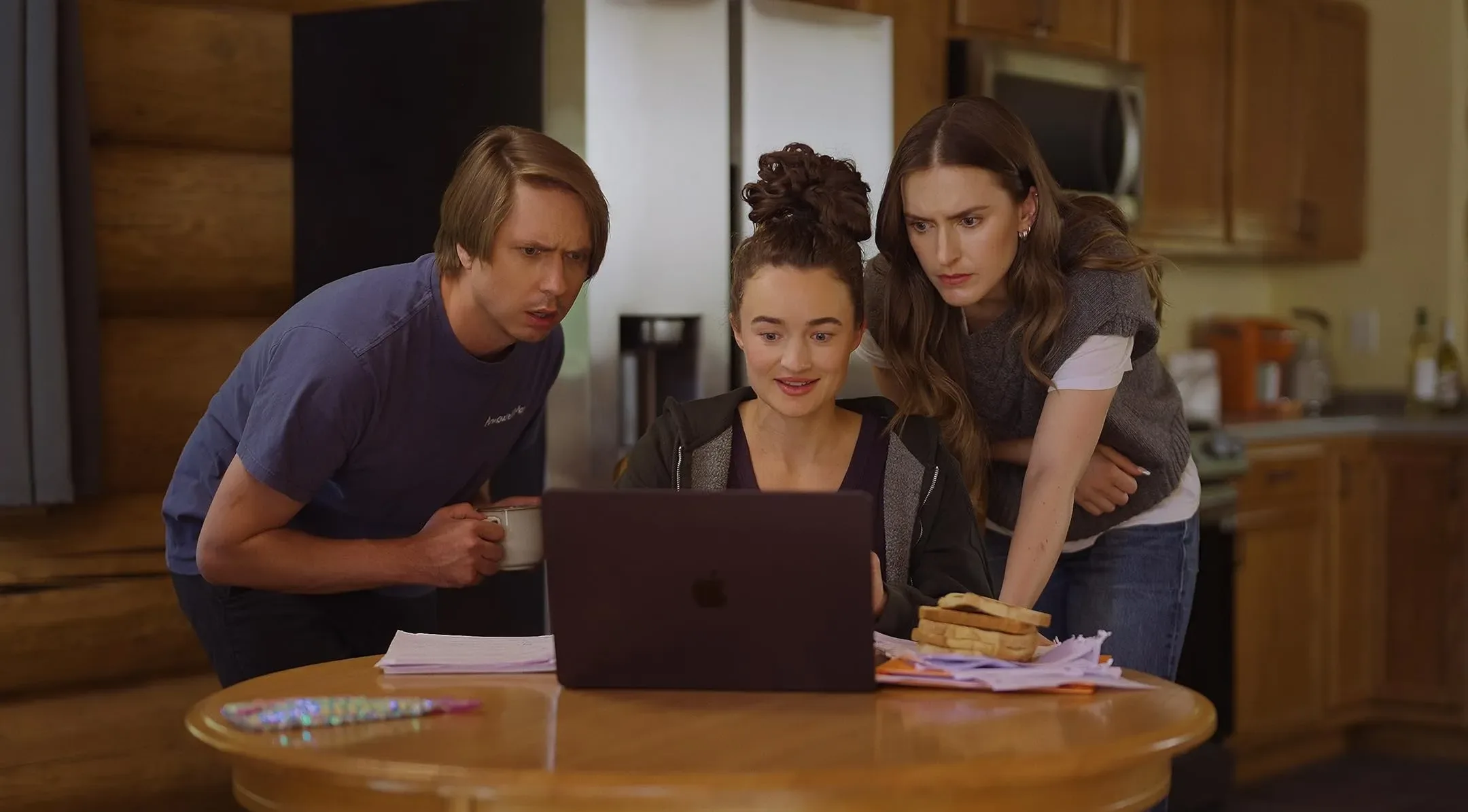

Stephen Portland’s Universal arrives as a quiet, sharply observed indie sci-fi dramedy that peels away its romantic surface to reveal a heady core. It starts with a familiar setup: two academics, Leo (Joe Thomas) and Naomi (Rosa Robson), head to a picturesque rental cabin with no cell service for a long-awaited romantic break.
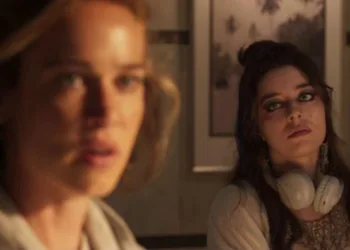
Their relationship feels lived in; the easy, slightly nerdy back-and-forth between them suggests years of shared jokes and intellectual sparring. That warmth makes the disruption hit harder when Ricky (Kelley Mack) appears without warning. Ricky, a self-described code breaker and Leo’s online acquaintance, arrives with a claim that her research into “Junk DNA” has led her to a discovery with world-changing implications.
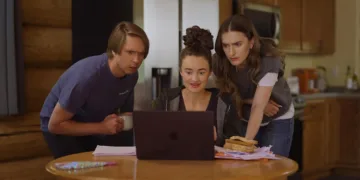
From that point, the film shifts gear. The light romantic premise gives way to a high-stakes scientific puzzle wrapped in a fierce armchair philosophy session, all contained within that one tight location. Universal aims directly at big questions about existence, knowledge, and what it means to be human, relying on three people and a laptop.
The Power of Three: Performances Driving the Dialogue
Universal works as a classic three-hander that depends on the current between its performers. Thomas and Robson give the film its emotional footing. Together they sketch Leo and Naomi as a smart couple whose bond feels real and lived in. Their relaxed chemistry makes Naomi’s anger at the hijacked holiday feel sharp, and her reaction keeps the spiralling situation grounded in something recognisably human. The main dramatic pull grows out of Kelley Mack’s work as Ricky.
Mack plays her as an eccentric intruder, socially awkward, blunt and frequently rude, a disruptive force who walks into the cabin and instantly knocks the emotional balance off-kilter. Ricky functions as the spark that ignites everything.
As the three characters dig into the research, their clashing temperaments, Leo’s deepening fixation, Naomi’s rising alarm, and Ricky’s urgent intensity, create a knotty but gripping dynamic. The cast turn a dense, dialogue-heavy script into something surprisingly alive, the kind of performance-driven piece that recalls late-night arguments where a single idea keeps everyone locked to the table.
Script as Stage Play: Ideas Over Action
Portland’s script sets up a structural challenge and leans into intellectual density, often feeling closer to a stage play than a conventional film. The exchanges unfold as relentless verbal duels in which every line and pause seems loaded with subtext, producing a tight, anxious energy that recalls the snap of a David Mamet play.

Universal circles the nature of discovery itself and keeps returning to a central anxiety: what happens to people when they stumble across a truth that should probably have stayed hidden. The academic science talk gains real intensity from that focus, and the film treats data like a belief system that can strip away both doubt and moral hesitation.
The narrative stays locked on process, what the discovery does to the discoverers and how it reshapes their thinking, and it avoids chasing a clear payoff or any kind of CGI-driven spectacle. That commitment to talk and theory comes with a cost. Long stretches of exposition slow the rhythm and demand patience from the viewer, who has to climb a steep wall of information.
I found myself thinking about dense sci-fi novels that ask readers to commit to the rules of a new world. Portland asks for a similar level of trust from his audience. The film’s tonal shifts present a notable weak point. The sharp, intellectually charged exchanges tend to land with precision, but occasional dips into broad, crude humour, especially an extended toilet gag, feel disconnected from the rest of the film’s smart, carefully drawn voice.
An Independent Vision: Scope and Execution
Universal reflects an indie sensibility where ambition towers over budget, and that imbalance becomes part of its character. Portland turns that limitation into a strength. He takes the isolated cabin setting and uses it to tighten the focus on the psychological and intellectual contest between the three characters. The direction feels controlled and precise because it sidesteps spectacle and keeps attention on performances and the unfolding scientific revelation.
As someone who enjoys films that swing hard at big ideas, I appreciate the attempt to pull together science fiction, philosophy, and deeply awkward comedy within one confined space. The film can easily test the patience of viewers who want traditional story beats or a clean, resolved ending, since the script repeatedly favours questions and uncertainty over neat closure.
There are clear stumbles in pacing and tone, yet the film’s earnest drive and the strength of the central trio keep Universal engaging. Viewers drawn to talky, idea-heavy sci-fi that values conversation over polish will find plenty to chew on here.
Universal is an independent sci-fi comedy-drama directed and written by Stephen Portland. The film centers on two academics, Leo and Naomi, whose romantic getaway is interrupted by an eccentric acquaintance named Ricky, who claims to have uncovered a world-changing secret hidden in DNA research. While the exact release date and distributor are not widely publicized, reflecting its indie status, the film has been featured on the festival circuit, including the Dances With Films festival. As an independent feature, it may be found on specialized streaming platforms or via Video on Demand (VOD).
Full Credits
Title: Universal
- Director: Stephen Portland
Writers: Stephen Portland
Cast: Joe Thomas, Rosa Robson, Kelley Mack, Kate Trefry
Composer: Rory Laws
The Review
Universal
Universal is a commendable, highly intellectual film that trades spectacle for substance, focusing on the intense character dynamics sparked by a world-altering scientific discovery. Its strength lies in the excellent performances and the courage to tackle grand philosophical questions within a tight, dialogue-heavy structure. While the film occasionally stumbles with uneven pacing and jarring tonal shifts, its ambition and commitment to idea-driven cinema make it a rewarding watch for those who appreciate intellectual sparring and minimal, high-concept drama.
PROS
- Excellent, lived-in chemistry between the three lead actors.
- Highly intellectual and idea-driven script that asks profound questions.
- Successful execution of a single-location drama, creating tension.
- Ambitious blend of sci-fi, comedy, and philosophy.
- Minimalist direction effectively focuses attention on character and dialogue.
CONS
- Uneven pacing; the setup and exposition can drag at times.
- Jarring tonal shifts, especially the inclusion of crude humor.
- Focus on process over payoff may frustrate viewers seeking traditional resolution.
- Dialogue-heavy style can occasionally feel overly academic or like a table read.