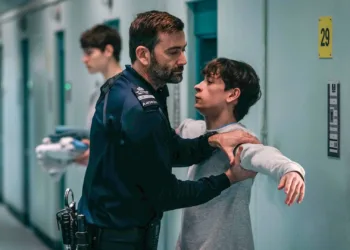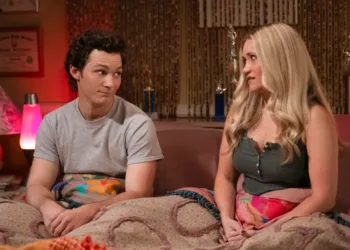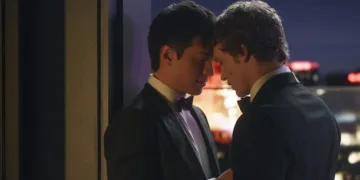

























The premiere of Heated Rivalry, a six-part drama from writer/director Jacob Tierney, lands like a carefully aimed slap shot at the streaming giants rather than a routine TV rollout. Produced for Crave in Canada and carried in the United States by HBO Max, the series signals a shift in where prestige television originates and which stories receive high-production investment.
The premise comes from Rachel Reid’s popular queer romance novel, and Tierney, widely associated with the comedic hockey world of Shoresy, approaches this material with clear sincerity. He steers away from parody and commits to the story’s emotional intensity and sexual explicitness.
The narrative follows Shane Hollander and Ilya Rozanov, two superstar Major League Hockey players presented to the public as fierce rivals while they conduct a long-running, deeply passionate, tightly guarded sexual relationship that stretches across international tournaments and professional seasons.
Heated Rivalry aligns itself with contemporary romance and embraces the explicit realism of what its audience would easily recognize as “smut.” At the same time, it keeps its attention on queer joy and the slow articulation of self-knowledge. The series turns away from a trauma-driven frame and leans into genuine connection, using its global platform to set a new expectation for what televised love stories on major services can look like.
Defining Characters in a High-Stakes World
The series depends on layered performances and the charged chemistry between its leads. The actors must sell elite athleticism, public antagonism, and a private, consuming desire at the same time, and the show’s emotional stakes rest on their ability to hold all three states in a single frame.
Hudson Williams plays Shane Hollander, a Canadian forward branded as the league’s “Mr. Nice Guy.” Shane carries significant symbolic weight. As a biracial Japanese-Canadian player in a predominantly white sport, he is framed as a standard-bearer for diversity. That symbolic function often runs through his hyper-involved mother, who also manages his career and constantly reminds him of his role as public figure and brand ambassador.
The job of being a polished representative of the league produces a tightly controlled image that clashes with his private desires. He grows up within a social environment that presents itself as open to queer identities, yet he enters his relationship with Ilya with little experience with men. That sheltered vulnerability defines him and stands against the confident and marketable persona he projects.
Williams gives the character a precise, contained performance. He works with small shifts in expression and tightly guarded looks, especially when he watches Ilya’s professional triumphs unfold in front of his own teammates. The restraint captures the habits of a closeted professional under constant observation. At the same time, it can leave Shane’s solo scenes feeling comparatively muted, which suggests that the character’s emotional energy truly activates in connection with Ilya. The series frames that activation as part of its central question about who gets to feel fully alive in public and who only finds that feeling in secret.
Connor Storrie plays Ilya Rozanov, the Russian “bad-boy” star of the Boston Raiders. Ilya projects a cooler, more openly aggressive presence, one that clearly feeds off familiar stereotypes about Russian athletes. The script links that edge to stark material pressures. He lives with constant stress, carrying the expectations of a financially struggling family in Moscow who read his career as a long-term financial solution. A relentless, judgmental father intensifies that demand. Unlike Shane, Ilya arrives with prior experience with men, and the series assigns him a sexually dominant role within the clandestine relationship from the start.
Storrie handles the character with care, generating strong chemistry with Williams. He offers a convincing version of the brooding, swaggering tough guy, while letting flashes of humor and hunger cut through the façade. Ilya’s edginess has a clear external source in the story, and that clarity gives Storrie firm ground for his performance. The character becomes a study in how economic obligation, national origin, and sexual history shape the posture a queer athlete adopts in public and in private.
The connection between Shane and Ilya drives the entire series. Their romance uses the familiar enemies-to-lovers trope, with a professional rivalry that the league deliberately heightens for marketing value. That staged antagonism quickly turns into an intense, secret attraction. Their relationship unfolds in a bubble of luxury hotel rooms and private digital exchanges. They rely on code names, “Jane” and “Lily,” for sexting, which underlines how much misdirection is required to keep their careers intact. The affair operates as an intentionally volatile, all-consuming bond anchored in two men who dominate their sport yet have limited emotional experience, a combination that fits both romance convention and the series’ interest in performance and repression.
Societal Pressures and Queer Storytelling
Heated Rivalry gains much of its cultural charge from the way it sets a lush queer romance inside the hypermasculine, “hetero-inflexible” culture of professional hockey. The series functions as a reflective surface for the difficult terrain queer athletes move through in high-stakes sport.

The show leans into a mild satire of media performance, paying close attention to the small absurdities of professional sports coverage. It highlights empty, interchangeable rinkside soundbites and the rigidly staged, aggressively masculine photo spreads that build a team’s public aura. For Shane and Ilya, these rituals form a protective carapace. The polished quotes and choreographed poses shore up their desirability in a presumed heterosexual market and leave little room for visible deviation.
The series traces the daily reality of being closeted and the ongoing threat of homophobia while resisting a didactic social-issue shape. A key moment comes at the Sochi Olympics, when an American teammate casually remarks that an out Canadian figure skater competing in Russia has “balls of steel.” The offhand comment carries real force. It exposes the prejudice living inside the supposed compliment and hints at the danger that still shadows open queerness on a global sports stage.
The invented rivalry between the Montreal and Boston teams operates as a conscious genre device, echoing the history of Crosby versus Ovechkin and turning the players into contemporary gladiators. Tierney frames the dynamic as a “Romeo and Romeo” story in which the two men themselves, rather than their families, act as the main feuding parties. The conflict feels personal and primal, and the romance plugs into a long theatrical tradition of lovers caught in opposition.
The series is frank about sex and keeps faith with the expectations of the source novel. Intimacy arrives early in the first episode and signals a strong commitment to the romance genre’s promise of explicit contact. The sex scenes are shaped through a queer gaze, showing gay male intimacy that reaches beyond surface-level provocation. Physical encounters serve as character work, turning communication, shifting power, and emotional exposure into the core of the erotic. At times the sexual exchanges read as competitive, mirroring the players’ drive to win on the ice.
Part of the show’s appeal, especially for its primary female readership, lies in how deeply it explores male vulnerability. Conventional romance often leans on stoic, hyper-competent men. Heated Rivalry allows both leads to be emotionally exposed and, in some moments, sexually passive. The emphasis on emotional openness, often tied directly to the sexual choreography between them, appears as a key attraction.
The story also uses the absence of gendered expectations between partners to examine desire and power in ways that sidestep familiar misogynistic patterns from heterosexual romance. The ability to move through different power configurations without those constraints feels creatively free and culturally pointed.
The writing draws a clear line between the different cultural and familial forces that shape each man’s time in the closet. Shane deals with the demands of global celebrity, his biracial identity, and his athletic success, all filtered and monetized through his mother’s management. Ilya deals with immediate financial strain at home and relentless expectations tied to his Russian background and athletic performance. The series shows how those divergent pressures produce distinct versions of secrecy, indicating that the closet changes shape with country, class position, and degree of fame.
Streaming Trends and Structural Experiments
Heated Rivalry challenges comfortable television rhythms through aggressive structural choices that echo current tendencies in streaming drama. Tierney relies on a telescoped form of storytelling built around bold time jumps. The first two episodes compress several years of the protagonists’ lives, charting their course from amateur competition to the MLH draft and onwards into professional rivalry, covering the stretch from 2008 to 2014.

The accelerated pace moves the pair quickly into an already established relationship, skipping the teasing “will-they-or-won’t-they” arc that many romance series stretch across entire seasons.
That speed serves efficiency. Viewers receive the central romantic payoff early, aligned with the expectations of fans who arrive looking for intense connection rather than prolonged delay. The cost sits elsewhere. The numerous jumps give limited space to the characters’ lives when they are apart. Their separate emotional states and professional milestones between meetings often appear as summaries instead of fully staged experiences.
The structure raises a pointed craft question that lives inside the text itself: would a more concentrated, slow-burn season have offered richer character work, or does this rapid approach fit the genre’s appetite for immediate, high-stakes reward on a streaming schedule built for binge viewing?
Tierney’s tone and direction work hard against any sense of financial constraint and build a premium aesthetic. The staging balances raw, sincere romantic emotion with gusty locker room talk among teammates. Dialogue in the intimate scenes comes across as particularly sharp, while the exchanges in the rink and the dressing room carry the rough, profanity-heavy sound of a real professional sports environment.
Visually, the show leans into the secrecy of the relationship. Intimate moments rely on tight close-ups and moody, half-lit hotel rooms that give the affair a feeling of luxurious confinement. A pulsing electronic score and constant narrative motion generate a cinematic energy that keeps the story moving even when the timeline compresses years into minutes.
The emphasis on the central couple leaves the supporting players with less space to grow. Characters such as Shane’s parents, played by Christina Chang and Dylan Walsh, largely serve as devices that push the plot or stand in for familiar “overbearing sports parent” types. They appear mainly as obstacles or as reminders of outside pressure on Shane rather than as fully rounded figures.
The choice to simplify the ensemble keeps the romantic throughline in clear focus and lines up with the conventions of the genre that originally produced the story. Taken together, the production communicates a clear ambition to succeed on contemporary streaming platforms, prioritizing intense relationship drama and polished visuals over sprawling, multi-thread ensemble storytelling.
The Canadian sports romance series Heated Rivalry is a highly anticipated adaptation of the novel of the same name by Rachel Reid. Created, written, and directed by Jacob Tierney, the six-episode series focuses on the passionate, secret, and long-term relationship between two rival professional hockey players, Shane Hollander and Ilya Rozanov. The show premieres on its originating platform, Crave, on November 28, 2025, with a two-episode debut. It will be immediately available in the United States and Australia via HBO Max on the same day, marking a significant international distribution win for the Canadian production. New episodes will be released weekly on Fridays, leading up to the season finale on December 26, 2025.
Full Credits
Title: Heated Rivalry
Distributor: Crave (Canada), HBO Max (United States, Australia), Sky (New Zealand), Movistar Plus+ (Spain)
Release date: November 28, 2025
Rating: TV-MA
Running time: 6 episodes (Approx. 60 minutes each, based on industry standard for this type of series)
Director: Jacob Tierney
Writers: Jacob Tierney, Rachel Reid (Based on the novel by)
Producers and Executive Producers: Jacob Tierney, Brendan Brady, Lori Fitchburg, Rachel Reid
Cast: Hudson Williams, Connor Storrie, François Arnaud, Robbie G.K., Christina Chang, Dylan Walsh, Sophie Nélisse, Ksenia Daniela Kharlamova
The Review
Heated Rivalry
Heated Rivalry succeeds as a vital piece of modern queer media, moving past narratives of trauma to focus on genuine connection and self-discovery. Jacob Tierney’s adaptation utilizes an aggressive structural pace, effectively charting a years-long secret romance within the high-pressure, hypermasculine world of professional hockey. The explicit content works as a tool for character exploration and power dynamics. While the supporting cast is underdeveloped, the chemistry and commitment of the leads anchor the series. It establishes a strong new direction for streamed romance, prioritizing vulnerability and emotional payoff.
PROS
- Successfully shifts the narrative away from trauma and suffering toward emotional fulfillment.
- Uses sex scenes effectively to explore character psychology, communication, and power dynamics rather than relying on mere titillation.
- Hudson Williams and Connor Storrie establish a palpable, consuming relationship.
- Achieves a visually polished, high-end feel despite potential budget constraints.
- Provides an insightful engagement with the subtle homophobia and performance pressures within professional sports.
CONS
- The aggressive time jumps and telescoped storytelling feel compressed, sacrificing deeper exploration of years covered.
- Secondary characters serve primarily as plot functions, particularly the parents.
- Shane's individual story often feels less complex than Ilya's when the two are separated.
- The fundamental bad-boy versus nice-guy dynamic is familiar within the romance genre.