
























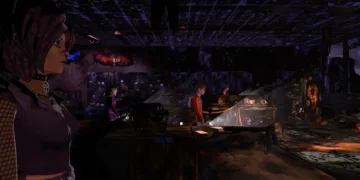






A sunburned stranger appears at the locked entrance of a shuttered beachfront hotel, stepping out of the white Florida glare and into a lobby frozen in uneasy silence. That threshold sets the stage for Luderdale, a mystery crime thriller conceived, written, and directed by Thom Mills. The story occupies the humid sprawl of 1980s Fort Lauderdale, yet it lives mostly inside the decaying shell of that sealed hotel, a once-glamorous property that now functions as a stylish prison.
Inside wait cousins Nicky (Austin Valli) and Tommy (Christian Shupe), holed up and hiding from dangerous mobsters. Their precarious arrangement fractures with the arrival of the drifter Hutch (John Gargan) and grows more unstable with Candy (Ayden Skye), a young woman whose presence carries an air of secrecy.
From the outset, the film treats the sunlit Florida setting as a mask stretched over constant low-level dread. The narrative favors a character-focused, slow-burn chamber design, trading high-speed gangster spectacle for an examination of brittle loyalty and the betrayals that follow close behind.
The Chemistry of Confinement
The core of the film rests on the charged, worn-in connection among the three central men, a dynamic that shapes the emotional architecture of the story. Their conversations flare between barbed, vulnerable, and exposed, giving the confined space an unsettling intimacy. John Gargan grounds the film as Hutch, a man who moves with quiet force, radiating easy charm while carrying a dense weight of guilt that never quite leaves his eyes.

Austin Valli’s Nicky brings nervous momentum, a restless figure shaped by addiction. His practiced bravado carries a hint of collapse, and that suggestion of deepening panic turns Nicky’s downward spiral into something sharply felt. Christian Shupe’s Tommy occupies the frame with size and heat. He functions as the volatile enforcer, a looming presence whose mix of menace and magnetism keeps each scene on edge. Ayden Skye’s Candy threads through their orbit with a spectral presence.
Also Read





Her mysterious, almost haunted air marks her as a figure who suggests vulnerability and possible threat at the same time, an ambiguous force inside the hotel’s closed system. The cast’s full commitment sustains the film’s grip. Their interplay charges the room with anxiety, yet the central trio sometimes tilts toward an attractive, stylized form of damaged masculinity that softens the harsher criminal edge that their situation implies.
The Nonlinear Rhythm of Secrets
Mills structures the film around a dual-timeline design, linking Hutch’s past life as a hustler entangled with the menacing Mr. J to his current entrapment in Fort Lauderdale. The structure sets out to unsettle linear progression and to keep the story’s secrets in motion, though the follow-through can waver. Story beats sometimes land with a disjointed logic, and certain subplots flare briefly before vanishing, never fully feeding into the central conflict.
The film settles into a deliberate slow-burn tempo that suits its pressure-cooker ambitions, layering conversations and confined confrontations until the hotel feels airless. This approach creates a thick, tense mood, yet extended dialogue stretches in the middle section occasionally sag, and the pacing begins to feel heavy enough to threaten audience engagement.
The shape of the piece sharpens in the third act. Here the construction locks into place, and the film bends audience expectations in a sharp turn. The finale arrives with a sudden, brisk, and convincingly prepared twist. A blood-marked revelation reconfigures what came before, shifting the film from a straightforward crime setup toward a more reflective study of identity, survival, and the spiritual price of living inside carefully maintained lies.
Aesthetic and Technical Limitations
On a visual level, Luderdale crafts a distinctive mood. The sun-bleached palette, built from burnt oranges and washed-out blues, captures the sense of rot that clings to faded seaside glamour. The 1980s setting feels thick with sweat and threat, an atmosphere that suits the story’s obsession with paranoia and decay.
Period recreation on an indie scale presents real pressure, and the film largely holds that illusion, though small fractures appear in details that suggest off-period payphone technology or wages. The hotel itself becomes a key instrument, a spatial trap that reinforces the characters’ fear. Windows frame the sea with striking consistency, offering a constant image of open water that contrasts sharply with their enforced isolation inside the crumbling interior. The technical side falters most visibly in the effects work.
Rooftop sequences seem to rely on green screen backdrops that call attention to themselves and sit awkwardly against the more grounded material. This visual limitation pulls energy away from the dramatic stakes. The film works best when it concentrates on faces, voices, and the emotional heat between people in a room, and it falters when it leans on these rougher, less convincing technical flourishes.
Luderdale, a character-driven crime mystery, premiered on October 21, 2025, from distributor Freestyle Digital Media. The film transports viewers to the gritty, sun-soaked atmosphere of early 1980s Fort Lauderdale, Florida, where a mysterious outsider disrupts the desperate hiding place of two criminals. The film is currently available to watch on demand, including platforms such as Amazon Video.
Full Credits
Title: Luderdale
Distributor: Freestyle Digital Media
Release date: October 21, 2025
Rating: R
Running time: 95 minutes
Director: Thom Mills
Writers: Thom Mills
Producers and Executive Producers: Thom Mills, Wendy Winston, Melissa Vitello
Cast: John Gargan, Austin Valli, Christian Shupe, Ayden Skye, Joe Chambrello, Rachel Lookshin, Sophie Swiszcz, Shaun Duke Jr., Clayton Louis, Rachael Adesuwa, Jesse Bluecloud Campbell, Samuel Code, Gavin Cole, Prejon Henderson, Joseph Integlia, Zachary Scott King, Stephen Mascoli, Neil Wachs, Portia D. Harris
Director of Photography (Cinematographer): Gavin Velasquez Murray
Editors: Robert Torrance
Composer: PJ Labinski
The Review
Luderdale
Luderdale is a flawed but focused piece of crime fiction that operates best as a character study of desperation and volatile trust. While the film struggles with technical polish and uneven pacing, the exceptional chemistry and magnetic performances of the core ensemble hold the viewer captive within its sun-bleached world of moral decay. Its complex narrative structure and shocking, effective finale solidify it as an ambitious, worthwhile genre experiment for audiences who appreciate atmosphere over seamless execution.
PROS
- The dynamic and raw interactions between the three lead actors (Hutch, Nicky, Tommy) provide the film's primary emotional and dramatic anchor.
- John Gargan, Austin Valli, and Christian Shupe deliver magnetic and intense portrayals that elevate the material.
- The decaying 1980s Fort Lauderdale hotel location creates a tense, effective environment of confinement and paranoia.
- The third-act reveal is unexpected, logical, and transforms the meaning of the story.
CONS
- The use of green screen backdrops for rooftop scenes is distracting and unprofessional.
- The dual-timeline structure and some subplot elements feel underdeveloped or randomly abandoned.
- The slow-burning rhythm occasionally becomes sluggish, risking viewer disengagement in the midsection.
- Minor anachronisms concerning technology and wages detract slightly from the 1980s setting.