


















A document labeled Downey Wrote That surfaces like a case file pulled from a long-ignored drawer, announcing its intent to track the life of Jim Downey. The immediate question is a formal and philosophical one: why construct a feature-length portrait of a man who shaped modern television comedy from the relative obscurity of the writers’ table?
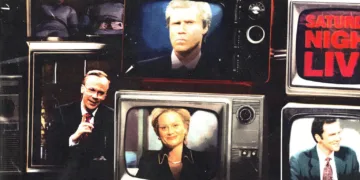
Downey functions as the key authorial presence behind much of what viewers treat as Saturday Night Live (SNL) bedrock. For decades he worked as the essential scribe, his fingerprints embedded in the show’s comedic spine. Yet for many viewers his name drifts at the edge of recognition, more rumor than celebrity. The film seeks to give that rumor shape, treating his influence and career as the primary subject of the frame and bathing a long-shadowed figure in direct light.
Downey’s professional timeline resists the fiction of steady ascent and instead unfolds as a fractured chronicle. His SNL tenure arrives in four distinct, non-consecutive runs, each aligned with a different comedic era, beginning with the second season in 1976. The film arranges this history through archival footage and a dense array of interviews, stitching together image and testimony to argue for Downey as a singular creative presence.
The narrative that emerges concerns power exercised from the safest part of the stage, the unseen hand in the back room pulled, somewhat reluctantly, toward the glare aimed at performers. The profile courts a paradox: a portrait of a man who consistently preferred to operate as a rumor just off-camera.
Style and Subversion: The Neo-Noir of the Joke
Downey’s comedic sensibility, as tracked by the film, becomes a meticulous study in how specificity mutates into subversion. His method revolves around an almost monastic devotion to hyper-precise wording and carefully calibrated phrasing. The documentary isolates recurring thematic and stylistic preferences with the patience of someone diagramming a punchline on a chalkboard. This rhythm of humor leans on an obvious, almost aggressively simple premise: a character explains something that everyone in the room already understands, then proceeds to mangle the explanation with confident inaccuracy.
The comedy depends on deliberate over-complication of everyday material. That pattern reads as a philosophical position. Communication appears as an elaborate engine that manufactures misunderstanding, and the human condition looks only slightly more coherent.
The film links this sensibility to an aesthetic logic. The jokes feel high-contrast, closer to a noir frame than to loose sketch chaos. Downey’s lines carve sharp edges, and the film likens that clarity to expressionistic framing, where lighting isolates a face, exposes a detail, and reveals a truth that sits somewhere between sharp insight and outright absurdity. The punchline arrives like a hard shadow on the wall.
Downey’s influence does not confine itself to 30 Rock. Before his various returns to SNL, he helped set the distinctly dry, strange tone of Late Night with David Letterman, with a key role in shaping the Top 10 List structure. The review treats this as part of a longer argument about his capacity to define comic architecture rather than simply to fill it.
His stretch writing “Weekend Update” with Norm Macdonald in the 1990s stands as an infamous peak, marked by persistent controversy. The segment on that period dwells on the ethical gray zone in their work and the way their O. J. Simpson material eventually cost them their jobs, turning their dismissal into a case study in artistic freedom colliding with corporate caution.
He returns to SNL once more and leaves another deep groove on the show’s style of political satire, shaping the Cold Opens that frame the rapidly shifting political atmosphere of the 2000s. The documentary also looks backward, toward his early work away from network stages: the Harvard Lampoon years, including the Henry Kissinger nude parody and the pointed John Wayne roast. In these fragments, the film tracks an already-formed hunger for satire that cuts close to its targets.
There is also the surprising on-screen appearance in Billy Madison, where Downey delivers the “I award you no points” monologue. The moment lands as a neat piece of dramatic irony. The writer who usually supplies language from the sidelines steps forward as the ultimate voice of judgment inside the story. Across these episodes, the film draws a line through his output, presenting a continuous ancestry of comedy and philosophy that connects collegiate prank, late-night absurdism, network news parody, and feature film cameos to a shared tradition of sharp American satire.
Illumination and Fragmentation: A Production Dissection
The film’s visual surface relies on measured shot choices and a play between different interview modes. The expected spread of single-subject interviews appears, each participant ready with praise for Downey. These images create a steady rhythm of faces in medium shot, talking to camera and underlining his importance.

The more arresting material emerges in the two-shot exchanges that place Downey across from collaborators like Conan O’Brien and Dana Carvey. In these scenes, composition and proximity do work that a solo talking head cannot. Two figures share the frame, and the space between them turns into an x-ray of process.
These conversations carry a noir-inflected quality. The blocking and lighting give Downey’s face a kind of intellectual chiaroscuro, half revealing and half concealing the habits that made him so potent in a writers’ room. The film treats each of these exchanges as a visual key, a way to translate the secrecy of joke construction into something legible.
The range of interview subjects reaches impressive scale. Lorne Michaels, Bill Murray, David Letterman, Seth Meyers, and a long roster of other voices line up to speak about him, each one reinforcing the sense that Downey operates as a comedian’s comedian, a fixed reference point inside the industry. The cumulative effect positions him as a guiding figure for comic television, someone whose ideas shaped colleagues who already count as icons. The testimonials keep repeating one idea: his peers know exactly how much of their world traces back to his pages.
The film’s pacing and editorial logic occasionally feel torn between two imperatives. One impulse seeks to preserve a deep archive, to keep every vivid story and scrap of footage. Another impulse favors a clean, easily followed through-line. The tension between these goals leads to a structure that sometimes feels jagged. The film shifts rapidly among eras, faces, and formats, chasing completeness and accessibility at once, and that tension shows.
The sound and graphic design introduce small aesthetic irritants. Recycled library score cues and abrupt on-screen text elements give certain passages a slick, pre-packaged sheen that clashes with the material’s handmade energy. The sonic choices create a faint sense of miscasting, as if the music belongs to a different program entirely. Still, the documentary finds its most striking identity in the archival material it uncovers.
The footage of Downey on the phone with Norm Macdonald, working joke lines with painstaking care, becomes the film’s most valuable sequence. Here the camera simply records a process that could easily have remained legend: two voices, a phone line, and an endless series of micro-adjustments.
The scenes expose the existential mechanics of writing comedy, where a single word change can tilt a gag from dead weight into something lethal. The tension arises not from plot but from timing, repetition, and small variations. For viewers, these passages make labor visible. They argue that the act of shaping a joke can hold the same grip on attention as the finished performance.
The Elusive Subject: Identity and Visibility
Across its running time, the documentary builds a portrait of Downey as a figure who thrives in the wings. Influence arrives in waves, while the person behind it steps aside. Years of creative impact accumulate through an almost programmatic habit of ducking the spotlight. That self-erasure raises a philosophical problem for the film to worry at: does identity require public recognition, or can a life find full definition inside the work itself? The question hovers whenever someone on screen calls him essential and then admits that most viewers would struggle to pick him out of a lineup.
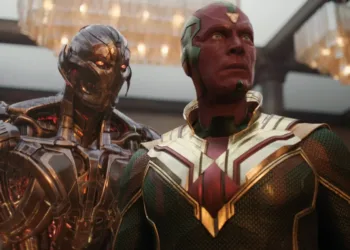
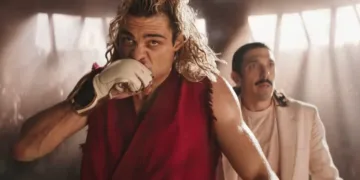
The film also tracks a recent transformation in that visibility. It notes his unexpected acting turns in the feature One Battle After Another and in the HBO series The Chair Company. These appearances indicate a shift in the way his creativity reaches audiences. The writer who spent decades crafting lines for others now appears directly in front of the lens, a quiet reversal that the documentary treats with some amusement. The joke architect becomes one of the faces that embody the joke.
In an attempt to soften the strictly professional aura, the film threads in personal photographs and brief scenes from life away from 30 Rock. We see him exhausted after his wedding, slouched in a dorm room, standing with family. These still images operate like emotional close-ups, bringing the scale down from institution-level influence to domestic fatigue and ordinary affection. The effect is simple and effective: the mythically productive writer looks tired, amused, and recognizably mortal.
The project functions very clearly as an expansive salute to his professional history, a collection of “greatest hits” that rarely lingers on the parts of his life untouched by cameras and cue cards. A critic watching this structure may feel a small ache for a deeper excavation of his private history or a longer stay with his inner life beyond the machinery of television. This review, too, stays mostly inside the orbit of his work, because that is where the film concentrates its gaze.
The piece operates like a rapid-fire appreciation, a montage of comedic victories assembled at high speed rather than a slow, psychological study of a single consciousness. For viewers deeply invested in the evolution of modern television comedy, Downey Wrote That stands as an essential record. It finally places a long-serving architect of televised laughter under a direct beam of recognition, matching the scale of his on-page influence with the visibility that his work has long deserved.
Downey Wrote That is a feature-length documentary exploring the sketches, contributions, and enduring influence of Jim Downey, one of the most impactful comedy writers in the history of Saturday Night Live. The film was released on October 17, 2025, and is available for streaming on the platform Peacock. This one-hour film serves as an essential look into Downey’s craft, detailing his role as the comedic architect of the show’s political and absurd humor for over three decades, revealing his importance to audiences who may not know his name but are certainly familiar with his legendary work.
Full Credits
Title: Downey Wrote That
Distributor: Peacock
Release date: October 17, 2025
Rating: TV-MA
Running time: 60 minutes (1 hour)
Director: Brent Hodge
Producers and Executive Producers: Lorne Michaels, Susan Morrison, Andy Breckman, Erin David, Eddie Michaels, Oz Rodriguez, Brent Hodge, Derik Murray, Brian Gersh
Cast: Jim Downey, Adam Sandler, Darrell Hammond, David Letterman, Maya Rudolph, Conan O’Brien, Emily Spivey, Lorne Michaels, John Mulaney, Fred Armisen, Dana Carvey, Greg Daniels, Will Forte, Al Franken, Bill Hader, Jon Lovitz, Seth Meyers, Garrett Morris, Laraine Newman, Bob Odenkirk, Lawrence O’Donnell, Molly Shannon, Martin Short, Robert Smigel, David Spade, Ben Stiller, Kenan Thompson
The Review
Downey Wrote That
Downey Wrote That is an essential document for any aficionado of modern comedy, successfully elevating its subject from a backroom legend to a deservedly recognized influence. While the film occasionally suffers from a fragmented structure and stylistic overproduction, its value lies in the sheer volume of priceless archival footage and the collective testimony of the industry's brightest minds. It is a powerful, appreciative portrait of a genius whose work defined decades of satire through hyper-specific language and comedic subversion. The documentary validates the importance of the writer as the true architect of chaos in television.
PROS
- Successfully gives overdue, critical recognition to Jim Downey, one of the most important writers in SNL and late-night history.
- Features an exhaustive, high-profile lineup of comedy legends (Michaels, Letterman, Murray, O'Brien) confirming Downey's status as a "comedian's comedian."
- Provides invaluable, candid glimpses into the creative process, such as his collaboration with Norm Macdonald.
- Clearly and precisely defines Downey's signature subversive comedic style (laborious explanations of the mundane).
CONS
- The narrative can feel uneven or disjointed at times, jumping between eras and segments.
- Suffers from mild overproduction, including the use of recycled score music and jarring on-screen text overlays, detracting from the core material.
- Primarily focuses on his professional life, leaving some of his personal history or motivation underexplored.