




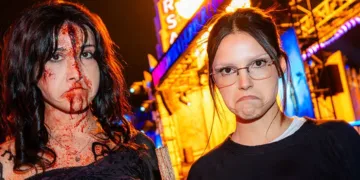


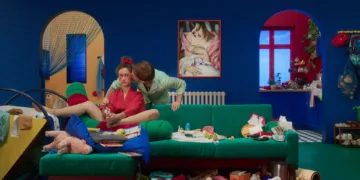











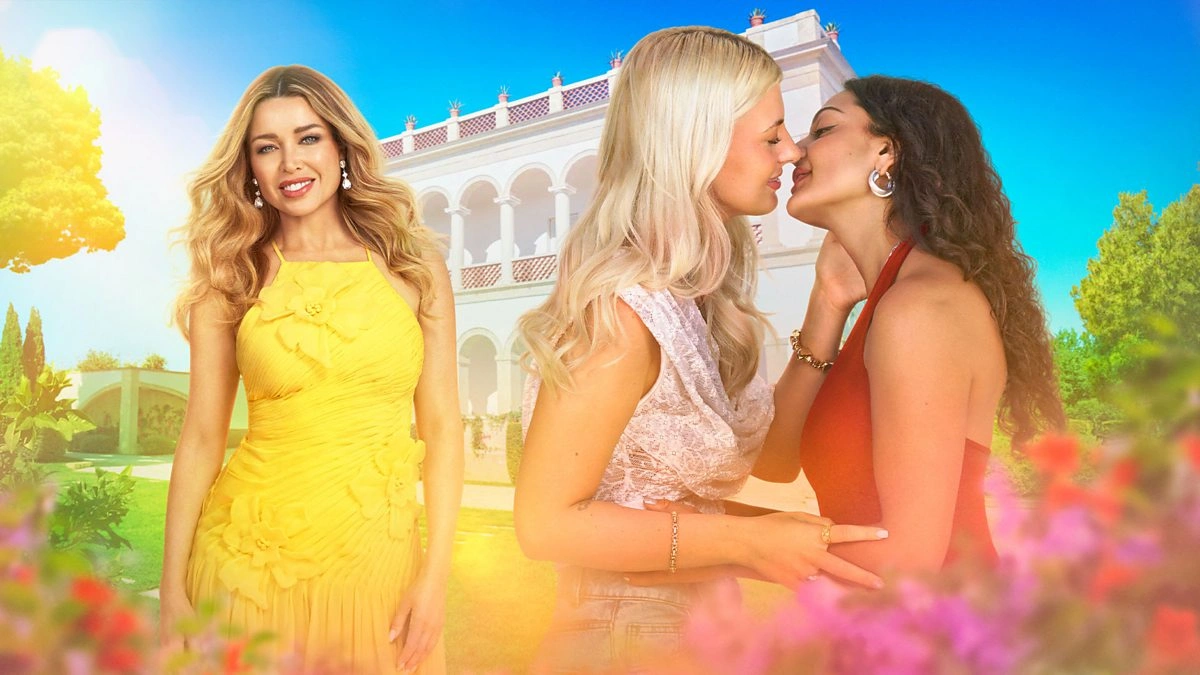

The strangest thing about the second season’s first kiss is that it already feels archived. I Kissed a Girl returns to BBC Three with Dannii Minogue presiding over a new group of queer women in an Italian masseria, asking them to kiss before they have enough information to build a fantasy. Then the show asks them to score the kiss. Romance has rarely looked so much like admin.
This would be funny enough on its own, and often it is. The opening matches carry the absurd efficiency of reality television at its most shameless: Faye and Elise are placed together, mouths do the introductory work, then the chemistry rating turns private confusion into public data. Elisha and Nikita land near the bottom, which gives the whole group permission to begin doubting before anyone has had a proper conversation. The system is ridiculous. It is also brutally effective.
The shadow over all this glitter is the BBC’s decision to end both this series and I Kissed a Boy. So every flirtation arrives with a strange aftertaste. Call it cancellation melancholy, the feeling that a show is still alive on screen while already being spoken about in the past tense.
The Masseria Machine
The season knows how to create weather. Charley Marlowe’s narration turns the masseria, or “mazzy,” into a camp pressure cooker, with Jane McDonald and Mighty Hoopla references arriving before the contestants have fully settled into their sunlit romantic laboratory.
Some of the queer pop-cultural shorthand feels programmed by committee, especially when the music supervision reaches for the most obvious needle drops. Still, the show’s vocabulary matters. Television has found endless ways to make straight dating rituals look universal. Here, a Lady Gaga cue can be corny and oddly corrective at the same time.
The format works best when it uses artificial devices to reveal natural panic. The kiss ratings are a clever little cruelty, because they force people to admit what their faces are already hiding. The early arrival of Blessing, Kayleigh, and Almayra does the same thing at group level, disturbing pairings before they calcify into strategic safety.
Lindsay’s turn toward Blessing leaves Renee bruised after a conversation that had seemed to promise effort. Ebony’s interest in Kayleigh complicates Imogen’s grip on her. Pippa’s entrance, with slicked-back confidence and non-binary swagger, gives Imogen exactly the jealousy instrument she thinks she needs.
Not every device earns its screen time. The U-Haul game is a thin sketch stretched into a challenge, and “The Tree of Desire,” with its glittery apple dares, has the delicate symbolism of a hen-party prop left in the sun. Yet the dinner party sequence shows why the machinery survives.
Failed communication, wine, attraction, embarrassment, and tactical honesty collide until the table becomes a tribunal. Reality TV loves a dinner-table implosion. This one has a specific charge because everyone appears fluent in emotional language until the bill arrives.
Types, Masks, and Softness
The cast is the season’s rescue operation. Faye, a chaotic femme from Warrington, enters wanting someone obsessed with her and quickly becomes a small tragedy in neon. Her connection with Elise has enough heat to top the chemistry ranking, then Elise sees Elisha and turns into a badly house-trained romantic thesis. Faye’s bluntness is funny, but her hurt lands because the show lets it sit on her face before cutting to the next spark.
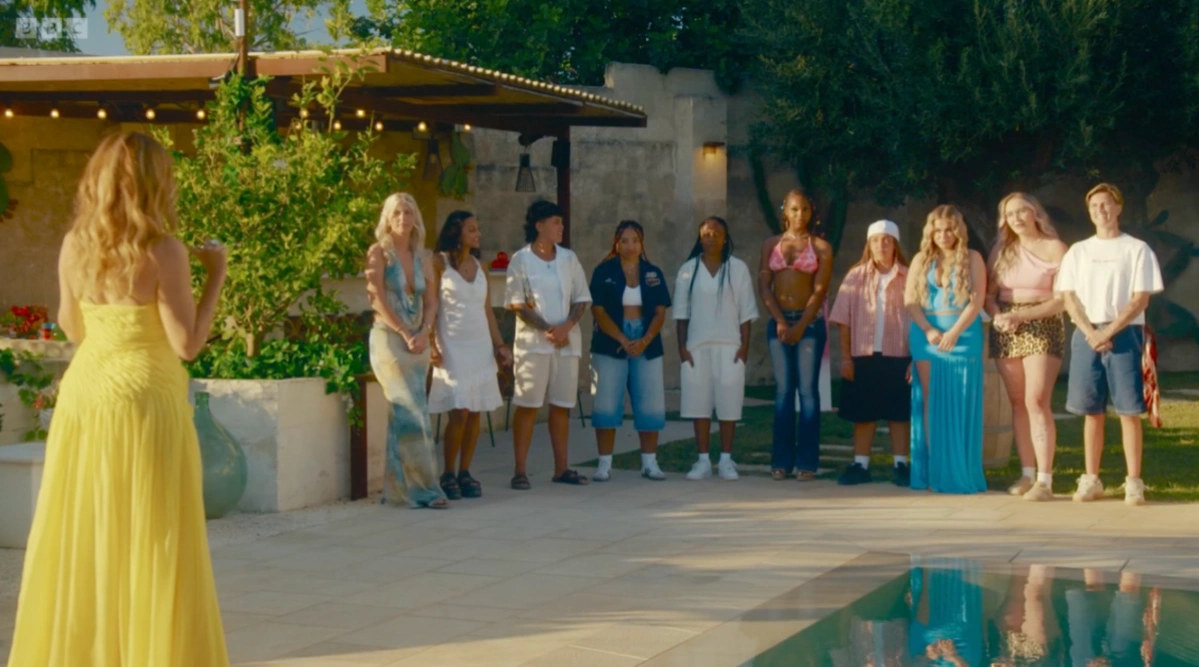
Elisha gives the season one of its clearest ideas: presentation is not identity, and being read as straight can become a kind of unpaid labor. Her femme-for-femme preference is not treated as a slogan. It becomes a live question when her interest in Elise cuts against her stated type. The show is good at this small instability, the moment when a contestant realizes a self-description may be true and incomplete at once.
Renee’s arc supplies the most valuable emotional correction. She arrives bold, rowdy, masc-presenting, built for the kind of reality-TV edit that could reduce her to swagger. Then, after conflict with Lindsay, she speaks about how masculine women are not always granted softness. “I’m just a really emotional woman,” she says, and the sentence punctures the entire masc-as-armor fantasy. The show does not need a seminar here. It needs her face, the room listening, and the brief silence after a person says something they have had to learn the hard way.
Ebony brings a different charge: cheeky Newcastle charm, delivery-driver ease, a grin that seems designed to excuse minor crimes. Her triangle with Imogen and Kayleigh works because the show refuses to make her a simple player. Imogen’s directness has its appeal, then curdles when it starts resembling control. Almayra, speaking about celibacy and needing a partner who understands her boundaries, opens another door rarely seen in dating TV, where intimacy is usually treated as either conquest or problem.
Public Service With Glitter
The political value of I Kissed a Girl is that it does not behave like homework. Its usefulness comes through gossip, bad decisions, whispered bed chats, lust, sulking, and contestants wondering if their tenderness is friendship or flirtation. That uncertainty is not filler. For queer women, especially younger viewers, it is part of the grammar the show is making visible.
The BBC’s cancellation decision looks stranger the longer the season runs. This is a broadcaster that has found room for decades of boardroom cosplay and entrepreneurial pantomime, yet its first gay dating franchise gets treated like a luxury item during budget cuts. There is a grim institutional comedy there (public service, now with disappearing lesbians).
Season 2 is far from pure. The games drag, the editing sometimes squeezes uncertainty into manufactured suspense, and several early couples look like they were matched by a mischievous spreadsheet. Yet the show keeps producing moments that feel culturally specific and televisually alive: Renee asking for tenderness, Elisha testing the limits of type, Faye masking hurt with one-liners, Almayra insisting that desire can include restraint.
The masseria may be a reality-TV construct, but for a few episodes it becomes something British television still does not offer enough: a room full of queer women allowed to be ridiculous, wounded, horny, articulate, wrong, and seen.
The highly anticipated sophomore season of the British reality dating series I Kissed a Girl premiered on June 23, 2026, on BBC Three and became available for immediate streaming on BBC iPlayer with a four-episode launch block. Hosted by pop icon Dannii Minogue and narrated by comedian Charley Marlowe, the final installment of the groundbreaking queer match-making franchise transports ten single British women to a gorgeous Italian masseria. The format serves up immediate drama by skipping the traditional period of online messaging, tasking the participants with locking lips right upon their very first face-to-face meeting to gauge immediate romantic chemistry.
Where to Watch I Kissed a Girl Season 2 Online

Full Credits
Title: I Kissed a Girl Season 2
Distributor: BBC Three, BBC iPlayer
Release date: June 23, 2026
Rating: TV-14
Running time: 45 minutes per episode
Director: Twofour Production Crew
Writers: Twofour Editorial Team
Producers and Executive Producers: David Brindley, Dan Gray, Mel Balac, Nic Patten
Cast: Dannii Minogue, Charley Marlowe
Director of Photography (Cinematographer): Twofour Camera Department
Editors: Twofour Post-Production Team
Composer: Ian Masterson, Hayley Sanderson
The Review
I Kissed a Girl Season 2
I Kissed a Girl Season 2 is messy, tender, frequently silly, and politically useful in the least medicinal way possible. Its games can feel like reality-TV scaffolding with glitter glued on, yet the cast keeps breaking through the format: Renee asking for softness, Elisha questioning type, Almayra naming intimacy on her own terms. The BBC cancelling it now feels like institutional self-sabotage with a funding memo attached. The show deserved time to become ordinary. Instead, it leaves as evidence.
PROS
- Strong, vivid cast
- Rich queer conversations
- Dannii Minogue’s warmth
- Messy but addictive pairings
- Sapphic pop-cultural texture
CONS
- Some games drag
- Format can force connections
- Early pairings feel shaky
- Cancellation shadows the season