























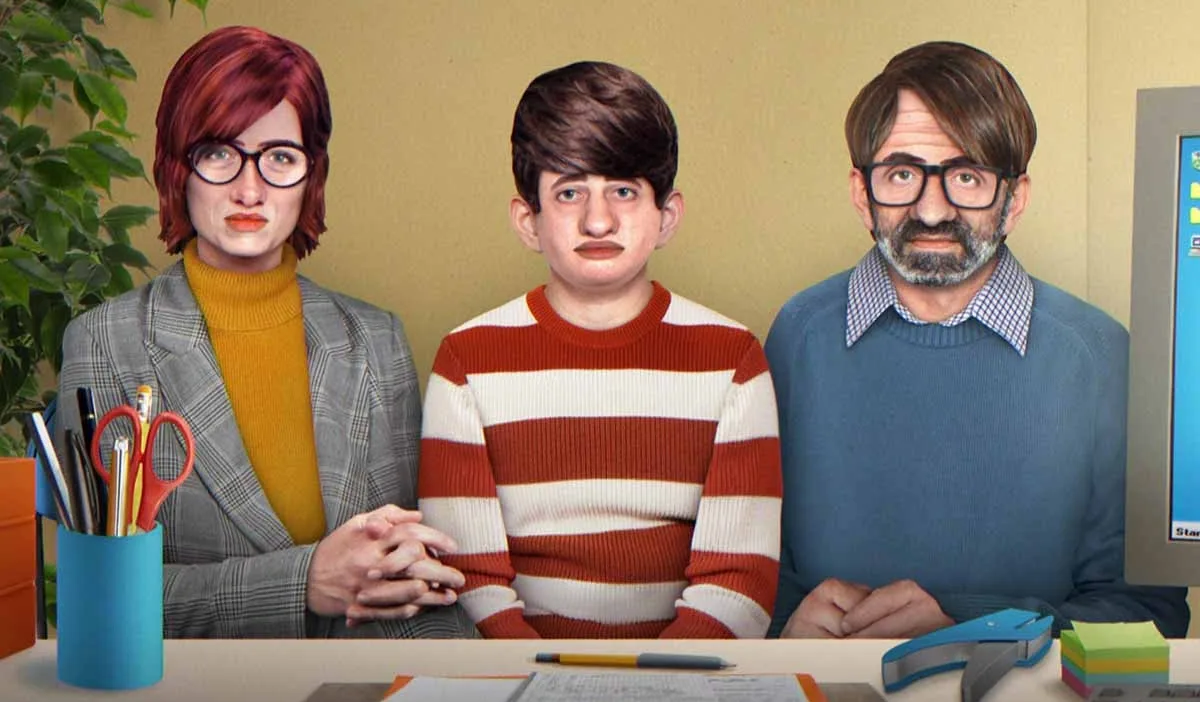

The Sauvage family has the air of people permanently bracing for a doorbell. Their bodies stiffen before anything happens. Their faces, assembled from photographic scraps, look half-human and half-administrative error: large noses, vacant eyes, mouths that seem built for apology rather than speech. In Blaise, directed by Dimitri Planchon and Jean-Paul Guigue from Planchon’s own comic and television series, this visual unease is not a flourish. It is the film’s first language.
Blaise himself, voiced by Timéo, is sixteen and almost aggressively undefined. He is not rebellious in the usual adolescent sense. He barely has enough shape to rebel against. At school, a counselor tries to discuss his inability to connect with others while his parents, Carole and Jacques, quietly turn the meeting into an exhibit of their own psychic damage.
Carole asks if her son might be gifted. The counselor’s answer, a slow and merciless “no,” lands like a tiny execution. Jacques then redirects the conversation toward his allergy to apple-scented cleaning products, because some wounds are ridiculous and still manage to bleed.
The Sauvage Method
The film’s comedy grows from a terrible family inheritance: the belief that discomfort must never be named. Carole, voiced with brittle precision by Léa Drucker, wants to be liked by her employees at the stone wholesale company where she now manages the gravel and pebble department. That setting alone carries a pleasing absurdity, a whole bureaucracy of small rocks.
Yet Carole’s scenes are funny because Drucker lets every good intention rot slightly before it reaches the air. She tries to sound generous, direct, maternal, competent. Her employees hear threat, manipulation, pity, or all three at once.
Jacques, voiced by Jacques Gamblin, lives inside another form of hunger. He wants admiration, or at least recognition, and his visits with the school counselor become less therapeutic than theatrical. The sadness of Jacques is that he cannot tell the difference. His need has grown so old inside him that any listener becomes an audience, any audience becomes a tribunal, and any tribunal must be survived through monologue.
Blaise watches these adults and learns the only lesson available: never say the thing. Never refuse. Never expose a desire that might be mocked, misunderstood, or ignored. Silence becomes his shield, then his leash.
Love, Revolution, and the Grenade
At a party, Blaise drifts into a conversation among teenagers debating political violence. He says almost nothing. Joséphine, voiced by Nina Blanc-Francard, mistakes that vacancy for depth. This is one of the film’s sharpest jokes: in a room full of borrowed convictions, the quiet boy seems profound because he has failed to interrupt the performance.
Joséphine is wealthy, though she hides it. She wants rebellion the way some people want a costume that photographs well. Her attraction to Blaise depends on a fantasy she invents around him, and his attraction to her depends on his inability to correct it. Soon the pair move from flirtation to protest to a plan involving a grenade, and the horror of the escalation is that Blaise never truly chooses it. He simply fails to step away at each smaller point where stepping away was possible.
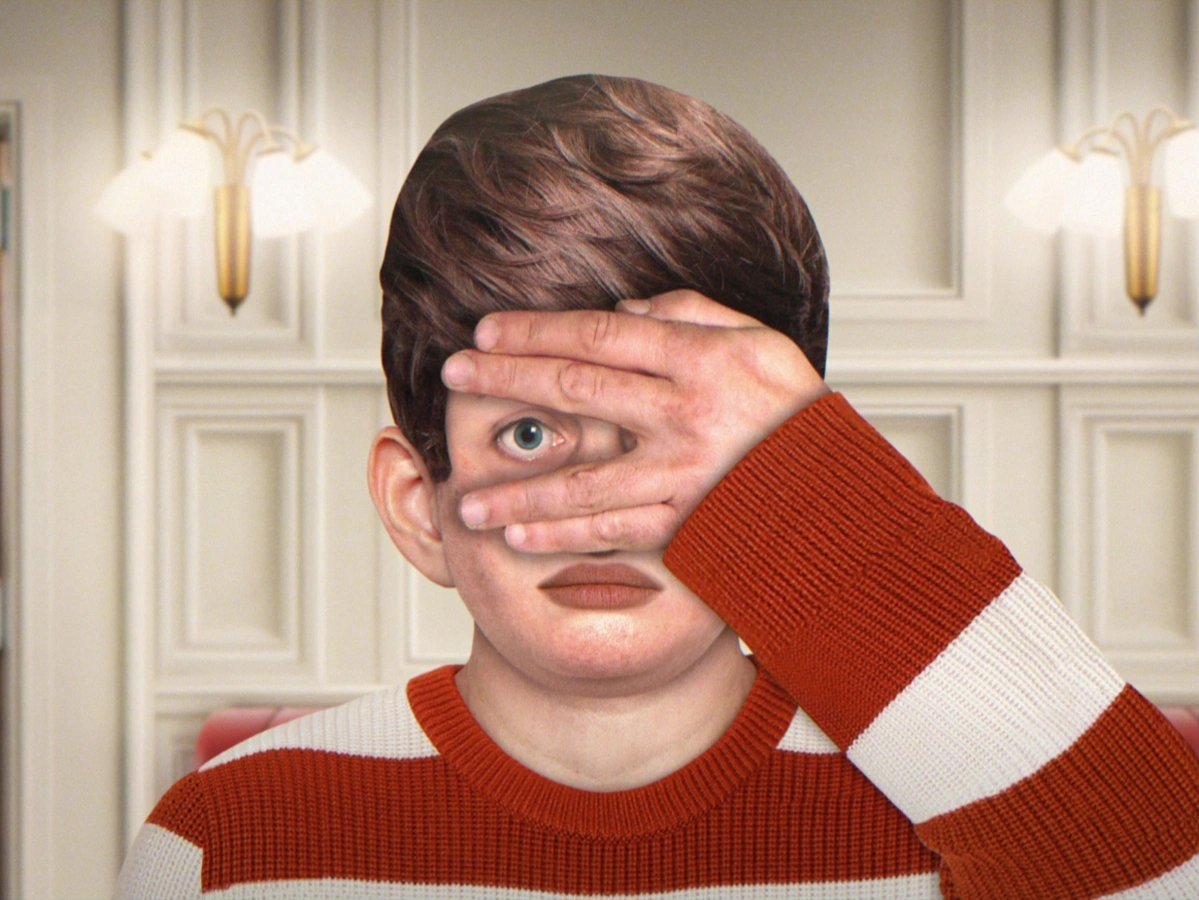
The film does not treat this as pure innocence. Blaise’s passivity is dangerous because it lets other people write him into their violence. Timéo’s deadpan delivery keeps the boy emotionally sealed, yet small pauses in his voice suggest panic gathering behind the glass. He is not empty. He is overcrowded by everything he cannot say.
The Music of Bad Manners
The animation keeps the characters close to stillness, so a blink can feel accusatory and a pause can feel terminal. Rooms have no need to become monstrous. A counselor’s office, a party, a workplace corridor, each one already contains enough threat because someone might ask a direct question. The photomontage style can be abrasive, and viewers who need animation to soften the world may find these faces difficult to sit with. That difficulty is part of the design. The film wants embarrassment to have a texture.
Its music gives the cruelty a strange buoyancy. Frothy jazz skips beneath scenes of social panic and political absurdity, refusing to mourn what the characters are doing to themselves. The contrast is funny, then faintly cold. Nobody here is walking into disaster with tragic grandeur. They shuffle toward it with bad posture, poor timing, and a smile they hope looks natural.
Planchon and Guigue are harsher toward hypocrisy than toward awkwardness. The film understands that ordinary cowardice can become institutional, familial, romantic, even revolutionary, if enough people agree to misread one another. Carole’s office disasters, Jacques’ therapeutic implosions, and Blaise’s accidental radicalization all come from the same source: the terror of plain speech.
No one in Blaise knows how to ask for love without disguising the request. That is why the film’s laughter feels so dry. It is the sound left after tenderness has missed its appointment again.
The French adult animated feature film Blaise premiered at the Cannes Film Festival on May 13, 2026, as part of the ACID sidebar selection. It follows an introverted, passive teenager named Blaise who is politely drawn into a chaotic, impromptu revolutionary crusade just to please a girl he likes, while his equally dysfunctional parents scramble to fix their own social standing. This satirical comedy will expand to a wider theatrical rollout through its distributor, and international viewing availability can be tracked via regional festival schedules and subsequent platform licensing.
Full Credits
Title: Blaise
Distributor: The Jokers Films, Best Friend Forever
Release date: May 13, 2026
Running time: 82 minutes
Director: Dimitri Planchon, Jean-Paul Guigue
Writers: Dimitri Planchon, Clémence Lebatteux
Producers and Executive Producers: Alexandre Gavras
Cast: Timéo Beasse, Léa Drucker, Jacques Gamblin, Nina Blanc-Francard
Editors: Jean-Paul Guigue
Composer: Alexis Pecharman, Denis Vautrin
The Review
Blaise
Blaise turns embarrassment into a private weather system: dry, cold, and somehow musical. Its photomontage faces may repel viewers who need animation to comfort the eye, but the discomfort is the point. Blaise’s silence, Carole’s mangled kindness, and Jacques’ hunger to be heard all become small failures of love, then larger failures of society. The film is cruel in its comedy, yet never empty. It laughs because these people cannot speak plainly, and because plain speech might destroy them faster.
PROS
- Distinct photomontage animation
- Piercing social cringe comedy
- Strong voice work from the family trio
- Sharp use of music against anxiety
- Absurd plotting with real emotional sting
CONS
- Visual style may alienate some viewers
- Blaise can feel too blank by design
- Some jokes lean on discomfort for too long
- Abrupt ending may frustrate