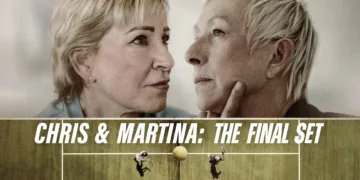



















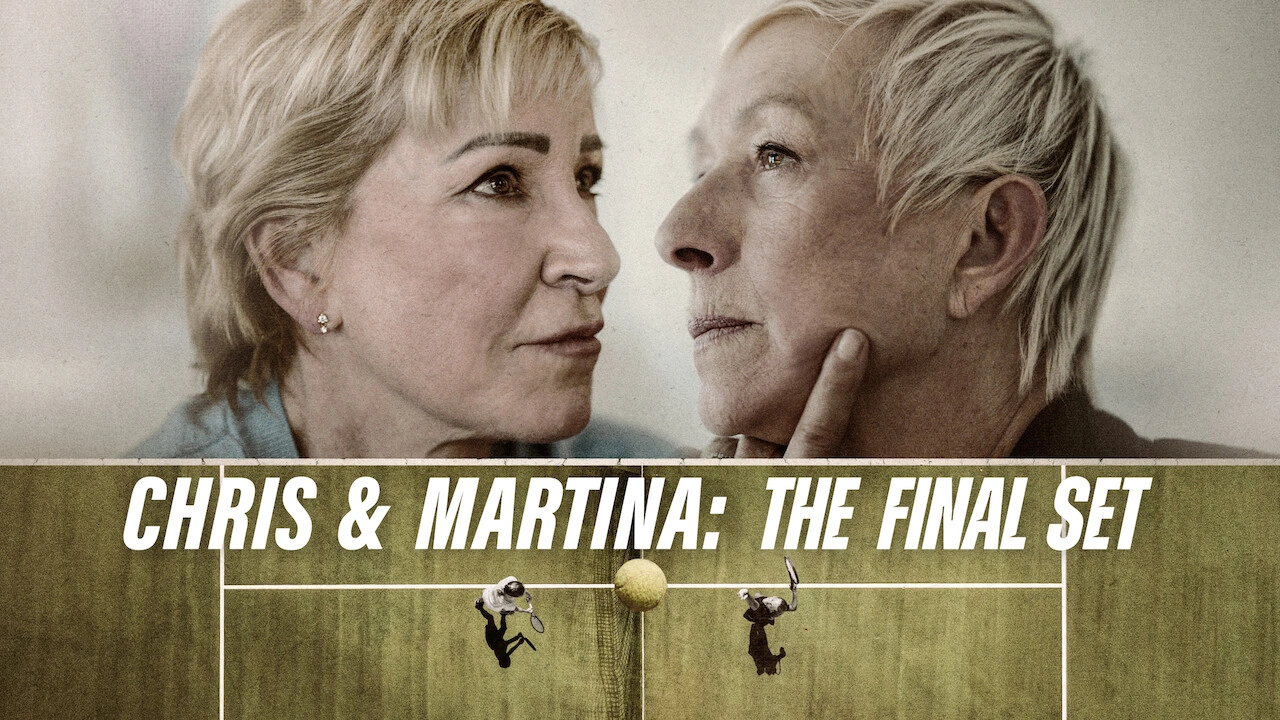

The couch scenes make old tennis footage behave like surveillance tape. Chris Evert and Martina Navratilova sit beside each other, watching younger versions of themselves stalk baselines, bend knees, read shoulders, and weaponize patience. Neither woman has to explain the score for the scene to work. Their faces do that. A smile tightens. A memory lands. A lost point still carries heat.
Rebecca Gitlitz’s Chris & Martina: The Final Set is built from familiar materials: archival matches, interviews, medical appointments, sports journalists, former players, and the careful chronology of a famous rivalry. The shape is conventional. The emotional geometry is not. Its subject is a friendship that had to pass through domination, exile, public myth, estrangement, age, and cancer before it could sit calmly on a sofa and laugh at its own brutality.
Two Images Built for Collision
The documentary’s sharpest historical argument comes from the way it places Evert and Navratilova inside public lighting they did not control. Evert is introduced through the old machinery of American sports adoration: the young prodigy, the clean image, the calm face, the girl praised with faintly patronizing softness while she was busy dismantling opponents. The archive gives us the “Little Chrissy” framing, and Gitlitz lets the phrase sour in the air. Cute is a useful word when a culture wants excellence to look harmless.
Evert’s own account is more severe. She describes the tunnel vision of wanting Number One, the way friendship became a liability if a friend could beat her. That detail matters because it keeps the film from turning her into a simple emblem of grace under pressure. Her composure was a weapon. Her loneliness was part of the cost of carrying it.
Navratilova enters under harsher light. She is the Czechoslovakian teenager who comes to America without family or coach, then defects in 1975 at 18, accepting the possibility that her mother and sister may vanish from her life for years. The film’s most piercing image from her early career is not a forehand or trophy lift. It is her memory of winning in Orlando and hugging a pole because no person was there for her. Sports documentaries love triumph. This one understands that triumph can leave a body standing alone in a bright room.
The media binary between them was crude and profitable: Evert as the American ideal, Navratilova as the foreign threat, later the lesbian athlete whose body and private life became public material. Gitlitz does not need to overstate the cruelty. The contrast between adoring coverage of one woman and suspicious fascination with the other supplies enough evidence.
The Match as Moral Pressure
Their rivalry works here because the film refuses to sand it down into inspirational softness. Evert and Navratilova liked each other early, played doubles, then separated when Evert realized Navratilova was learning too much from proximity. That choice is almost noir in its moral clarity: affection survives until strategy makes it dangerous.

The matches become psychological chambers. Each player knows the other’s strengths with forensic precision. Evert’s clay-court control, Navratilova’s grass-court attack, the adjustment of fitness, the shift in confidence, the cold calculation of where to send the next ball. Gitlitz and the editors cut the archival material so that the court stops feeling spacious. It contracts around two minds trying to predict each other.
The 1984 U.S. Open material gives the film one of its cleanest dramatic turns. Navratilova beats Evert, and the crowd’s silence lands like bad weather. No thunder. Just a deadened atmosphere around victory. Evert’s devastation is visible, but Navratilova’s win carries its own isolation. The shot pattern of sports memory usually bends toward celebration. Here, winning can look like being tried by a room.
That is where the documentary finds its strongest moral texture. Competition improved both women, yet it also trained them to measure selfhood through the other’s failure. The film sees the damage without scolding the hunger that produced the greatness. A lesser version would call this sportsmanship and move along. Gitlitz stays with the bruise.
Illness Changes the Frame
The present-day cancer thread gives The Final Set its second visual language. The court footage is public, bright, and combative. The medical scenes are smaller, quieter, fluorescent in a different way. Evert at a screening, Evert inside an MRI process, Evert having her head shaved during chemotherapy, Navratilova confronting breast and throat cancer after her earlier diagnosis: these scenes remove performance without removing discipline.
Gitlitz’s camera is respectful, sometimes too tidy, but the access has force. The women tell each other when the cancer has returned, and the old rivalry vocabulary becomes useless. There is no score to manage. No surface to favor. No crowd to seduce or disappoint. The opponent is cellular, invisible, indifferent to technique.
The supporting figures matter in small strokes. Andy Mill’s presence around Evert’s appointments gives her scenes a steadying human frame. Julia Lemigova’s appearances beside Navratilova do similar work without pulling focus from the central bond. The documentary is not especially adventurous in form, but it knows where to place the weight of a room.
Its limitation is one of proportion. Navratilova’s defection has the density of a separate film, with its fear of surveillance, family severance, and political risk. Here, it receives strong attention, then yields to the larger Evert-Navratilova arc. The cancer material faces a related problem. It is powerful whenever allowed to breathe, yet the career timeline keeps calling the film back to the archive.
Still, the best scenes solve that imbalance by placing past and present in direct contact. Two women watch their younger bodies fight for supremacy, their older bodies now marked by treatment and survival. The image is simple. The shadow it casts is not.
The sports documentary Chris & Martina: The Final Set premiered at the Tribeca Film Festival earlier in June and became available for streaming globally on Netflix on June 26, 2026. The film chronicles the legendary tennis rivalry and deep, lifelong friendship between icons Chris Evert and Martina Navratilova, highlighting their parallel battles with cancer.
Where to Watch Chris & Martina: The Final Set (2026) Online


Full Credits
Title: Chris & Martina: The Final Set
Distributor: Netflix
Release date: June 26, 2026
Rating: TV-MA
Running time: 1 hour 33 minutes
Director: Rebecca Gitlitz
Writers: Rebecca Gitlitz
Producers and Executive Producers: Jenna Ricker, Jonna McLaughlin, Jennifer Ollman, Ian Orefice, Amanda Spain, Jon Wertheim
Cast: Chris Evert, Martina Navratilova, John McEnroe, Pam Shriver, Zina Garrison
Director of Photography (Cinematographer): Marie Hinson
Editors: Chad Beck, Devin Concannon, Paul Frost, Bret Granato
Composer: Adam Peters
The Review
Chris & Martina: The Final Set
Chris & Martina: The Final Set uses a familiar documentary frame, yet its best scenes find moral drama in reflection: two rivals watching old footage, two survivors reading fear in each other’s faces. The cancer thread gives the film its late-life gravity, while the archival matches still carry the pressure of public myth, sexism, exile, and loneliness. Navratilova’s defection deserves sharper focus, but the film earns its tenderness.
PROS
- Rich couch-watch scenes
- Strong archival match material
- Moving present-day illness thread
- Sharp contrast between public images
- Intimate access to both athletes
CONS
- Conventional documentary structure
- Defection chapter feels compressed
- Cancer thread sometimes gets crowded
- Some talking-head material feels routine