




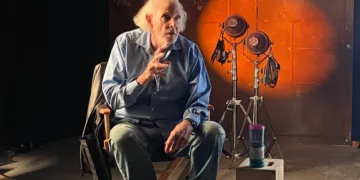
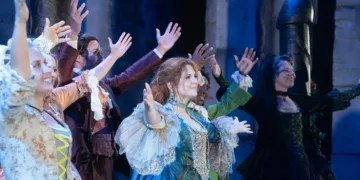
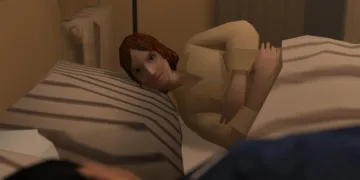








No! You’re Wrong, often presented with the subtitle or: Spooky Action at a Distance, is the latest feature directed by and starring Crispin Glover. Any honest account of the experience starts with the format. The film plays as one piece within a multi-hour theatrical evening that Glover tours. He frames the screening with live performance, reads from his published books, and closes the night with an extended, unmoderated question and answer session.
This release signals a shift in the director’s narrative emphasis. Earlier projects leaned into aggressively provocative material, while this work adopts a more stylized and tender register. The piece functions as an era-spanning noir thriller written for Glover and his father, Bruce Glover. A second track runs alongside it: a meta-docudrama that comments on the noir’s creation. Beauty and methodical oddness shape the first impression, and the storytelling announces a new direction for the artist.
Constructing an Anti-Narrative
The structural design of No! You’re Wrong sets a deliberate challenge for the viewer. Two distinct works appear as one: a period noir and a contemporary account of how that noir came to be. The noir unfolds across multiple eras beginning in the late 1800s.

The companion piece, Spooky Action at a Distance, slices into the action with observations about process. Editing choices collapse time and reality, and the resulting rhythm steers the audience into a dream state where scenes echo rather than resolve.
Form reinforces this deliberate disorientation. The film is shot largely in black and white, with nods to early photographic techniques and a plainly deliberate, almost first-year art student aesthetic. Craft details arrive with meticulous care, even when they read as idiosyncratic.
Handmade miniature sets, unnerving silicone mask figures, and Glover’s specific methods for developing segments all sit on the surface. The fractured chronology and tactile imagery place the movie in ongoing conversation with surrealist traditions in cinema, with a clear line of influence from David Lynch. The storytelling pursues layered suggestion and sustained unease rather than tidy clarity.
The Performance of Self and Story
A central engine in the narrative architecture is the relationship between Crispin Glover and his father, veteran actor Bruce Glover. They cycle through multiple roles within the period strand, shifting identities across years. The performance mode favors caricature over naturalism.
Outrageous accents and an intentionally hammed-up delivery define many scenes, and this approach produces striking comic and grotesque textures. Exchanges between the two, including sequences set in a jail, provide several of the film’s sharpest acting moments.
Friction between an actor and “the filmmaker” operates as a primary thematic device. Scenes often split open as characters debate lines or motivation, with someone calling “cut” mid-beat. That pattern of interruption turns the film set into part of the fiction.
Reality and staged fantasy mingle, and the arguments over method become a running commentary on authorship. The father–son presence gives the experiment a human axis across both planes, and their shared screen time supplies feeling even as the structure stays abstract. Actress Kansas Bowling appears briefly and adds another face to the rotating cast of figures orbiting the project.
The Event as Artistic Statement
Access to the film remains strictly limited to Glover’s touring presentation. That choice protects a shared room experience and reframes a screening as a total artwork. The evening opens with a substantial performance in which Glover reads from his self-published books, including RAT CATCHING, often paired with a Magic Lantern slideshow. The hour serves a narrative function. It tunes the audience to the director’s cadence and ideas before the projector rolls, and it teaches the rules the film will play by.
After the credits, the room shifts into an unmoderated, long-form Q&A. Glover gives the audience time, often for an hour or more. Responses can stretch and wander, yet they keep attention because they extend the night’s guiding concerns: process, intention, and the strange mechanics of making art in front of people.
The combined program shapes a singular theatrical experience. The live reading sets the terms, the film performs those terms on screen, and the conversation folds the audience into the method. The evening raises the perceived value of the project through context and presence, and the package encourages a view of Glover as a cinematic auteur whose process is the point of entry.
No! You’re Wrong. or: Spooky Action at a Distance is a 2025 American film written, edited, produced, and directed by Crispin Glover. It premiered at the Museum of Modern Art on October 2, 2025. The film’s theatrical distribution is highly unconventional; like his two previous directorial works, Glover only screens the movie as part of a touring event that includes a live performance, a question-and-answer session, and a meet-and-greet/book signing. The film is therefore not available on standard streaming services or through conventional home video release.
Credits
Title: No! You’re Wrong. or: Spooky Action at a Distance
Distributor: Volcanic Eruptions
Release date: October 2, 2025 (Museum of Modern Art)
Rating: Not Rated
Running time: 85 minutes
Director: Crispin Hellion Glover
Writers: Crispin Hellion Glover, Bruce Glover, Mike Pallagi
Producers and Executive Producers: Crispin Hellion Glover
Cast: Bruce Glover, Crispin Hellion Glover, Mika Mae Jones, Kansas Bowling, David Brotherton, David Lynch
Director of Photography (Cinematographer): Kai Miedendorp
Editors: Crispin Hellion Glover
Composer: Charlotte Kemp Muhl
The Review
No! You're Wrong
The full theatrical presentation of No! You're Wrong offers an experience far richer than the film alone. The movie challenges viewers with its intentionally disorienting structure, which fuses a period noir with a meta-documentary on its own making. The visuals are striking, utilizing handmade sets and a compelling black and white style. The dual performance by Crispin and Bruce Glover is the centerpiece, lending a touching, theatrical energy to the abstract narrative. This unconventional, four-hour artistic event is essential viewing for anyone interested in experimental cinema and performance art.
PROS
- The film’s fusion of narrative and meta-commentary breaks conventional storytelling molds.
- The dynamic between Crispin Glover and Bruce Glover provides an emotionally resonant core.
- Thoughtful visual style, including hand-developed film segments and detailed miniature sets.
- The accompanying book reading and unmoderated Q&A create a rare, singular artistic exchange.
CONS
- The intentionally fragmented narrative may feel abstract or slow to viewers expecting conventional entertainment.
- The film is only available through a touring event, preventing repeat viewings or wider access.
- The strong surrealist and "Lynchian" influence may alienate audiences who prefer realism.