









![Kingdom Hearts Collection [I-III] Review](https://gazettely.com/wp-content/uploads/2026/10/Kingdom-Hearts-Collection-I-III-1-360x180.webp "Kingdom Hearts Collection [I-III] Review: KHII Holds Steady as Newer Entries Fluctuate 33")









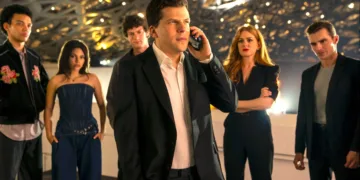
Nearly a decade after their last collective performance, the Four Horsemen step back into the spotlight. The third entry, Now You See Me: Now You Don’t, frames itself as a legacy sequel that stitches a long gap in the series timeline. J. Daniel Atlas (Jesse Eisenberg), Merritt McKinney (Woody Harrelson), Jack Wilder (Dave Franco), and Henley Reeves (Isla Fisher) return as showmen-thieves who weaponize grand illusion with a Robin Hood ethic, stealing and exposing in the same practiced motion.
A younger wing enters the troupe: Charlie (Justice Smith), Bosco (Dominic Sessa), and June (Ariana Greenblatt). Their objective fixes on the Heart Diamond, a storied gem in the possession of Veronika Vanderberg (Rosamund Pike), an ultra-wealthy antagonist. The mission reads as a clean equation: secure the diamond and throw light on Vanderberg’s international operations in money laundering and arms trafficking. The series still champions the same thesis, a crusade against secrecy that uses misdirection as both method and message.
The Aesthetics of Absurdity
Ruben Fleischer takes the helm and keeps the tempo in the red, with a cheeky, almost gleeful sense of frivolity. The residual polish of the first film’s “Ocean’s Eleven” vibe falls away. This chapter commits to pop spectacle. Think adventure caper, a National Treasure energy translated into sleight-of-hand.
Fleischer’s touch favors character business, quick gags, and buoyant momentum over any kind of gritty verisimilitude. The illusions become a philosophical stress test. The premise insists on staged tricks, yet the set pieces lean on lavish budgets, improbable tech, and conspicuous digital augmentation. That reliance stretches the old pact between storyteller and spectator, the contract of belief, to its thinnest point.
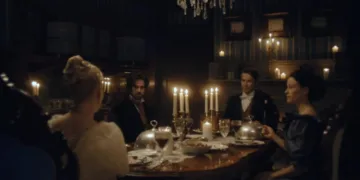
A notable outlier arrives with the French chateau sequence. The custom-built maze of spaces, with an upside-down room, warped mirrors, and perspectives that nod to M. C. Escher, restores the pleasures of tactile ingenuity. For a stretch, craft outmuscles computation. Elsewhere, the script prizes effect, layering spectacle and scenario-first contrivances while sidestepping internal logic. Cause follows after the fireworks. That choice defines the film’s own stance on its premise.
The Performance of Persona
Rosamund Pike’s Veronika Vanderberg commands attention. The part draws on the image of a swaggering billionaire magnate, a shorthand many viewers will recognize. Pike leans into an amplified South African accent and a gleefully big interpretation. The pitch approaches camp and finds a precise frequency there.

The original Horsemen reconvene in the expected formation. Eisenberg’s imperious Atlas and Harrelson’s airy Merritt still spark, although the collective presence sometimes softens. Certain familiar faces read like variations on their established riffs.
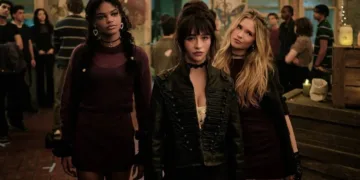
The fresh recruits supply momentum. Justice Smith, Dominic Sessa, and Ariana Greenblatt click as a unit and bring different tools, from tech fluency to nimble, parkour-adjacent movement. Their clash and cooperation with the veterans forms a recurring bit and a practical engine for tension. Youth wants a turn. Age guards the brand. The film enjoys the friction.
Continuity receives care. Morgan Freeman’s Thaddeus Bradley returns and brings a grounding note. The absences of Mark Ruffalo’s Dylan Rhodes and Lizzy Caplan’s Lula receive tidy explanation, a nod to viewers invested in the series’ evolving lore.
Theme, Irony, and the Screenplay’s Con Game
The plot arrives densely packed, credited to a team of writers (Grahame-Smith, Lesslie, Reese, Wernick). The central aim, the theft of the Heart Diamond, keeps slipping behind detours and set-piece scaffolding. An opening Brooklyn play on crypto culture lands with wit, while a later F1 sprint in Abu Dhabi feels ornamental.

The franchise continues to harness anti-capitalist posture. The Horsemen operate as folk champions who practice a kind of stage-managed class agitation, turning humiliation into a civic instrument. The pitch is simple: make power look ridiculous and the crowd might feel newly equipped.
The framing carries a twist of irony. A large studio product, complete with very visible brand placements, packages a fantasy of revolt while selling beverages and airfare. The film talks about pushing the system and also monetizes the conversation. That friction is the text, not a footnote.
The mythology scales up. The Eye receives a historical tether, hinting at wartime activity by magicians aligned against Nazis during World War II. This revisionist flourish shifts the series from heist logic toward a pocket of magical-realism history. The imagery stays glossy and inviting. Brian Tyler’s score punches the rhythm hard, a brassy surge that sometimes overwhelms quieter beats.
The final movement lands with a signature flourish, a chaotic reveal that courts two valid reactions: gasps or giggles. Both responses make sense. That is the coin trick this series keeps flipping.
The third installment of the magician-heist franchise, Now You See Me: Now You Don’t, is set to premiere on November 14, 2025. Distributed by Lionsgate Films, the movie brings back the original Four Horsemen along with a new generation of illusionists for another round of high-stakes spectacles and elaborate thefts. It is expected to be released exclusively in cinemas initially.
Credits
Title: Now You See Me: Now You Don’t
Distributor: Lionsgate Films
Release date: November 14, 2025
Rating: PG-13
Running time: 112 minutes
Director: Ruben Fleischer
Writers: Michael Lesslie, Paul Wernick, Rhett Reese, Seth Grahame-Smith (Screenplay), Eric Warren Singer, Michael Lesslie (Story)
Producers and Executive Producers: Bobby Cohen, Alex Kurtzman, Kelli Konop
Cast: Jesse Eisenberg, Woody Harrelson, Dave Franco, Isla Fisher, Justice Smith, Dominic Sessa, Ariana Greenblatt, Rosamund Pike, Morgan Freeman
Director of Photography (Cinematographer): George Richmond
Editors: Stacey Schroeder
Composer: Brian Tyler
The Review
Now You See Me: Now You Don't
Now You See Me: Now You Don't is a spectacular exercise in cinematic sleight-of-hand that trades plausibility for relentless energy. Director Ruben Fleischer knows exactly the kind of unapologetic, absurd fun the audience expects, delivering bombastic heists that redefine "suspension of disbelief." The film's self-aware corniness, anchored by Rosamund Pike’s deliciously manic villainy, successfully carries the spectacle. While the political messaging is predictably hollow—an anti-capitalist critique financed by corporate synergy—the chemistry of the expanded ensemble provides sufficient diversion. It is a messy, entertaining paradox that succeeds precisely because it embraces its own incoherence.
PROS
- High energy and zany, self-aware tone.
- Rosamund Pike's over-the-top, villainous performance.
- The delightful chemistry of the new, younger ensemble.
- Inventive, physical trickery set pieces (the magician's mansion).
- Strong adherence to franchise continuity and lore.
CONS
- Extreme reliance on implausible CGI and technology.
- Convoluted, overly complicated plot structure.
- Ironic thematic messaging (anti-capitalism within corporate cinema).
- Some returning cast members feel muted or less engaged.
- The score occasionally overwhelms key dramatic moments.