































Goodnight Universe opens with a precise hook: you play as Isaac, a newborn with adult-level cognition and a latent set of psychic abilities. The entire story unfolds from crib height, turning a small domestic space into a stage loaded with pressure. The game builds around family ties, time’s steady movement, and the daily work of keeping a household intact.
The starting point is a loss. Isaac’s grandfather has died, and the family absorbs that shock while trying to reassemble routines. From that moment, each member pushes forward in a distinct pattern: a mother wary of repeating earlier missteps, a father focused on income and stability, and a teenage sister weighing a decision that could set her path.
Isaac’s telepathy and telekinesis give the player a way to observe those arcs, nudge certain beats, and examine how a home shifts under stress. The design frames intimacy through helplessness. The mind inside the infant sees everything, and the body defines how that vision reaches the world.
Narrative Telekinesis
The central dramatic engine comes from Isaac’s power matched with constraint. He understands the father’s money worries, the mother’s grief, and the sister’s uncertainty. He can move objects and sense thoughts. His body, however, operates on infant terms with limited motion and crying as baseline tools. That limitation sets the tone for tension.
The player often grasps the depth of a situation while lacking clean ways to comfort or resolve it. Writing and performance hold this line with consistency. Voice acting lands messy affection, frayed patience, and persistent hope without slipping into caricature. A recurring structure places the mother beside the crib, speaking to Isaac as if to a counselor. Another scene turns the father’s bedtime reading into a channel for private panic, visible through readable thoughts. The mind reading system anchors the narrative. It shows the surface of an interaction and the storm behind it.
The sister can present a bright face to a recruiter while her inner monologue roars like a punk set, and that split exposes how a person performs composure while carrying anxiety. Domestic moments supply most beats, yet the plot widens with the arrival of the Aio Corporation, tied to the grandfather’s history. The shift raises the stakes without breaking the thematic thread. The ending lands with warmth and ache, and it reframes earlier scenes through a tighter lens on time and choice. The design keeps returning to what a day means, how decisions echo, and who absorbs those echoes inside a family.
Interfacing with Infancy
Goodnight Universe commits to a streamlined point-and-click structure. You scan rooms and characters to push scenes forward, often by finishing small lists or spotting the next prompt in the space. Psychic interaction serves as the main verb set. With telekinesis you slide objects, tidy spaces, and later handle security hurdles while docked in a robotic crib.
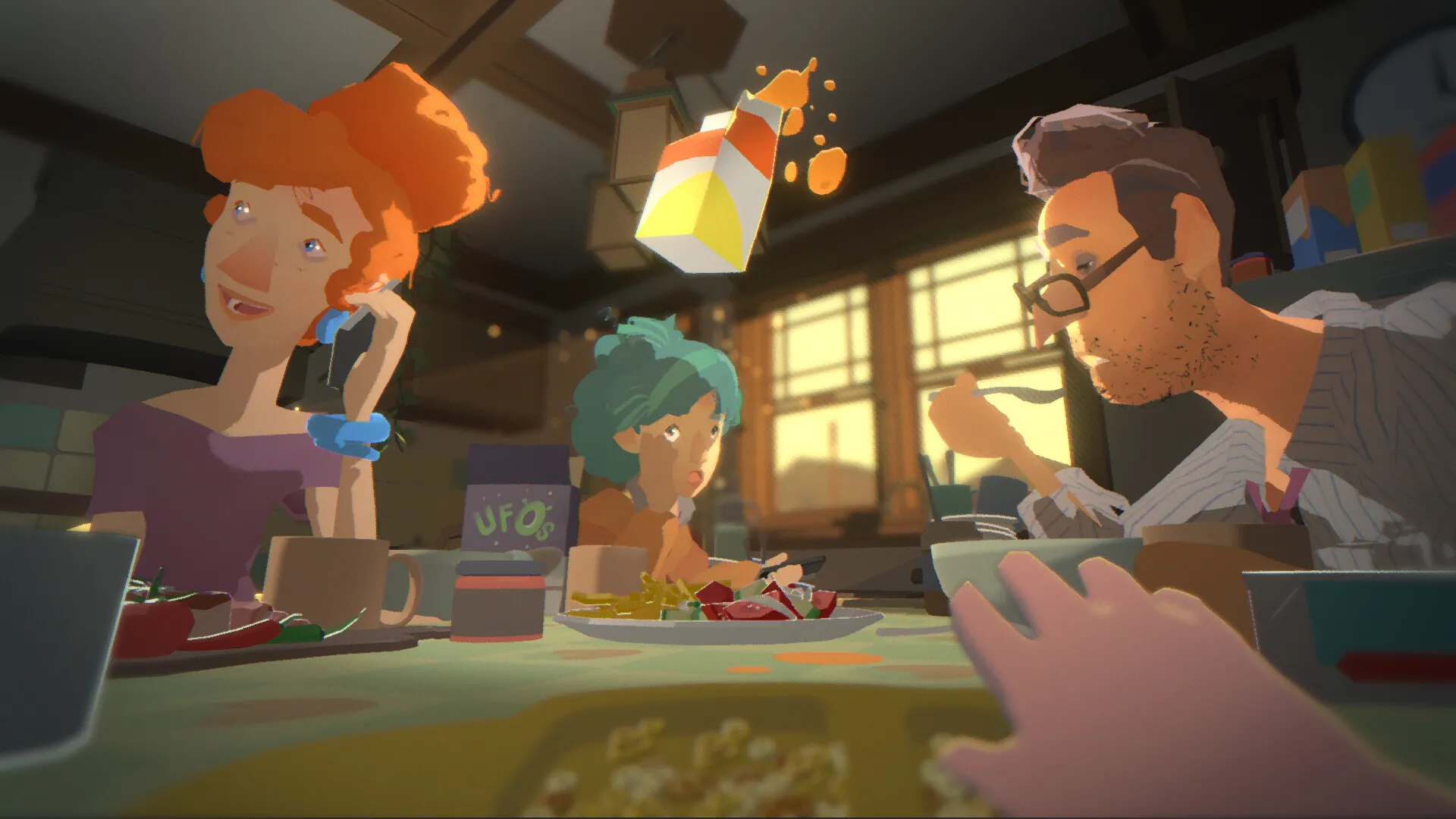
Two control modes guide that power. On PC, camera tracking sits as the intended input. Blink to trigger effects or advance time. Shape a small hand movement to aim or confirm. This option maps Isaac’s limited physical language onto the player’s body and builds a tighter loop between thought and action. Traditional controls use a cursor on the right stick to point at floating words for actions and dialogue, then a flick to fire a psychic move. That layout is clear and usable. It removes the direct physical mirror of the camera approach and trades it for steady reliability.
Feedback stays straightforward, which keeps attention on performance and story beats rather than complex mechanics. Later set pieces ask for sharp timing with these simple motions. The demand can spike, and the precision required in those moments can feel like a shift toward game-first friction. That shift can momentarily pull the player out of the otherwise seamless dramatic flow.
Player choice exists inside a largely guided plot. Branching appears as tonal twigs rather than full forks. You choose how Isaac frames himself, such as labeling his presence as a kind of deity or a device of pain. These choices shape mood and self-awareness inside scenes. They do not create large structural splits. The system clarifies authorship: the game steers the arc while the player manages texture, emphasis, and the emotional lens.
Auditory Architecture and Visual Language
The visual presentation favors clarity and expression. Big proportions fit the premise of a telekinetic baby and leave room for faces and motion that sell quiet moments. The family’s micro-reactions carry scenes, and the animation keeps them readable. The audio design functions as a second script. Music and mix lift comic beats and heavy pauses with precision.
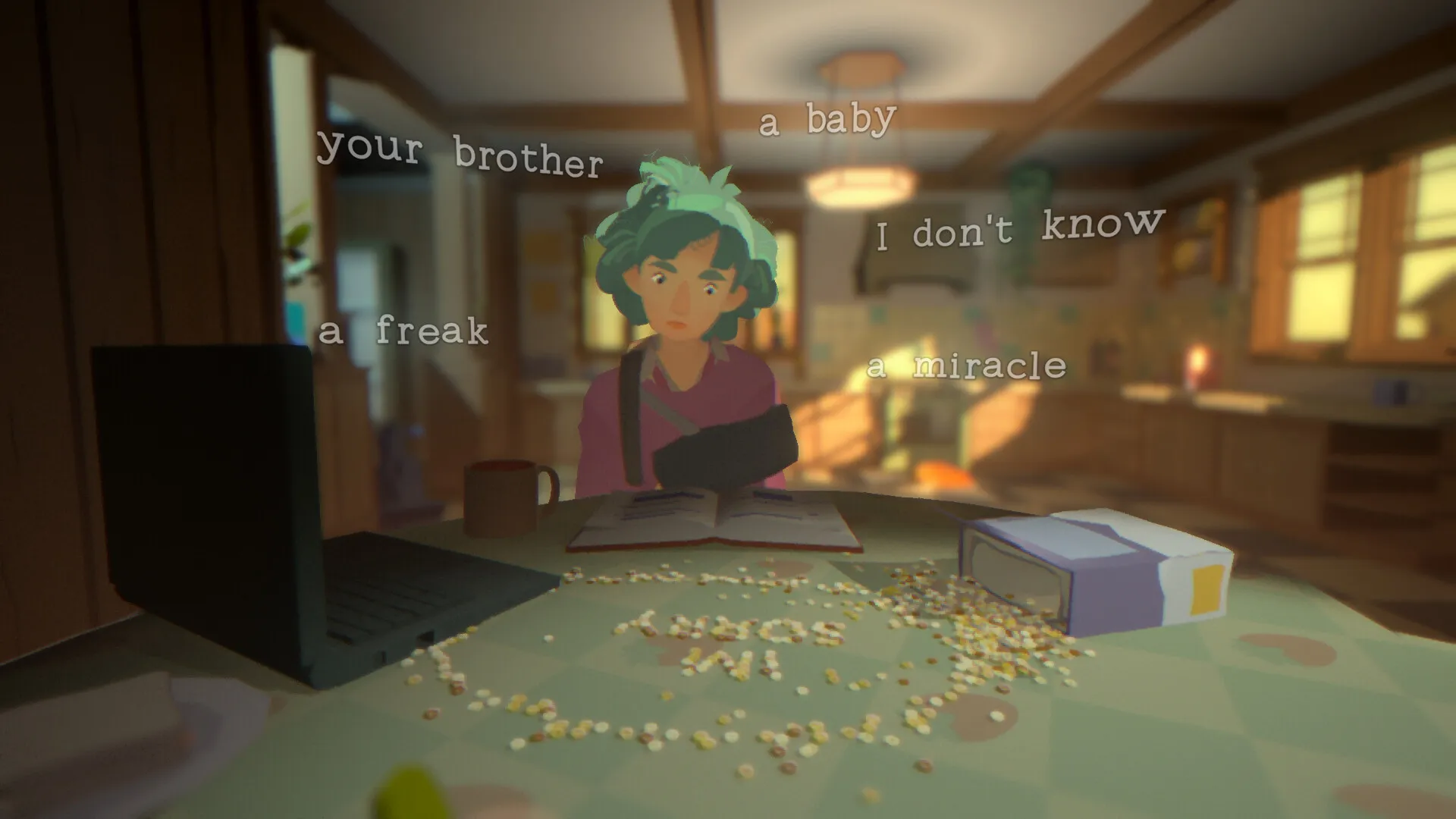
Original cues thread through soft playfulness and sharp pressure, and the placement of those cues supports character beats rather than competing with them. Voice work remains strong across roles. The mix matters as much as delivery. Internal monologues arrive from distinct positions in the sound field, which turns private thought into spatialized presence and deepens the sense of overhearing something you should not catch.
That spatial trick reinforces the mind reading mechanic and strengthens the feeling of intimacy. The game recommends headphones, and that guidance aligns with the design. The full soundstage depends on close listening for both emotional cues and informational clarity. Playing that way reveals how the score and the mix carry narrative weight, keep pacing tight, and signal where attention should go next.
Goodnight Universe ties its systems to its story through limits, not excess. An adult mind inside a baby’s frame sets the rule set, and every tool grows from that rule. Telekinesis expands reach, mind reading exposes motive, and the interface keeps the action grounded in small physical gestures. The plot widens with corporate intrigue through Aio’s link to the family past, yet the focus stays on conversations at bedtime, sudden silences in hallways, and choices that feel tiny until they land.
The design treats choice as a change in tone and self-definition rather than a map of diverging roads. It asks the player to pay attention to how people speak around pain, how they act when money runs short, and how a teenager tests a future while the house recalibrates after a funeral. The result feels like a study of care under pressure, built from mechanics that make attention an action and empathy a form of play.
The Review
Goodnight Universe
This is a captivating narrative experience that masterfully uses its unique infant perspective and psychic mechanics to explore complex family dynamics and the passage of time. The emotional depth and authentic character writing are outstanding, making up for the few moments where the simple, gesture-based controls feel slightly clumsy during action sequences. It is a necessary play for fans of powerful, character-driven independent games.
PROS
- Profound, emotional storytelling.
- Authentic, well-written characters.
- Immersive camera-tracking controls (PC).
- Exceptional voice acting and sound design.
CONS
- Occasional finicky controls in action scenes.
- Largely linear story structure.