
























![Kingdom Hearts Collection [I-III] Review](https://gazettely.com/wp-content/uploads/2026/10/Kingdom-Hearts-Collection-I-III-1-360x180.webp "Kingdom Hearts Collection [I-III] Review: KHII Holds Steady as Newer Entries Fluctuate 37")




Lotfy Nathan’s The Carpenter’s Son peers into the buried story of a figure whose canon demands perfect, selfless goodness. The film builds its unsettling premise on the apocryphal Infancy Gospel of Thomas, a neglected text that imagines Jesus as a teenager. The setting carries us to Roman-era Egypt in AD 15, a place of dust and persecution where a family of three moves in constant flight.
The young man, named only The Boy, lives beside The Carpenter, his adoptive father, and The Mother. The work reads less like strict history and more like a meditation on the birth of moral will, fusing the austerity of a religious epic with the dread of supernatural horror. The Boy awakens to a volatile, emergent power while The Stranger exerts a subtle, corrosive pull. The Stranger does not call to appetite. The challenge touches the meaning of existence itself, and the film lingers on that tremor.
The Razor’s Edge of Becoming
The film grounds its force in a refusal of predetermined destiny and frames The Boy as a figure of moral ambiguity. His developing power arrives like a rare puberty, an involuntary surge that grants and removes life without a steady compass. The absence of self-knowledge plays out in stark trials that feel almost clinical: a grasshopper crushed in his hand returns to life moments later; a shove knocks him into a leper, and healing erupts where contact lands, neither sought nor welcomed.
The figure diverges from the Christ of scripture and reads as a volatile youth confronting the existential terror of absolute ability. Anxiety deepens as a hidden truth about parentage shadows him, and the need for a father swells into a raw inquiry about origin. The search for a source becomes a search for a self, which lends the myth an intimate psychological pulse.
The Stranger’s draw is conceptual rather than carnal. She proposes “dangerous games” that probe the limits of emerging divinity. Tension sharpens when her aims change. The teasing challenger turns advocate for open, public healing.
The move carries a sheen of goodness while luring The Boy toward exposure. The fragile disguise thins. The world of suffering presses in. Serpent signs coil through the frames, and scenes of sickness and torture gather weight. The film dwells on that burden and makes the adolescent messiah feel the charge of every gaze.
The Confluence of Contradiction
The revisionist thrust depends on committed performances, even as some casting choices threaten the spell. Noah Jupe locates the metaphysical struggle with raw, vulnerable focus. The work mesmerizes in its quiet stretches. He locates the human in the sacred and plays uncertainty and teenage unrest as a crucible for later goodness.

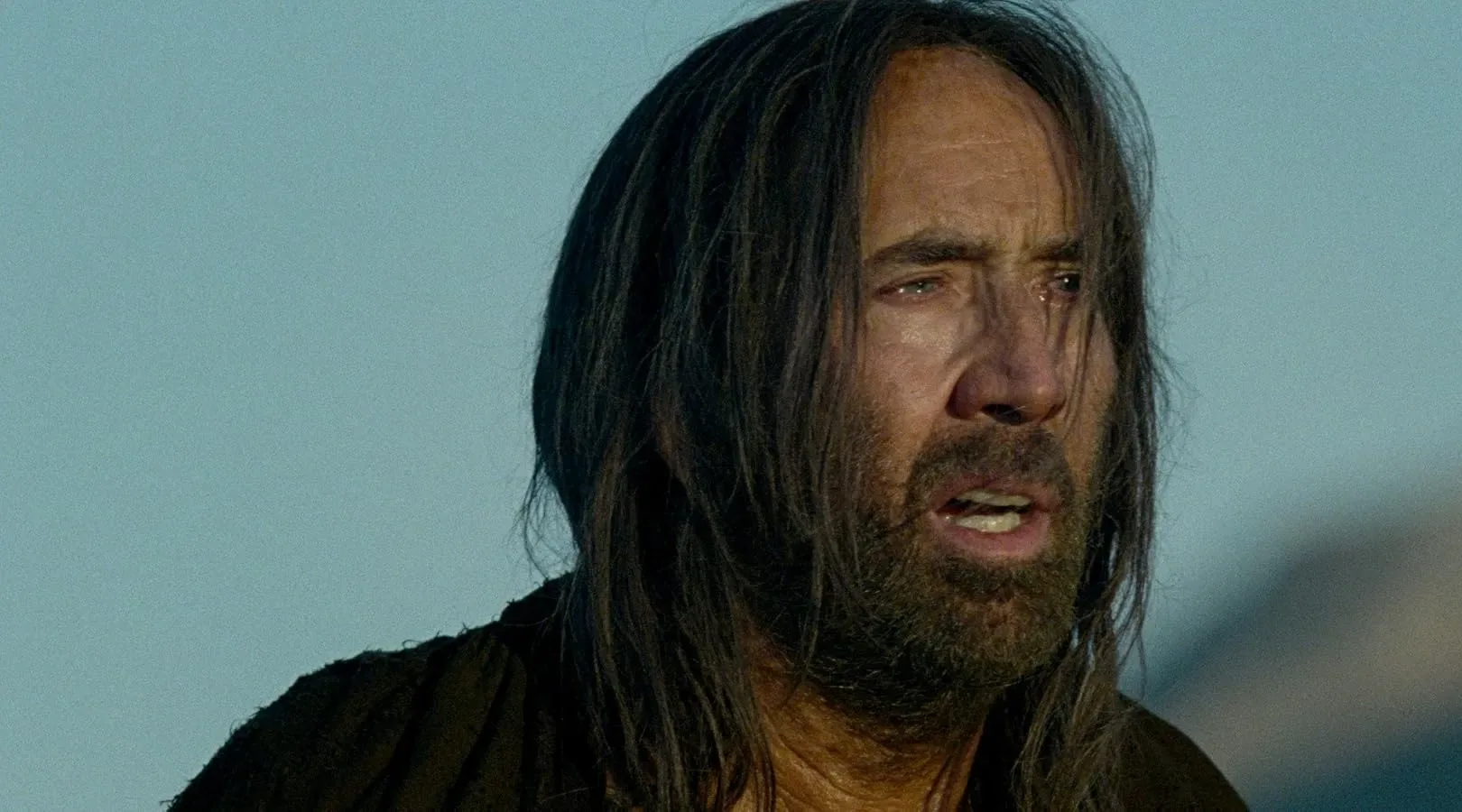
Nicolas Cage, as The Carpenter, gives the story its human anchor. The intensity that marks his screen presence turns inward. The portrayal centers on spiritual agony. He appears haunted by apocalyptic visions and absolute panic, and faith falters like a “broken crutch” under the duty of guarding a miraculous son. The conflict reads on his face and in his labor.
He secretly accepts work building pagan idols, a direct betrayal of faith taken to keep his family alive. Isla Johnston, as The Stranger, carries a different kind of magnetism. The gaze unsettles. Conviction sharpens the line readings, and the character grows into an emotional focal point. The questions she speaks reach beyond simple good and evil and press on the binaries that shaped her role.
FKA twigs as The Mother stands out as the most puzzling element. The role does not command the center, and the calm that settles on her face often sits apart from the surrounding fear. The image draws attention. At times she flares into fierce strength, and those flashes land. Still, the presence of Cage and twigs, both tethered to contemporary cinema, can strain the film’s sense of period. Era specificity flickers. Moments of unintended camp slip through and briefly puncture the solemn mood.
Shadow and Visceral Dread
Lotfy Nathan and cinematographer Simon Beaufils sculpt tone through an exacting visual split. The surface suggests a straightforward historical drama with the sober weight of mid-century epics. Ethereal incidents and stylistic ruptures slide under that surface and seed dread.

Beaufils’s camera favors tactile compositions, a naturalistic palette, and soft focus that fold a quiet, introspective aura around The Boy. Intimacy gives way at intervals to expressionistic fury. Light turns blood-red, pressure builds, and the approach to the climax grows oppressive. The horror grammar avoids loud punctuation. Jump scares rarely carry the load. The environment holds the fear at a steady hum. Serpent signs recur with corroding insistence and leach unease into scene after scene.
The film delivers “jolting delights” of body horror, including vicious snakes erupting from the mouths of the afflicted. A soundscape of harsh whispers keeps the nerves raw. The first two acts move with a measured, allegorical gait. The last act breaks open with crackling, infernal scope and serves an emotional release for the dread stored up along the way.
The Cost of the Humanizing Act
The Carpenter’s Son stands as challenging genre work. Its signal achievement lies in the sincere attempt to humanize a deity and to reckon with the price of moral triumph. The film stages an interior war between benevolence and malice and lets the murk hold. Familiar sacred narrative gains a new angle through that attention.

Dependence on the Infancy Gospel of Thomas shapes both strength and fragility. The allegory, intricate on the page, does not always cross over with clarity. Viewers unfamiliar with the obscure source material may find the experience demanding and may feel called to an act of intellectual faith. A deeper concern sits in the film’s framing of The Stranger’s androgyny as a sign of evil.
Ambiguous features and costuming read as demonic markers, and that image turns backward in a story otherwise committed to questioning religious norms. Even with that problem and the peculiar notes in casting, the work holds to its conviction. The film gives a dark, fresh angle on a myth rarely treated with such candid psychological scrutiny, and it lingers like a question that refuses to resolve.
The Carpenter’s Son is a psychological horror film inspired by the apocryphal Infancy Gospel of Thomas. It is scheduled for release in the United States on November 14, 2025, distributed by Magnolia Pictures. The story focuses on the Holy Family living in Roman-era Egypt, where their teenage son begins to manifest mysterious, potentially dangerous powers. The film is rated R due to strong/bloody violent content and brief nudity. You can check local cinema listings for showtimes around the US release date and for any announcements regarding streaming availability following its theatrical run.
Credits
Title: The Carpenter’s Son
Distributor: Magnolia Pictures (United States), Le Pacte (France)
Release date: October 30, 2025 (Argentina), November 14, 2025 (United States)
Rating: R
Running time: 94 minutes (or 1 hr 34 mins)
Director: Lotfy Nathan
Writers: Lotfy Nathan
Producers and Executive Producers: Julie Viez, Alex Hughes, Riccardo Maddalosso, Nicolas Cage, Eugene Kotlyarenko, Yiannis Iakovidis, Scott Aharoni, Alexandra Boussiou, Alain de la Mata, Noémie Devide, Sinan Eczacibasi, Harry Finkel, Christopher Granier-Deferre, Nick Shumaker, Jennifer Venditti, Theo Vieljeux
Cast: Nicolas Cage, Noah Jupe, FKA Twigs, Isla Johnston, Souheila Yacoub, Kaiti Manolidaki, Orestis Paliadelis, Elena Topalidou, Manolis Mavromatakis
Director of Photography (Cinematographer): Simon Beaufils
Editors: Sophie Corra, Monika Willi, Guillaume Fusil
Composer: Lorenz Dangel
The Review
The Carpenter's Son
The Carpenter's Son daringly transforms the myth of Christ's youth into an intense psychological horror, utilizing an obscure source to explore the raw, terrifying birth of moral will. The film’s strength lies in its committed central performances and stunning, atmospheric visuals that layer dread upon religious gravitas. While challenging in pace and hampered by jarring casting and a troubling symbolic framework for its antagonist, it remains a fascinating, fiercely original contemplation on the burden of a divided self.
PROS
- Highly original, psychologically rich approach to an established myth.
- Noah Jupe and Isla Johnston are mesmerizing and fully committed.
- Gorgeous, solemn cinematography (Simon Beaufils).
- Successfully integrates religious epic tones with supernatural/body horror.
- Offers a genuine, humanizing look at divine potential and volatility.
CONS
- First two acts can be slow and heavily allegorical.
- FKA twigs is underused and sometimes appears emotionally distant.
- Heavy reliance on obscure source material makes the film less accessible.
- Odd casting (Cage and twigs) disrupts the historical setting.
- Antagonist's portrayal uses ambiguous gender symbolism to signify evil, which feels backward and inconsistent with the film's progressive subversion of other religious norms.







