

























![Kingdom Hearts Collection [I-III] Review](https://gazettely.com/wp-content/uploads/2026/10/Kingdom-Hearts-Collection-I-III-1-360x180.webp "Kingdom Hearts Collection [I-III] Review: KHII Holds Steady as Newer Entries Fluctuate 37")





“You are the angriest man ever to audition,” the network head tells him, a cold measure of temperament that locks the tone in place. Ben Richards, played by Glen Powell, arrives as a blacklisted factory worker whose rage springs from scarcity. He needs money for his daughter’s medicine, and that need funnels him into a televised hunt engineered by a corporate America.
Edgar Wright adapts Stephen King’s 1982 novel The Running Man as a 2025 dystopia where violent reality television functions as the central instrument of control. The show throws Richards against professional Hunters, and survival for thirty days promises a billion dollars. This version stays far nearer to the novel’s punishing premise than the glossy 1987 film and updates the critique of media power.
The Kinetic Canvas
Wright treats bleak material with throttle-wide momentum. The hallmarks remain, from quick camera moves to razor edits to dialogue that sparks during frantic passages. The film aligns science fiction thriller with racing action and sharp satire.
Its look plants modern, towering cityscapes beside analog fixtures like CRT sets and VHS. The retrofuturist palette breeds analog paranoia, a picture of a surveillance order that mistrusts the internet while leaning on old, numbing screens that never switch off.
A tension runs through the tone. Wright excels at entertainment, and the film favors a lively, almost carefree rhythm over the novel’s relentless darkness. Slick set pieces and situational humor shave the edge the material can carry.
The spectacle roars, and the social reading often trails the chase. When the final stretch reaches for King’s heavier political notes, the shift lands with a jolt. The long stretch of bright, playful action lowers the emotional charge required at the close, and the impact fades where it should tighten.
The Spectacle of Control
The Network rules through the “Free-Vee” platform, flooding the country with diversion that screens corporate power, broken care, and stubborn poverty. Media saturates every corner. The film aims straight at reality TV culture through The Running Man and through add-on programs such as the Kardashian-adjacent The Americanos. These shows doctor contestants’ stories and recast the exploited as moral offenders, a loop that smothers dissent and protects the order that made the game.

New anxiety enters through fabrication. Producer Dan Killian, played by Josh Brolin, deploys AI and deepfakes to assemble fake clips that depict Richards as a public menace. The edits prove the Network can own truth itself. That power even invites a question about why the game must continue when images alone can erase a person.
Resistance rises in the margins. Molie, played by William H. Macy, lives like a stubborn anarchist and leans on dated tech to dodge surveillance. Elton, played by Michael Cera, runs hot and prints counterculture zines, setting up safe houses. Bradley, known as “The Apostle” and played by Daniel Ezra, drops masked videos and handmade graphics that expose the Network’s rot.
These figures spark interest, though the film’s pulse keeps jumping forward before their arguments can settle. The satire cuts clean for a moment and then moves on, leaving a softer critique where a harsher diagnosis might sit.
The Anatomy of an Everyman
Glen Powell shapes Ben Richards through contained fury and volatile spikes, a take that aligns with the novel’s angry, scrappy lead. He plays the hothead without losing the small-scale appeal that keeps the audience in his corner. The 1987 version carried an aura of destiny around its star; Powell’s Richards reads as breakable and human, never far from the net. His physical presence fits Wright’s tempo, proving he can anchor large-scale action while landing quick beats of humor.
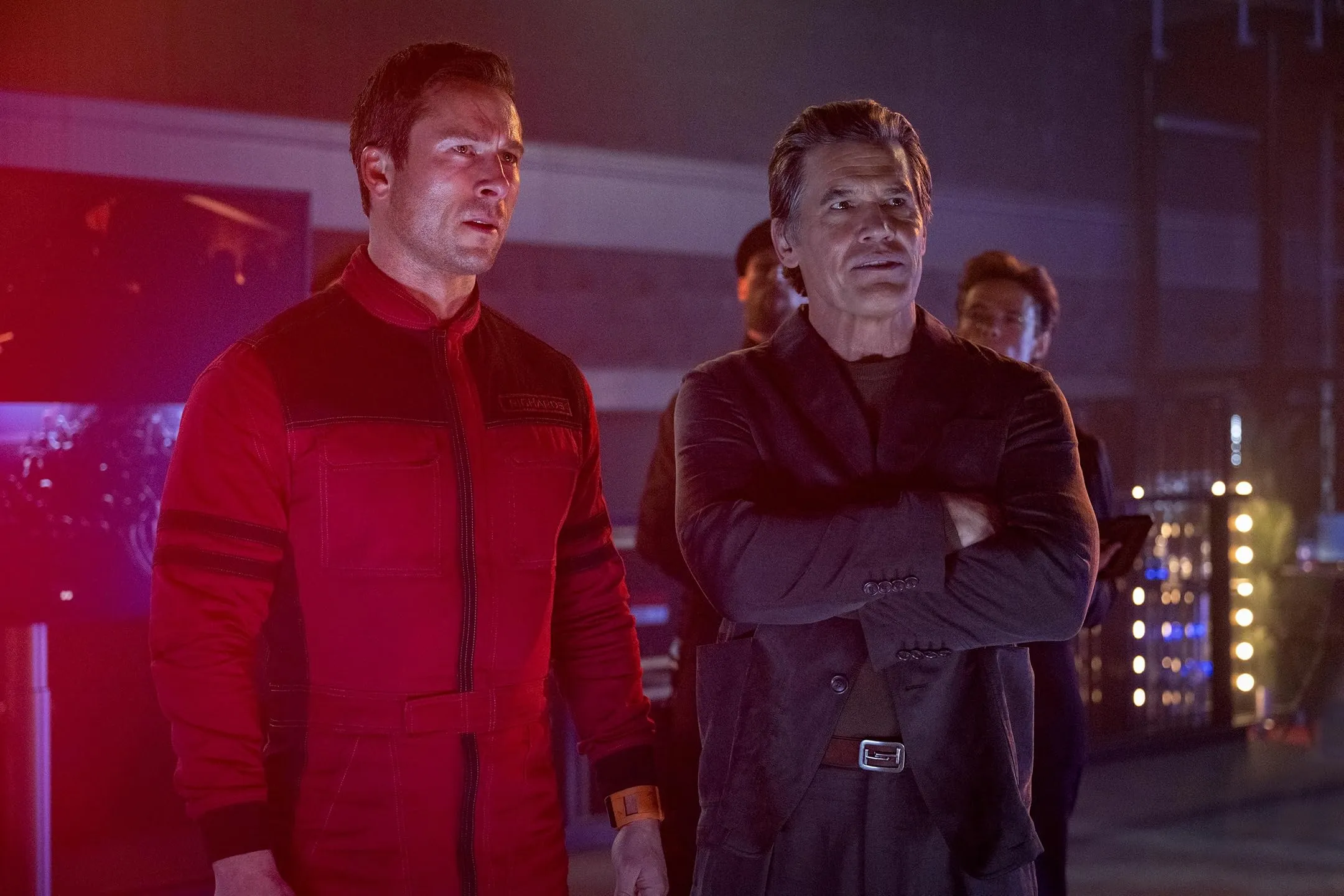
The Network’s inner ring arrives with polished menace. Colman Domingo gives the host, Bobby T Thompson, an oily charm that sells the theater of pain to the crowd. Josh Brolin’s Killian smiles through corporate cruelty. He locks on to Richards as a ratings engine, a combustible asset who can supercharge the show. The clash between Richards’ raw anger and Killian’s cheerful calculus holds the conflict steady and gives the chase a clear face.
The bench supports the tone with precision. Michael Cera’s Elton runs on jittery wit, a spark that frames resistance as a heady thrill. Emilia Jones plays Amelia, a well-off hostage whose view widens under pressure. The ensemble clicks with Wright’s calibrated rhythm and adds fast, verbal texture to the forward rush.
Velocity and Structure
Wright’s gift for staging action fires repeatedly. The movie stacks full-speed pursuits and meticulous set pieces. Standouts include an elaborate safe-house rig bristling with traps and a high-stakes sequence built around a plane. The opening sprints. Stakes arrive quickly, and the ground rules lock in with brisk clarity.
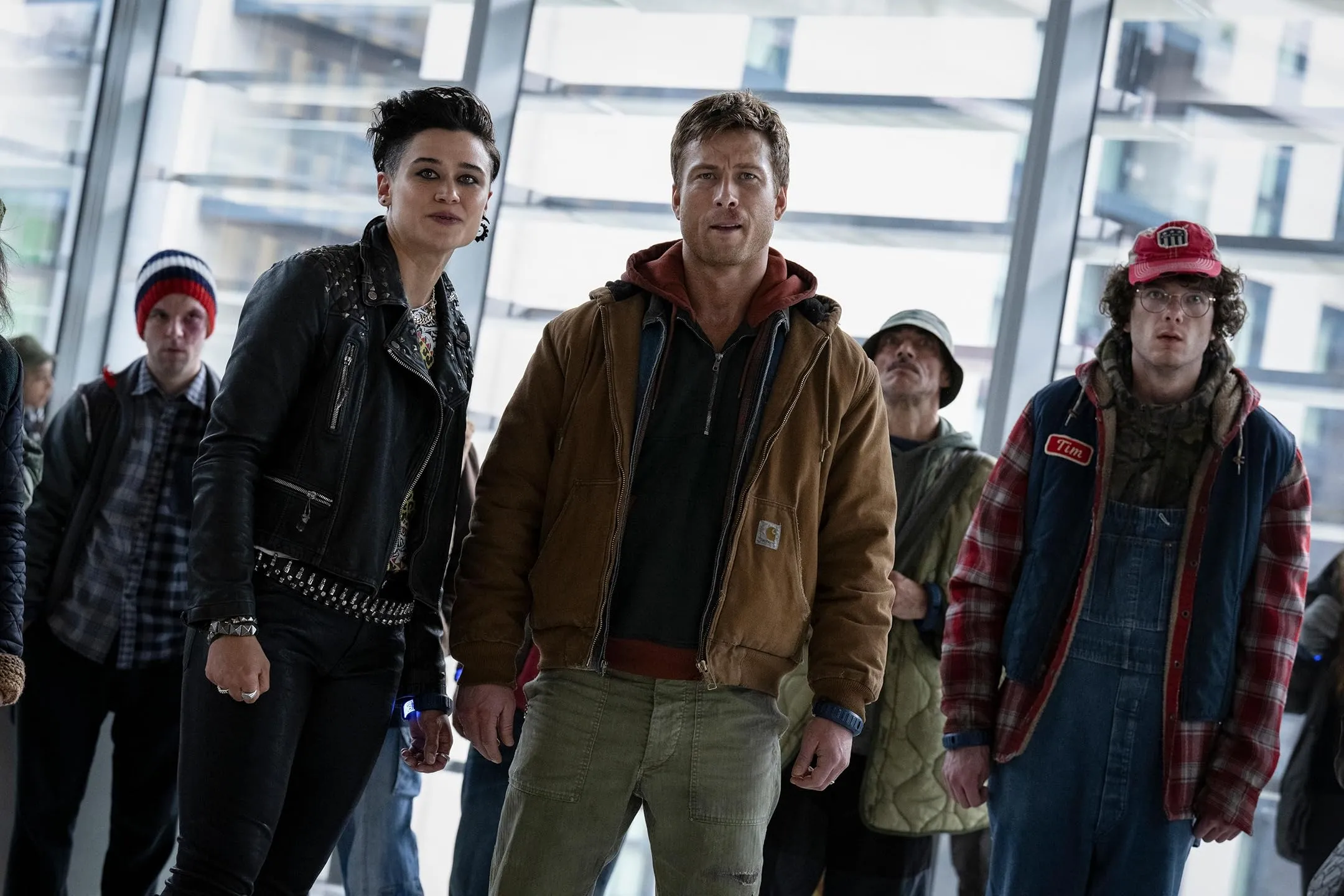
Sustaining that pace proves harder once Richards moves across a chain of safe houses and hideouts. The rhythm slips toward an episodic pattern. Each near miss provides a jolt, yet repetition creeps in, especially beside the clockwork timing of Wright’s earlier work. The final act amplifies that strain. The film lingers across the last thirty minutes, and the climax stretches longer than the material can bear. The result loosens the tight, sharp control that defines the first hour and mutes the finish.
Wright still delivers an exacting machine for movement and sound, and the film frames entertainment as a ruling instrument that feeds on hunger, illness, and fear. The analog glow of the image, the AI sleight of hand, and the spin of the Network’s hosts map a culture trained to cheer the hunt it funds. Ben Richards charges through that maze with battered resolve, a worker pushed onto a stage where survival counts as spectacle and truth bends to the cut room. The pieces fit cleanly, even as the final turn asks the film to carry a weight it earlier sets aside.
The Running Man is a science fiction action thriller released in the United States by Paramount Pictures on November 14, 2025. Directed by Edgar Wright, this film is the second adaptation of the 1982 novel by Stephen King, taking place in a dystopian near-future where a lethal reality show is used for mass entertainment and social control. The movie carries an R rating for strong violence, some gore, and language.
Credits
Title: The Running Man
Distributor: Paramount Pictures
Release date: November 14, 2025 (United States)
Rating: R
Running time: 133 minutes
Director: Edgar Wright
Writers: Michael Bacall, Edgar Wright, Stephen King (based on the novel)
Producers and Executive Producers: Simon Kinberg, Nira Park, Edgar Wright, Audrey Chon, George Linder, James Biddle, Rachael Prior, Andrew Lary, Pete Chiappetta
Cast: Glen Powell, Josh Brolin, Colman Domingo, Lee Pace, William H. Macy, Michael Cera, Emilia Jones, Daniel Ezra, Jayme Lawson, Sean Hayes, Katy O’Brian
Director of Photography (Cinematographer): Chung-hoon Chung
Editors: Paul Machliss
Composer: Steven Price
The Review
The Running Man
Edgar Wright delivers a kinetic, high-energy adaptation that succeeds as pure action spectacle. Glen Powell captures the protagonist's simmering rage, backed by sharp performances from the supporting cast. The film’s retrofuturist style is engaging. However, the commitment to entertainment dilutes the source material’s sharp social critique, especially toward the awkward conclusion. While undeniably fun for long stretches, the story misses its opportunity for deeper cultural commentary, ending instead as robust, if flawed, popcorn cinema.
PROS
- Kinetic, high-energy directorial style
- Strong central performance by Glen Powell
- Engaging supporting cast
- Thrilling action sequences
- Captivating retrofuturist design
- Successful as high-octane entertainment
CONS
- Softened social satire
- Thematic weight is diminished
- Pacing issues (episodic middle)
- Final act feels distended
- Awkward tonal shift in the last act







