


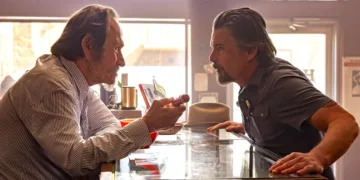





















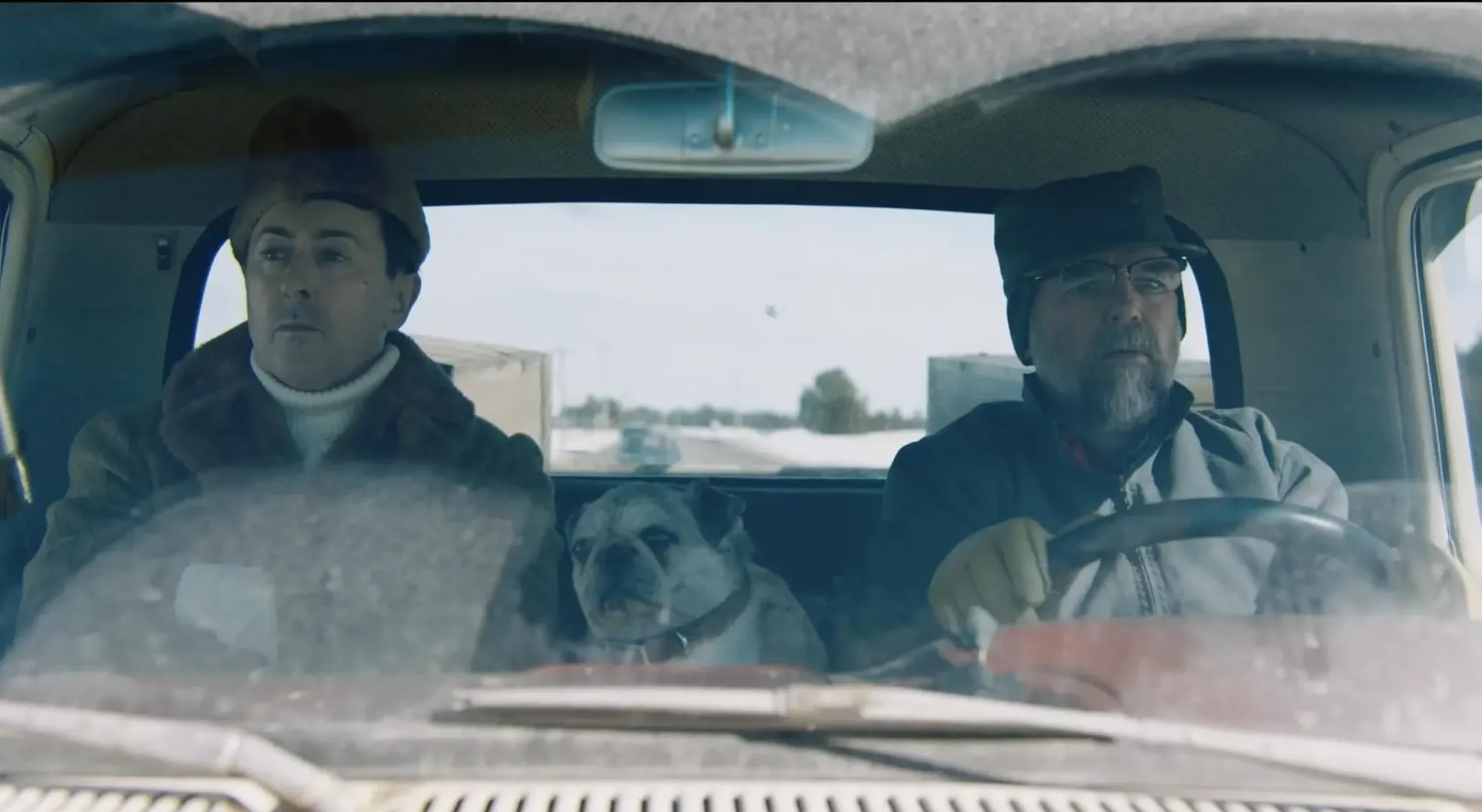

The road movie often treats speed as therapy. Michael Clowater’s debut, Drive Back Home, slows that prescription to a winter crawl and lets the cold do the diagnosing. The year is 1970. Weldon “Wid” (Charlie Creed-Miles), a taciturn plumber from rural New Brunswick, leaves his protected routine to collect his older, estranged brother Perley (Alan Cumming) from a Toronto jail after an arrest for public indecency.
The distance is roughly 900 miles. The task is mandated by fate and by their formidable mother, Ade. The trip doubles as an inquiry into family damage. The car becomes a small tribunal where two lives shaped by the same house argue by proximity. Cumming and Creed-Miles lock the frame into a fierce two-hander from the first scenes.
Kinship and the Geography of the Self
The film builds its power on a broken fraternity. Wid and Perley present a case study in social drift inside a single family system. Wid keeps to a small-town code, sour with resentment and circled by rigid locality. Perley arrives as a witty urban peacock whose polish carries self-destructive seams (including an eccentric loyalty to a taxidermy pug).
Creed-Miles tracks repression like a map across Wid’s face. His fear of the world beyond New Brunswick shows early in a practical detail: extra gas cans to bypass French-speaking Quebec. That tactic reads like policy. Call it spatial conservatism, the reflex that treats difference as a border to be fortified rather than a road to be taken.
Cumming charges Perley with characteristic electricity. The performance constructs a glittering shield against longstanding abuse, then lets the dents catch the light. Fierce, proud, and fragile live in the same frame. The theatrical surface never hides the hurt; it calibrates it. The role refuses the “eccentric queer cousin” box through a steady insistence on history and consequence. The brothers’ bickering, nudged and tolerated by their gruff, loving mother (Clare Coulter), reads as a dialect of pain more than a hobby of conflict.
The Chronotope of the Closet
Drive Back Home locates itself with precision in 1970 Canada. Statute decriminalized homosexuality, yet social permission to punish continued with efficiency. The road—time plus space—operates as a chronotope that magnifies queer trauma in transit. The film treats trauma as event and record, not metaphor. Scenes of systemic discrimination and physical violence sit in the narrative with the weight of evidence. The ledger is public and personal at once.
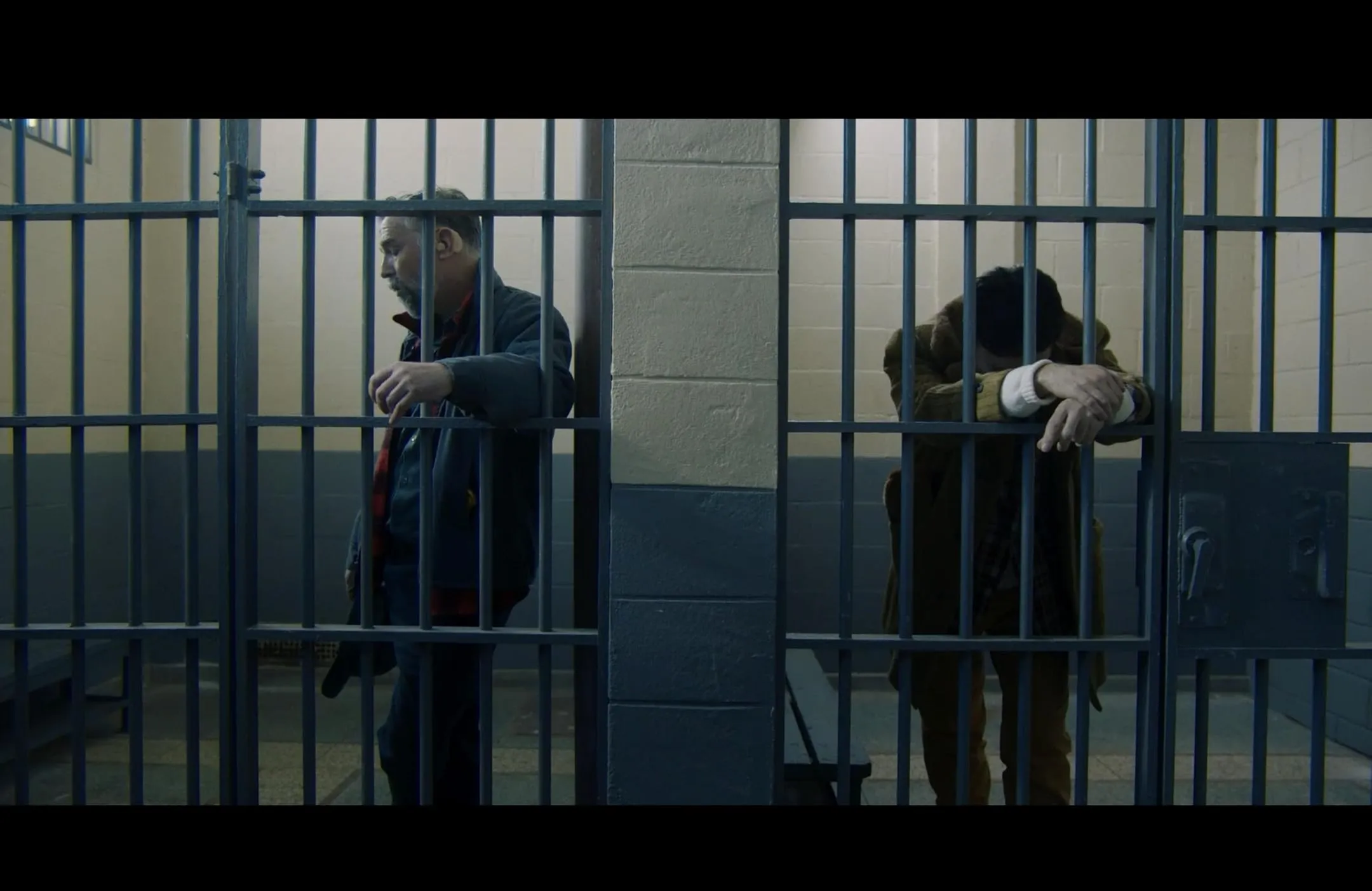
The brothers exhibit two survival grammars formed by the same father-shaped wound. Wid chooses silence and rule-keeping; the stasis reads as symptom. Perley counters with flamboyant display and self-medication; the defiance reads as self-rescue with a price. These are parallel strategies born from a single origin point. The film watches both without endorsing either. It simply lets the cost accumulate.
Language carries the most elegant symbolism. Wid’s dread of French-speaking Quebec becomes a literal barricade plotted on a route. Perley’s easy French appears without fanfare and marks a life Wid never tracked. Their speech falters in more than words. Perley shares quiet signals with other gay men, codes meant for safety and recognition. Wid finds a brief pocket of fluency with a French plumber where trade jargon bridges everything that ordinary talk cannot. Communication occurs, then fails, then finds detours. The motif externalizes isolation and invents a small anthropology of how people speak when the main language no longer fits.
Aesthetical Echoes and Structural Tensions
Clowater stages the film with the assurance of someone already comfortable in classical grammar. The aesthetic favors winter realism, with textures that nod toward 1970s cinema. Tone lives at a tricky intersection of witty, quirky, and deeply sad, which invites comparison to Alexander Payne’s American school (Nebraska gets name-checked by the frame even before the mind does). A line of Coen-like grim humor threads through, cutting heaviness with a sideways grin.
The road-trip structure supplies the narrative engine. The car acts as a pressure vessel for unvoiced history. Clowater works jump cuts and long, near-silent passages into the driving sequences. They serve as yard markers for vacuous yearning, the miles where conversation refuses to begin. Occasionally the pace relaxes into slackness and the film slides toward familiar structure.
The payoff arrives in the slow stacking of small revelations: a glance withheld, a joke told for protection, a memory that lands like sleet. The method feels less like genre renovation and more like careful fieldwork in a period-specific social climate, carried by intimate, sibling-level observation.
One scene’s timing can change on a dime, and the film allows for it. A line reads defensive in one moment, tender in the next. That shift mirrors the way public policy can alter headlines while daily life keeps its hazards. The cultural weather of 1970 never leaves the windshield. The brothers move through it with two temperaments that share a root system they refuse to name.
Performance remains the anchor. Creed-Miles studies inwardness without dead air. Cumming plays courage as craft and as reflex. Coulter’s Ade frames their conflict with tough love that looks like logistics and sounds like a verdict. Even the pug, frozen in its own forever, becomes a small museum of Perley’s self-invention.
If one needed a coinage, the film practices kinopolitics: the politics of family movement under public scrutiny. The route across provinces turns into a social cross-section, from gas stations that sell silence to rooms where law and gossip sit at the same table. The camera respects the ordinary, then lets an offhand detail bite. A glance at a bilingual sign. A service interaction that curdles. The click of a seat belt that refuses to reassure.
Drive Back Home invites reading at several scales. At the micro level, two brothers test the tensile strength of blood ties under winter pressure. At the macro level, a nation adjusts a statute while leaving habitual punishments in place. The film’s cultural charge grows from that overlap. Memory becomes infrastructure; policy becomes weather; the car becomes both shelter and courtroom. The road heals nothing by itself. It only compels a reckoning and records who arrives.
Drive Back Home is a Canadian drama film, set in the winter of 1970. The plot follows Weldon, a gruff plumber from New Brunswick, who is forced by his mother to drive 1,000 miles to Toronto to bail his estranged, openly gay brother, Perley, out of jail following an arrest for public indecency. The movie premiered at the Cinéfest Sudbury International Film Festival on September 19, 2024, and was inspired by the true story of director Michael Clowater’s grandfather and great-uncle. It has been screened at various film festivals, including the Calgary International Film Festival. The film’s U.S. theatrical release was scheduled for December 6, 2024. Drive Back Home is available to rent or purchase on Amazon, AppleTV, Google Play, and Fandango at Home. Distribution in Canada is handled by Photon Films.
Credits
Title: Drive Back Home
Distributor: Photon Films (Expected US Release), Cinéfest Sudbury International Film Festival (Premiere)
Release date: September 19, 2024 (Cinéfest)
Running time: 100 minutes
Director: Michael Clowater
Writers: Michael Clowater
Cast: Alan Cumming, Charlie Creed-Miles, Clare Coulter, Sprague Grayden, Gray Powell, Judah Davidson, Alexandre Bourgeois, Anthony Jones Nestoras, Gord Rand, Brian Bisson, Thomas Mitchell, Jennifer Carroll, Deborah Tennant, Dan Beirne, David Assinewai, Jayden Kirton, Joe Drinkwalter, Cameron Nicoll, Jude Zappala
Director of Photography (Cinematographer): Stuart Campbell
The Review
Drive Back Home
Drive Back Home transcends typical road trip dynamics by focusing on two brothers confronting decades of shared trauma against the backdrop of 1970s Canadian homophobia. Alan Cumming and Charlie Creed-Miles deliver intensely nuanced performances that give weight to the difficult subject matter. While the pacing is occasionally slack and the structure risks convention, the film’s authenticity and emotional power are undeniable. It is a resonant examination of kinship, repression, and the painful search for self-acceptance.
PROS
- Exceptional central performances by Alan Cumming and Charlie Creed-Miles.
- Deep, nuanced exploration of identity, trauma, and societal homophobia.
- Sophisticated use of symbolism, particularly surrounding language and geography.
- Polished direction and aesthetic, especially strong for a debut feature.
- Achieves a genuinely earned and emotionally powerful climax.
CONS
- Pacing issues in the middle sections, risking conventional genre trappings.
- The unflinching depiction of queer trauma is genuinely difficult to view.