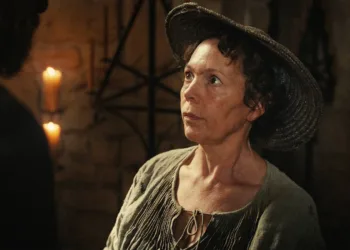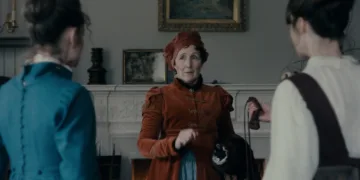































The Education of Jane Cumming plants its story on the rural edges of Drumsheugh, near Edinburgh, at the dawn of the nineteenth century. The countryside projects calm, yet the film keeps revealing the strict social codes that shape women’s lives and limit their options. Jane Pirie and Marianne Woods, former governesses with carefully kept reputations, gather modest funds and open a boarding school for young ladies of status.
The project reads as a determined move toward financial independence, a way out of the domestic servitude expected of women in their position. Their curriculum carries an aspirational energy, pairing scientific inquiry and mathematical discipline with the social graces demanded by Regency society. The school becomes a delicate system where enlightenment ideals sit beside inherited rules, each pressing against the other.
That balance shifts with the arrival of Lady Cumming Gordon and her three granddaughters, a powerful presence inserted into a space built on careful management and quiet persuasion. One of the girls is Jane Cumming, a teenager of mixed heritage born in India, whose presence keeps the colonial world in view even while the setting insists on Scottish isolation.
The film tracks Pirie and Woods as professionals bound together by ambition and by the daily labor of staying respectable in a culture trained to suspect female independence. Their partnership is presented as both practical and intimate, shaped by shared risk and by the constant pressure of being watched.
The Outsider and the Aristocratic Gaze
Jane Cumming occupies an unstable position inside the school, treated like a guest who never becomes part of the household. Her heritage and her “illegitimate” status mark her, and the film shows how quickly that marking turns into routine exclusion among girls trained to police one another.

Social life becomes a series of small refusals, delivered casually, then absorbed as custom. Even the school’s arrangements intensify the strain: the two-girls-to-a-bed system forces closeness while magnifying discomfort, making the dormitory a place where bodies share space without sharing safety.
Lady Cumming Gordon emerges as the clearest instrument of aristocratic control. She offers Jane access to education, then reinforces the limits of Jane’s place with the same steady hand. A summer retreat to the coast briefly loosens the hierarchy, allowing a glimpse of a life where the trio might exist on level ground. The return to school brings the old order back with sharper edges, and the earlier openness makes the reimposed structure sting.
Jane’s effort to secure a permanent role as a future teacher meets a firm rejection, and the denial lands as a verdict on belonging itself. The film ties this rupture to race, class, and colonial history, framing Jane’s understanding of power through her position as a child of the East India Company. Shut out of the white girls’ games and secrets, she falls into a deep isolation that keeps tightening.
Her hunger for a stable place turns corrosive. What begins as a plea for recognition hardens into something weaponized, directed at the women who tried to offer her a future within the school’s walls. The conflict expands beyond petty schoolroom hostility and becomes a collision of identities contained by a social system that survives by sorting people into fixed ranks.
The Architecture of Restraint
The boarding school functions as a pressure chamber, filmed with attention to the weight carried by a glance held too long or a silence that lasts one beat past comfort. The imagery leans on a steady shift between the cool clarity of Scottish daylight and the warm flicker of interiors at night, letting temperature and brightness shape the emotional register. Tight rooms and shared corridors cultivate claustrophobia, and the film keeps returning to the sense that movement is always observed, assessed, filed away.

Pirie and Woods register as sharply different presences inside that confined world. Pirie holds herself with contained rigidity, speech measured, posture controlled, each choice shaped by risk. Woods moves with an easier physical rhythm, her calm suggesting a private inner life that remains protected from public scrutiny.
Their connection appears in the margins of their duties, communicated through texture and gesture instead of declared feeling. A hand warmed between palms, a look that lingers during a lesson, the slight pause before a sentence continues: these details carry the emotional charge the setting refuses to permit openly.
The score stays restrained and responsive, guiding shifts in mood and tightening tension without tipping into melodrama. The film builds a space where what goes unsaid weighs heavily, and where intimacy becomes a matter of timing, proximity, and nerve.
Shared moments accumulate quietly, shaping the sense of an evolving closeness that must fit inside the school’s rules and its appetite for surveillance. Even the simple act of sharing a room takes on the feeling of negotiation, desire pressed against duty while appearances remain carefully maintained. The viewer is drawn into muffled sounds, controlled routines, and the constant risk of discovery that hangs in the air like a held breath.
The Fragility of Truth and Reputation
The story pivots when Jane Cumming delivers a calculated accusation to her grandmother. She supplies specific, lurid descriptions of nighttime activity between her teachers, drawing on the dormitory’s smutty rumor mill to make the claim sound plausible in its own era. In 1810, the allegation functions as a social death sentence, carrying consequences that move faster than evidence ever could. The timing carries a grim irony: the scandal arrives as Pirie and Woods begin facing what their feelings have become.
The film stays with emotional collapse rather than letting procedure take the spotlight. The libel trial appears mainly through the damage it inflicts on the women’s livelihoods and spirits, the slow grinding down of security and self-possession. Reputation becomes the currency that governs survival, and the film treats that economy as brutal precisely because it is ordinary, upheld by people who call it virtue.
The story ends with a suddenness that echoes historical erasure. The fight for legitimacy fades into a quiet retreat, and the film leaves space for the audience to sit with the cultural invisibility imposed on women who challenged the moral architecture of their time.
The legal aftermath remains offscreen, yet its force presses through the final act, present in what has been lost and in what the characters can no longer afford to name. The focus stays on interpersonal fallout, on the way scandal corners Pirie and Woods into choosing between truth and survival, and on the society that prizes reputation while allowing reality to be rewritten by a single vengeful lie.
The Education of Jane Cumming premiered globally on February 15, 2026, as part of the Panorama section at the 76th Berlin International Film Festival. The film is a co-production between Germany, Switzerland, and the United Kingdom, and it is currently touring the international festival circuit. While a wide theatrical or streaming release date has not been finalized for all regions, it is distributed by Farbfilm Verleih in Germany and Frenetic Films in Switzerland, with broadcast support from WDR and ARTE, where it is expected to be available for television audiences in the future.
Full Credits
Title: The Education Of Jane Cumming
Distributor: Farbfilm Verleih, Frenetic Films AG, WDR, ARTE
Release date: February 15, 2026
Running time: 114 minutes
Director: Sophie Heldman
Writers: Flora Nicholson, Sophie Heldman
Producers and Executive Producers: Bettina Brokemper, Karin Koch, Nadira Murray, Paul Welsh, Andrea Hanke
Cast: Flora Nicholson, Clare Dunne, Mia Tharia, Fiona Shaw, Sadie Shimmin, Amy Louise Walker, Rebecca Martin
Director of Photography (Cinematographer): Kate Reid
Editors: Isabel Meier
Composer: Balz Bachman
The Review
The Education Of Jane Cumming
The Education of Jane Cumming offers a rigorous examination of the friction between individual desire and social preservation. It eschews the sweeping romanticism often found in period dramas to focus on the quiet, claustrophobic reality of two women attempting to carve out a life of their own. While the pacing occasionally stutters and the conclusion arrives with a jarring suddenness, the strength of the central performances provides a grounded, honest anchor. It is a work of precision and restraint that highlights the high price of truth in a world built on appearances.
PROS
- Exceptional performances by Fiona Shaw and the lead duo.
- Evocative, atmospheric cinematography that uses light effectively.
- A sophisticated handling of race and colonial identity.
- Avoids common period drama tropes for a more grounded feel.
CONS
- The narrative pace feels uneven in the second half.
- The ending arrives abruptly, leaving threads unresolved.
- The internal lives of the teachers lack deeper exploration.
- Some viewers might find the tone overly restrained.