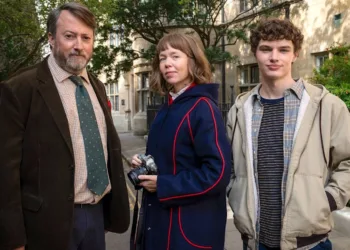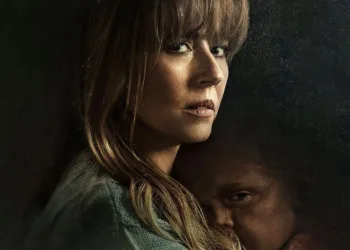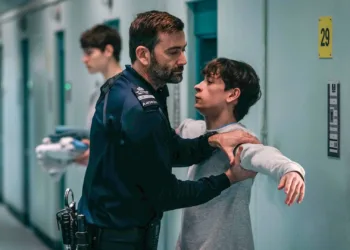
























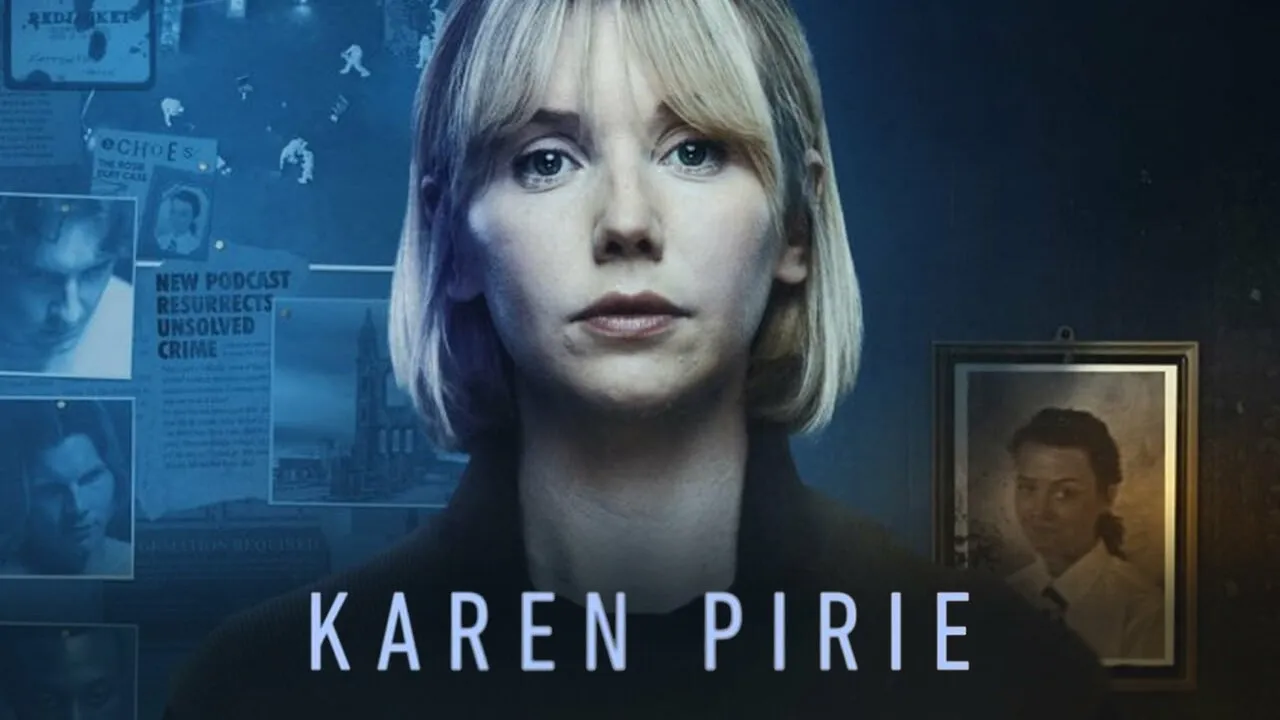

The bum bag is back, and so is the detective who wears it without a hint of irony. In a television landscape littered with brooding, tortured male detectives staring into the middle distance, DI Karen Pirie feels like an act of quiet rebellion. Three years after her debut, a small eternity in television time, Lauren Lyle’s unpretentious Scottish investigator returns not with a dramatic new haircut or a tragic backstory, but with a promotion and the same pair of Doc Martens. Her task this season is to pry open a wound in Scotland’s collective memory: the 1984 kidnapping of Catriona Grant, a young oil heiress, and her two-year-old son.
The case went ice cold decades ago, a ghost story whispered among the elite. But when a modern murder unearths a forgotten clue, Pirie is thrown into the orbit of the powerful Grant family, whose patriarch, Sir Broderick (a magnificently intimidating James Cosmo), has built an empire on secrets he would prefer remain buried deep beneath the North Sea. The case is a puzzle box of family dysfunction and historical grievance, demanding a detective who cares less about appearances and more about the truth. Good thing she’s here.
Then Meets Now
The series’ most effective narrative tool remains its elegant dual-timeline structure, which braids the present-day investigation with the simmering tensions of 1984. This is more than a simple storytelling device; it is the engine of the entire show, turning what could be a standard police procedural into a richer, more textured historical drama.

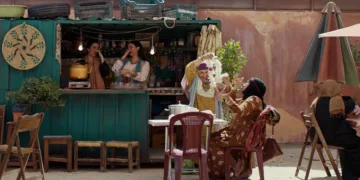
The flashbacks are crafted with a remarkable eye for detail, capturing the specific anxieties of Thatcher-era Scotland. The visual language is distinct; the 1980s scenes are cast in a softer, almost melancholic light, a stark contrast to the crisp, cool tones of the modern timeline. This is a past remembered, not just re-enacted. Through these sequences, the victim, Catriona Grant, is granted a life beyond the case file. She is not a static photograph on an evidence board but a complicated young woman struggling with the gilded cage of her inheritance.
We witness her secret affair and her growing political conscience, which puts her in direct opposition to her father’s rapacious capitalism. The show skillfully situates her personal drama within the larger social upheaval of the 1984 miners’ strike, suggesting that the personal and political are inextricably linked. The kidnappers, a seemingly amateurish group calling themselves the “Anarchist Covenant of Scotland,” are shown to be products of this volatile environment, their motivations more complex than simple greed.
Back in the present, each discovery made by Karen’s team acts as a trigger, propelling the narrative back in time. Finding Cat’s old car key in the possession of a murdered drug dealer is not just a clue; it is a key that unlocks a memory, allowing the audience to witness a piece of the past that the detectives can only guess at. This method brilliantly avoids the static, exposition-heavy interrogation scenes that can bog down lesser crime dramas.
It also cultivates a potent sense of dramatic irony. We watch Sir Broderick in the present day, a grieving father playing the part of a pillar of the community, all while knowing what he was doing and saying behind closed doors in 1984. This knowledge transforms our perception of him and every other character connected to the original crime, making their modern-day interactions fraught with unspoken history and suspense.
A Team of Real People
In a genre overpopulated with archetypes, Karen Pirie populates its world with actual people. At the center of it all is Lauren Lyle’s masterful performance. She imbues Pirie with a sarcastic wit and a deep well of empathy, creating a character who feels utterly authentic. Her defiance is not loud or theatrical; it is in the casual way she shoves her hands in her pockets when facing down a billionaire, or in her deadpan responses to the casual sexism of her superiors.

When her boss, DCS Lees, condescendingly remarks that it is good for women to “send the ladder back down” after getting a promotion, her subtle, unimpressed reaction speaks volumes. Her infamous fashion sense is its own form of characterization, a rejection of the polished, power-suited image of a female DI. She is there to do a job, not to manage her brand.
Her team reflects this same grounded realism. Chris Jenks’ DC “Mint” Murray remains a source of perfectly calibrated comic relief, his quirky competence a perfect foil for Karen’s directness. The romantic subplot with DS Phil Parhatka (Zach Wyatt) is handled with a refreshingly adult sensibility; their relationship is a source of support and gentle conflict, not a wellspring of melodrama.
The season’s strongest new player is DC Isla Stark (Saskia Ashdown), a sharp and enigmatic analyst from E-crime. Ashdown portrays Isla’s ambition and moral conflict with a quiet intensity; coerced by her boss to spy on Karen, she is a character trapped between her principles and her career, and this internal struggle makes her a far more interesting figure than a simple mole.
The only real misstep in the character department is the return of journalist Bel Richmond (Rakhee Thakrar). Now helming a true-crime documentary for a streamer, her presence often feels inorganic, a narrative contrivance designed to introduce clues or create conflict rather than a believable part of the world. She represents a modern, sensationalist view of crime that feels at odds with the show’s otherwise methodical and humane approach.
Lean, Mean Storytelling Machine
The series’ most admirable quality may be its respect for the audience’s time. In an era where many streaming dramas stretch four hours of plot into an eight-episode season, Karen Pirie tells its complex story in three taut, feature-length installments. This structure, a throwback to the classic British miniseries format, allows for both narrative depth and relentless momentum.

Writer Emer Kenny, working from Val McDermid’s novel, constructs a plot that is intricate without being convoluted. Each episode functions as a satisfying chapter, with its own set of revelations and cliffhangers, while building towards a cohesive and powerful whole. The pacing is consistently propulsive, a testament to the thriller instincts of its production company. Twists and turns feel earned because they are deeply rooted in the characters’ histories and the social fabric of the past. There are no last-minute contrivances here, only the slow, deliberate unspooling of long-held secrets.
This meticulous plotting serves a set of potent themes. The show is a sharp critique of the impunity that immense wealth can buy, with the Grant family’s oil fortune casting a long, corrupting shadow over decades. The narrative draws a direct line from the industrial politics of the 1980s to the entrenched power structures of today, suggesting that the battles of the past are never truly over.
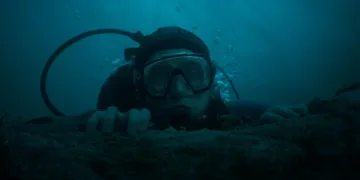
Even the final act’s shift to Malta, a location change that in other shows might feel like a gratuitous travelogue, is narratively essential. It is not a holiday for the cast; it is the place where the final, darkest secrets of the Grant family were buried. By taking its characters out of the familiar grey of Scotland and into the harsh Mediterranean sun, the show makes its final, unflinching point about how far power will go to protect itself. It’s a smart, confident piece of storytelling from a series that continues to be one of the best things in a very crowded field.
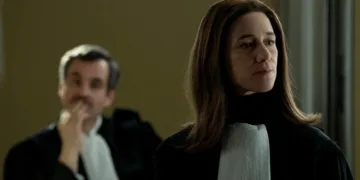
Karen Pirie is a British crime drama television series based on the Inspector Karen Pirie series of novels by Val McDermid. The second season, which is an adaptation of the novel A Darker Domain, sees the titular character, Karen Pirie (Lauren Lyle), promoted to Detective Inspector. The series follows Pirie as she reopens a historical case: the 1984 kidnapping of oil heiress Catriona Grant and her two-year-old son, Adam, after a man’s body is discovered decades later with links to the original crime. Developed for television by Emer Kenny, the series is produced by World Productions and premiered its second season on the ITV network in the UK in July 2025.
Full Credits
Director: Gareth Bryn
Writers: Emer Kenny, Gillian Roger Park, Val McDermid
Producers and Executive Producers: Simon Heath, Elizabeth Binns, Emer Kenny, Val McDermid, Clare Kerr, Marcus Wilson
Cast: Lauren Lyle, Chris Jenks, Zach Wyatt, Emer Kenny, Rakhee Thakrar, Steve John Shepherd, Saskia Ashdown, James Cosmo, Frances Tomelty, John Michie, Julia Brown, Kat Ronney
Director of Photography (Cinematographer): Ryan Kernaghan
Editors: Gareth Bryn
Composer: Stephanie Taylor
The Review
Karen Pirie Season 2
Karen Pirie returns with a second season that is smarter, sharper, and more confident than its excellent debut. Anchored by Lauren Lyle’s refreshingly grounded lead performance and a masterful dual-timeline narrative, the series delivers a tightly plotted, emotionally resonant cold case that feels both classic and modern. While a minor character subplot feels slightly forced, the season as a whole is a superb example of the detective genre done right, blending a compelling mystery with rich character work and sharp social commentary. It was worth the wait.
PROS
- A compelling, witty, and refreshingly normal lead performance from Lauren Lyle.
- The intelligent dual-timeline structure enriches the mystery and provides emotional depth.
- Tight, efficient plotting across three feature-length episodes that avoids genre bloat.
- A strong and believable supporting cast with excellent chemistry.
- High production values that authentically recreate the 1980s setting.
CONS
- The role of the returning journalist character feels narratively forced and less organic than other elements.
- Occasionally leans on familiar genre tropes, such as the stereotypically surly boss.