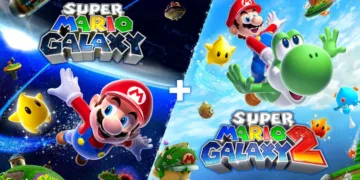


























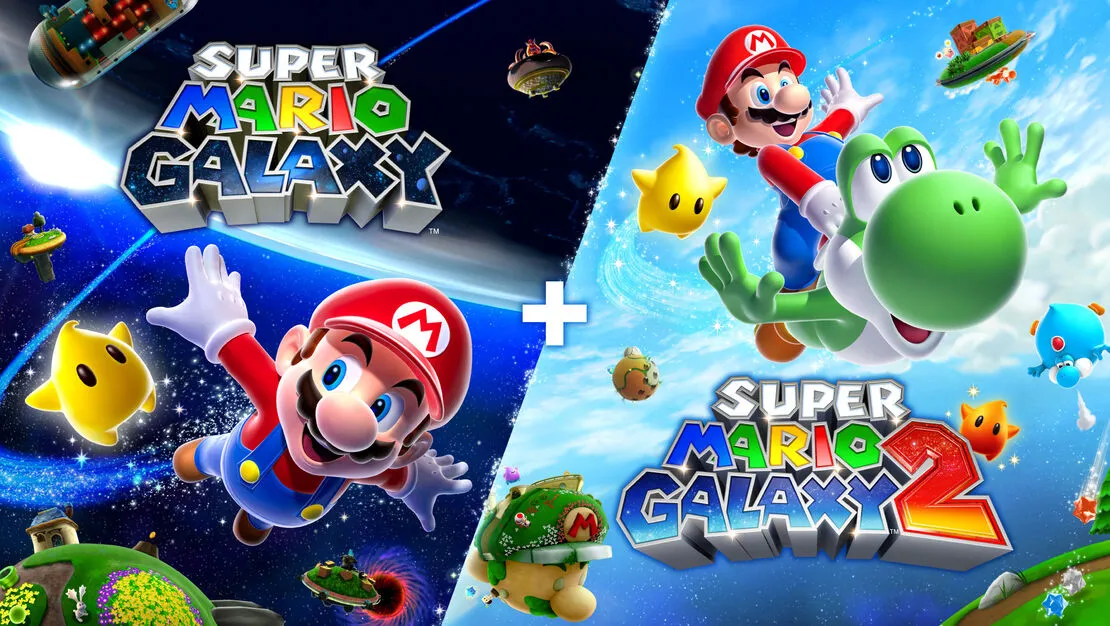

The Mario franchise has a peculiar relationship with direct sequels. Super Mario Galaxy and Super Mario Galaxy 2, originally released for the Wii in 2007 and 2010, stand as rare exceptions where Nintendo leaned into iteration rather than reinvention. This Switch and Switch 2 release matters for a specific reason: Galaxy 2 has been stranded on obsolete hardware for over a decade, making this the first time in years that players can experience one of the most inventive 3D platformers ever made on modern consoles.
Both games revolve around a simple yet radical premise. Mario travels through space, hopping across spherical planets where gravity pulls in every direction. What feels like “up” changes constantly as you run along curved surfaces, the camera pivoting to match your new perspective without missing a beat.
These are the games that brought Rosalina into the Mario canon, establishing her presence across every spin-off that followed. The HD and 4K visual treatment breathes new life into these classics, though the question remains whether the modest upgrades justify the £58.99/$69.99 price tag for games that already achieved near-perfection on their original platform.
Spheres of Influence
The genius of Galaxy’s design lies in how naturally it makes the impossible feel intuitive. Running upside down across a tiny planetoid, then leaping into space to land on another floating sphere, becomes second nature within minutes. The controls shift seamlessly as your orientation changes, turning what could have been a disorienting mess into fluid movement. Each galaxy introduces its own twist: new power-ups, environmental hazards, or physics-bending gimmicks that appear for a handful of stars before the game moves on to something completely different.
Galaxy 1 structures its adventure around The Comet Observatory, a hub world that expands as you collect stars. You unlock new domes and areas, creating a sense of progression that feels satisfying if occasionally sluggish between levels. Galaxy 2 strips away this approach entirely, opting for a world map reminiscent of Super Mario Bros. 3. The change reflects a philosophy shift. Where the first game wanted you to inhabit a space and explore it, the sequel prioritizes efficiency and variety. Neither approach feels wrong, though I lean toward Galaxy 1’s hub for the atmosphere it creates. There’s something special about returning to Rosalina’s observatory between adventures, watching it fill with life.
Yoshi’s arrival in Galaxy 2 opens up entirely new possibilities. His gobbling mechanic works through the pointer system, letting you snatch distant items and enemies. Swing flowers turn him into a grappling tool, and his power-ups range from speed boosts to balloon inflation that sends you floating skyward. The absurdity of a dinosaur inflating like a balloon while drifting through space shouldn’t work, yet it does. Mario himself gains new transformations: Cloud Mario creates temporary platforms beneath your feet, Rock Mario turns you into a destructive boulder, and the Spin Drill lets you burrow through entire planetoids to attack enemies from below.
The level design remains astonishing. Supermassive Galaxy plays with scale, enlarging enemies to comical proportions. Haunty Halls Galaxy introduces Mattermouths that devour the platforms you’re standing on, forcing constant movement. Throwback Galaxy recreates Whomp’s Fortress from Super Mario 64 with Galaxy’s spherical gravity mechanics, a perfect example of how the sequel recontextualizes familiar spaces. Every star introduces some fresh idea or clever twist on an established mechanic.
Yet the collection system feels archaic now. Grabbing a star immediately boots you back to the hub or world map, forcing you to reload the level if you want to continue exploring. Modern platformers like Super Mario Odyssey let you gather dozens of collectibles before returning to your ship. The stop-start rhythm here creates friction, breaking immersion just as you’re settling into a level’s flow. Galaxy 2 mitigates this somewhat with its streamlined structure, but the fundamental issue remains. The games were designed for an era when this felt normal. Playing them now highlights how much the genre has evolved.
Motion and Emotion
Control schemes on Switch and Switch 2 offer flexibility that the Wii versions couldn’t match. The Joy-Con setup replicates the Wii Remote and Nunchuk experience: left stick for movement, right stick or motion for spinning, pointer controls for collecting star bits. Handheld mode lets you tap the touchscreen for item collection while shaking the console or pressing Y to spin. Pro Controllers work similarly, requiring gentle motion for specific mechanics but leaning heavily on button inputs.

The motion controls feel sharper than I remember from the Wii era. Whether this reflects actual improvements or better hardware remains unclear, but the responsiveness makes a noticeable difference. Spinning to attack enemies or activate switches registers instantly. That said, certain segments stubbornly require motion controls where traditional inputs would work better. Rolling a ball across a narrow pathway by tilting the controller feels like a relic from 2007. These moments aren’t frequent enough to ruin the experience, but they highlight how accessibility standards have changed. Modern games offer multiple input options for every mechanic. Galaxy’s motion-dependent sections don’t, and that feels like a missed opportunity for this remaster.
Assist Mode attempts to address difficulty concerns by adding extra health and preventing most fall deaths. It serves as a helpful introduction for younger players or anyone who wants to experience the levels without the challenge. However, it doesn’t replace comprehensive accessibility options. The inability to fully remap controls or adjust motion sensitivity leaves gaps that contemporary games routinely fill.
Visually, the upgrade makes a dramatic impact. HD and 4K upscaling transforms these games, sharpening textures and bringing out details that were muddy on the Wii. Environments that once looked serviceable now genuinely pop, with vibrant colors and crisp edges that make each galaxy feel alive. The contrast becomes jarring during pre-rendered cutscenes, where the resolution drops and everything looks noticeably worse. It’s a reminder of how far we’ve come, even if the games themselves still hold up beautifully.
Some rough edges remain. Toad character models in the hub areas look lifeless, their vacant stares a reminder that this predates Nintendo’s current attention to expressive character animation. Occasional lighting glitches occur where effects bleed through surfaces in ways that feel unintentional. Performance hitches crop up during explosive set pieces, brief frame drops that shouldn’t happen on hardware as powerful as the Switch 2. These issues are minor, but they suggest a remaster that focused primarily on resolution rather than deep technical refinement.
Stars and Storybooks
Beyond visual improvements, this release adds modest content. Rosalina’s picture book in Galaxy 1 gains an additional chapter, while Galaxy 2 receives an entirely new storybook with surprisingly emotional narrative beats. These additions work well for players invested in Mario lore, offering glimpses into Rosalina’s backstory and the universe’s mythology.

For those focused purely on platforming, they’re pleasant bonuses that won’t change your experience. Full soundtracks become accessible from the main menu, a welcome feature for anyone who wants to revisit Koji Kondo’s stellar compositions outside the game. Galaxy 2 also lets you play as Luigi more frequently, his floatier physics and goofy sound effects providing a different feel without fundamentally altering the gameplay.
The value proposition creates tension. At £58.99/$69.99 for the bundle, or individual purchases available separately, this feels expensive. Galaxy 1 appeared in Super Mario 3D All-Stars just a few years ago, making its inclusion here less exciting. These remain the same games from the Wii era with prettier visuals and minor additions. The remaster doesn’t reimagine or significantly expand either title. What it does accomplish is preservation. Galaxy 2 has been unavailable for over a decade outside of tracking down aging Wii hardware. Ensuring both games remain playable with authentic motion controls on modern platforms matters, even if it doesn’t justify the premium price for everyone.
The games themselves are extraordinary. The level design radiates creativity, each galaxy packed with ideas that still feel fresh. The gravity mechanics create moments of genuine wonder as you wrap your head around impossible architecture. Camera issues persist from the original releases, with incremental movement that prevents free look. Some design choices feel dated compared to current platformers. But the core experience remains special, a testament to how strong foundational design can transcend its era’s limitations.
These are essential experiences for anyone who missed them during the Wii generation. If you played Galaxy 1 in the 3D All-Stars collection and want to finally experience Galaxy 2, this delivers the definitive version of that sequel. For returning players who’ve already explored both games, the visual upgrade might not be enough to warrant the asking price. The remaster succeeds at what it attempts: making two beloved classics accessible and beautiful on modern hardware. It just doesn’t do much beyond that, leaving you wondering what could have been with a more ambitious approach to updating these masterpieces.
The Review
Super Mario Galaxy + Super Mario Galaxy 2
Super Mario Galaxy 1 and 2 remain masterful platformers with gravity-defying level design that still astonishes. The HD upgrade makes them look stunning, and preserving Galaxy 2's accessibility alone justifies this release's existence. However, the premium pricing feels steep for what amounts to a visual polish with minimal new content. Dated mechanics like forced motion controls and restrictive cameras reveal their age, while the star collection system interrupts modern expectations of flow. Essential for newcomers, harder to recommend for veterans who've already experienced both games.
PROS
- Exceptional level design with endlessly creative ideas
- Gravity mechanics remain fluid and intuitive
- Stunning HD/4K visual upgrade
- Galaxy 2 finally accessible on modern hardware
- Yoshi and power-ups add meaningful variety
CONS
- Premium price for modest remaster effort
- Forced motion controls feel dated
- Stop-start star collection breaks immersion
- Minor technical issues (lighting glitches, frame drops)
- Limited new content beyond visual improvements