













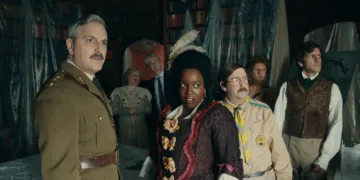
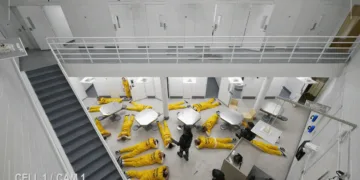
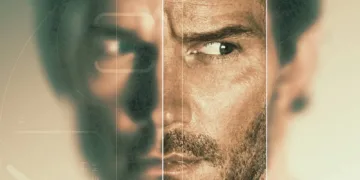
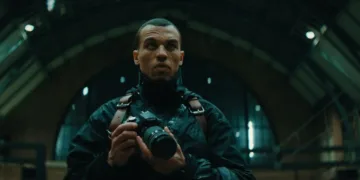








Rural West Flanders in 1999 sits there like a soaked tabletop: flat, damp, a little resigned. Then the dot-com gold rush jolts it awake. The landscape becomes a quiet stage for the collapse of an entrepreneurial dream, the sort that starts with spreadsheets and pep talks and ends with somebody staring at a wall, waiting for the phone to ring.
Anke Blondé treats the era as frantic, near-delirious investment, a moment when local software titans appear to have permission to rewrite reality itself. Luc and Geert ride straight into that storm. Luc supplies the coding wizardry (a technical genius tucked inside a mousy exterior). Geert supplies the marketing, all polished executive sheen. Together, they sell a future where voice becomes code.
Then the shine peels. A network of shell companies and falsified figures surfaces, and an investigative reporter corners them in a glitzy bathroom, that sterile lighting doing its best to flatter a filthy revelation. The confrontation starts the timer. They have exactly 36 hours before the Monday morning markets open and the whole construction officially collapses.
Blondé, working from a screenplay by Angelo Tijssens, shifts attention away from public triumph and toward private panic. The film refuses the familiar high-stakes chase and chooses the quiet torture of waiting for the inevitable. It becomes a study of two men watching the ground vanish beneath expensive shoes.
Disintegrating Suits and Binary Masks
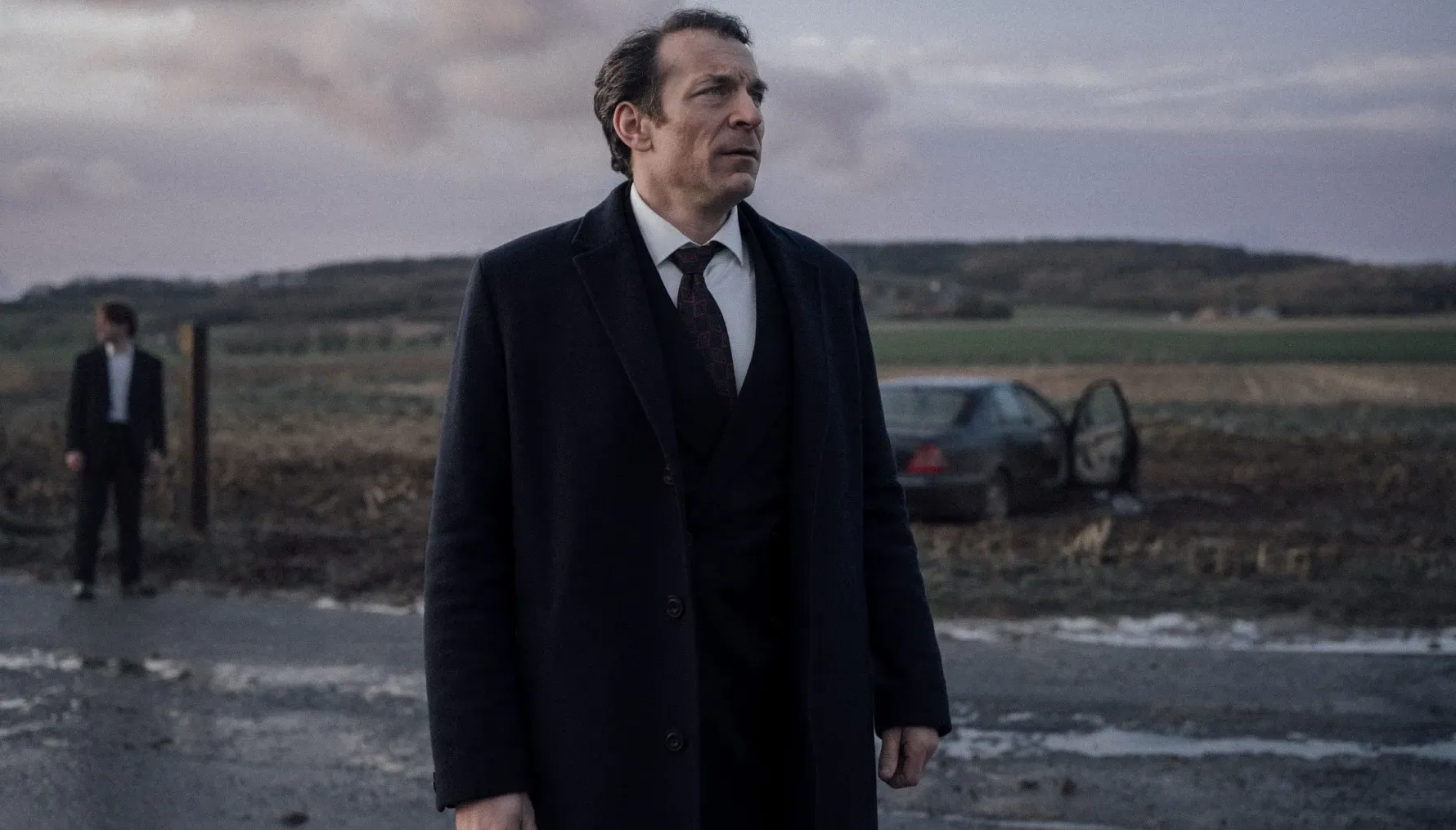
Jan Hammenecker plays Luc with a physical commitment to failure that feels almost athletic. Stress does not stay inside him. It shows up on the suit as a literal mess, and it keeps returning as the urgent need to vomit. His thinning hair goes sweat-slick and spikes upward like devil horns, a blunt visual cue for internal rot. Luc starts to look like someone the Flemish mud is actively reclaiming.
Arieh Worthalter gives Geert a colder temperature, an unreadable fire kept behind practiced control. Geert stays immaculate. He keeps pitching the salesman version of himself even while that product is exposed as fraud.
Their home lives sharpen the split. Luc goes back to his domineering wife, Alma, and starts the frantic, pathetic work of burying evidence. Geert goes looking for comfort with his driver and secret lover, Kenneth. The divergence exposes what I’d call “suit-hollowed” living, the condition where identity gets eaten alive by professional costume (and the person inside keeps clapping along). The looming arrest begins stripping away those binary masks. Trust thins out, and tension grows in the spaces between them.
They carry a suffocating, old-fashioned masculinity that treats vulnerability like a terminal defect. Failure becomes unprocessable data. These are men who spent years acting as if “downside” was a software bug already patched out, and now the error message is filling the screen.
The Chromatic Nausea of the Digital Ghost
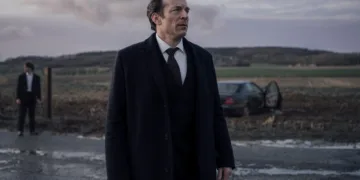
The film’s palette leans hard into a sickly yellow tinge. The hue tracks Luc’s constant nausea, staining the frame with a jaundiced, decaying quality. Flemish mud returns as symbol and substance, a “feet of clay” motif made literal. It sticks to everyone, regardless of social standing, as if the land itself refuses the fantasy of clean hands.
Frank van den Eeden shoots the rural landscapes with a cold eye. The wide-open fields tighten into something prisonlike, a reminder that space does not guarantee freedom. Sometimes it just gives panic more room to echo.
Sound works the same way. Christopher Wilson builds a design that folds the rhythmic, mechanical crunch of a paper shredder into a droning ambient score. It creates a steady pressure, the sensation of walls inching closer. The structure supports that unease through elliptical editing and flashbacks. We watch them pitching their revolutionary voice-recognition technology on global stages, then the cut drops us back into present-day rumination, small and pathetic.
A recurring joke lands with a nasty little sting: the software fails to recognize Geert’s own name. The irony writes itself, then keeps rewriting itself. These tech pioneers get blocked by their own creation, and the “revolution” they promised for human connection cannot acknowledge the man who sold it. The fragmentation pushes the film away from linear drama and toward ghost story. The ghosts keep breathing, and history has already tossed them out.
Echoes of the Bubble and the Myth of the Heroic Fraud
The 1999 setting holds up a grim mirror to our present era of “vaporware” and artificial intelligence hype. Dust nails a specific kind of “bubble-blindness,” the mindset that treats growth as natural law instead of temporary fluke. It also refuses the easy comfort of simple villains. The film treats Luc and Geert as products of a voracious capitalist system that demands miracles and hands out prizes to anyone willing to fake them convincingly.
That raises the uncomfortable question the film keeps circling: are they victims of their own hubris, or designated fall guys for a culture that cheered their deception? Some moments suggest they’re receiving exactly what they earned. Other moments slip into a strange “gonzo-sentimental” mode that tries, against better judgment, to humanize them. I found myself resisting that softness, then feeling it land anyway. Annoying, yes. Effective, also yes.
Identity becomes the main casualty. When the virtual empire vanishes, the physical reality stays behind: muddy shoes, balding patches, bodies that still sweat and retch and wait. The film implies the distance between visionary and criminal can shrink to a matter of timing. By showing the ending at the start, Blondé removes the bait of plot twists and forces attention onto psychological ruin instead of legal outcome.
The second half sometimes loses narrative momentum. The style stays committed. The lasting image is blunt: men who sold a future they could never inhabit, “original tech bros” sinking back into the mud they thought code would lift them above.
Dust had its world premiere at the Berlin International Film Festival on February 15, 2026. This feature film tracks the final 36 hours of two tech entrepreneurs in the late 1990s before their financial fraud becomes public. It arrived in Belgian theaters on February 25, 2026. Kinepolis Film Distribution handles the release in its home country. The story presents a look at the collapse of a digital empire.
Full Credits
Title: Dust
Distributor: Kinepolis Film Distribution, LevelK
Release date: February 15, 2026
Rating: 12 (Pending)
Running time: 115 minutes
Director: Anke Blondé
Writers: Angelo Tijssens
Producers and Executive Producers: Dries Phlypo, James Watson, Mikko Makela, Joanna Szymanska, Krystyna Kantor, Giorgos Karnavas, Angelo Tijssens, Tine Klint, Rich Simpson
Cast: Arieh Worthalter, Jan Hammenecker, Thibaud Dooms, Anthony Welsh, Fania Sorel, Janne Desmet, Aldona Jankowska, Verona Verbakel, Robin Keyaert, Armin Mola
Director of Photography (Cinematographer): Frank van den Eeden
Editors: David Verdurme, Lambis Haralambidis
Composer: Andrea Balency-Béarn
The Review
Dust
Dust functions as a haunting autopsy of the digital age’s infancy. By trading traditional thriller beats for a grueling, yellow-hued descent into psychological rot, Anke Blondé captures the specific misery of men whose identities were merely equity in a bubble destined to pop. While the narrative occasionally drifts into stylistic indulgence, the raw physicality of the performances ensures that the inevitable crash feels less like a corporate failure and more like a terminal illness. It is a bleak, essential study of hubris.
PROS
- Jan Hammenecker and Arieh Worthalter provide a masterclass in contrasting desperation.
- The sickly yellow palette and industrial, droning score create a palpable sense of dread.
- Offers a sharp, feminine perspective on the fragility of 20th-century masculinity.
- Frank van den Eeden captures the Flemish landscape with a chilling, claustrophobic intimacy.
CONS
- The tension occasionally slackens in the second half as the film prioritizes style over momentum.
- Because the downfall is established early, the film lacks the traditional urgency of a ticking-clock thriller.
- Some viewers might find the non-linear editing more distracting than illuminating.