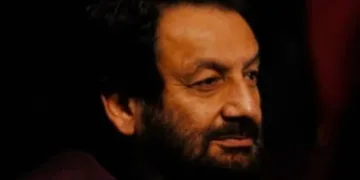

























Filmmaker Shekhar Kapur has warned that artificial intelligence could bring about the collapse of the traditional studio system, arguing that corporations built on costly, tightly controlled models will struggle to survive as filmmaking tools become widely accessible. Speaking at the WAVES Film Bazaar in Mumbai in remarks reported by Variety, he said AI is poised to dismantle long-standing hierarchies that have defined the global entertainment industry.
Kapur described AI as the most democratic technology in cinema’s history, predicting an explosion in the number of filmmakers once sophisticated tools are available to anyone with a laptop and an internet connection. He has repeatedly criticised business models that depend on massive budgets and exclusivity, saying that “A-listers” and big studios rose on structures designed to keep newcomers out and that these structures are now at risk of becoming obsolete.
In public posts and recent interviews, he has argued that AI will flatten power structures not only in film but across society, “sucking inertia out of existing structures” and replacing rigid pyramids of authority with looser networks of creators. In this view, studios and tech giants face a choice between clinging to scale and control or redirecting resources toward individual storytellers who wield AI directly.
At the same time, Kapur draws a firm line around what he believes AI cannot do. At recent technology and film events in Bengaluru and Goa, he said AI works on predictability and struggles with the emotional complexity that lives in a close-up, particularly the “pupil-to-pupil” connection between actor and audience. Storytelling, he said, is a finite being trying to touch the infinite, and that impulse remains beyond machine logic.
Kapur nevertheless embraces AI as a creative medium and cost-cutting engine. He has suggested that a film once requiring a $200 million budget could soon be made for a fraction of that sum, and he often uses the example of a housemaid using ChatGPT to produce a better presentation than a highly educated landlord as a symbol of a flattened hierarchy. He is also developing an AI-generated sci-fi series titled Warlord and has spoken about a future in which AI can even generate its own “stars,” freeing directors from dependence on established celebrities.
Kapur’s forecast lands in an industry already wrestling with AI’s impact. Recent contracts won by writers and actors in the US include new rules on disclosure, consent and compensation for AI-generated material and digital replicas, reflecting fears that the same tools he praises could be used to deskill or displace creative workers.
Debates around AI use on productions such as the drama The Brutalist, which faced backlash after revelations about AI-assisted dialogue and imagery, show how contested the technology has become even at the margins of a film’s workflow.
Set against that backdrop, Kapur’s message at WAVES frames AI as both threat and opportunity: a force that could break the economic logic of the studio era while giving millions of new storytellers access to tools once reserved for a handful of global players, provided that human emotion and creative risk remain at the center of the work.