























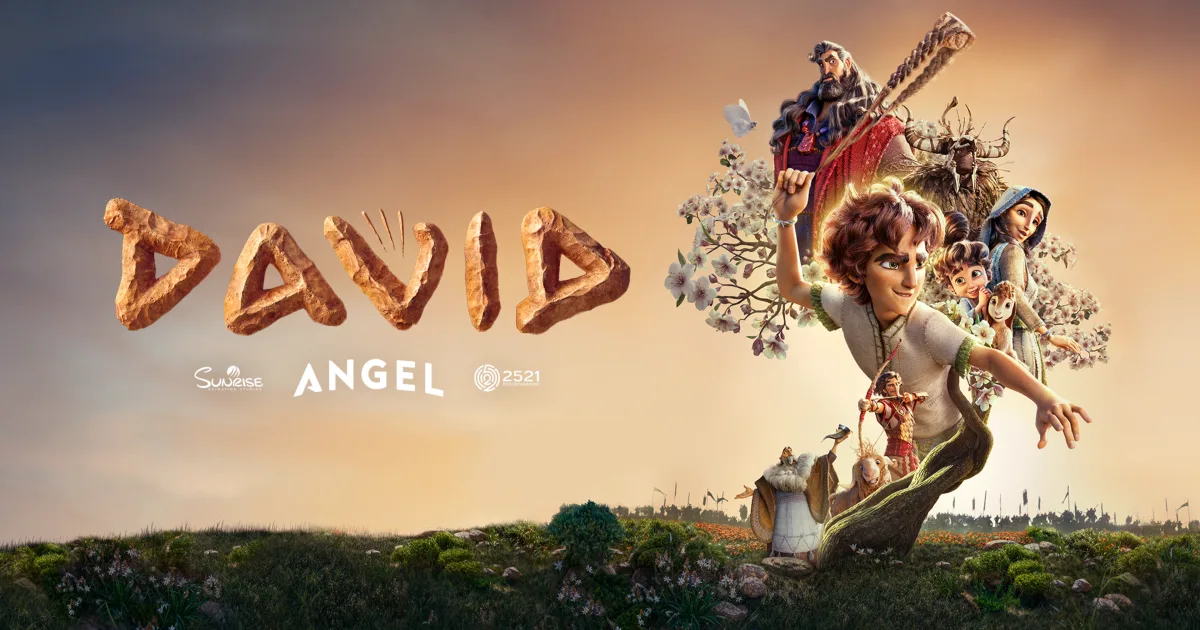

Angel Studios’ David arrives as a musically driven epic that follows the shepherd boy’s path toward Israel’s throne. Crafted by Cape Town’s Sunrise Animation Studios, it turns ancient text into approachable family drama. A divine calling meets human doubt: young David tends sheep beneath Bethlehem’s sun, slingshot in hand, lyre nearby, carrying a quiet sense of purpose instead of royal hunger.
Prophet Samuel’s anointing oil seals the direction of his life, and the story moves into politics with teeth. King Saul’s psyche frays in public. Goliath looms as a living threat. A nation’s hope turns heavy enough to bruise. The film brings visual polish and earnest faith to the pressure points, giving the spiritual narrative a pulse of court anxiety as David moves from pastoral innocence toward the shadowed corridors of Gibeah’s half-built palace.
The Loom of Light and Shadow
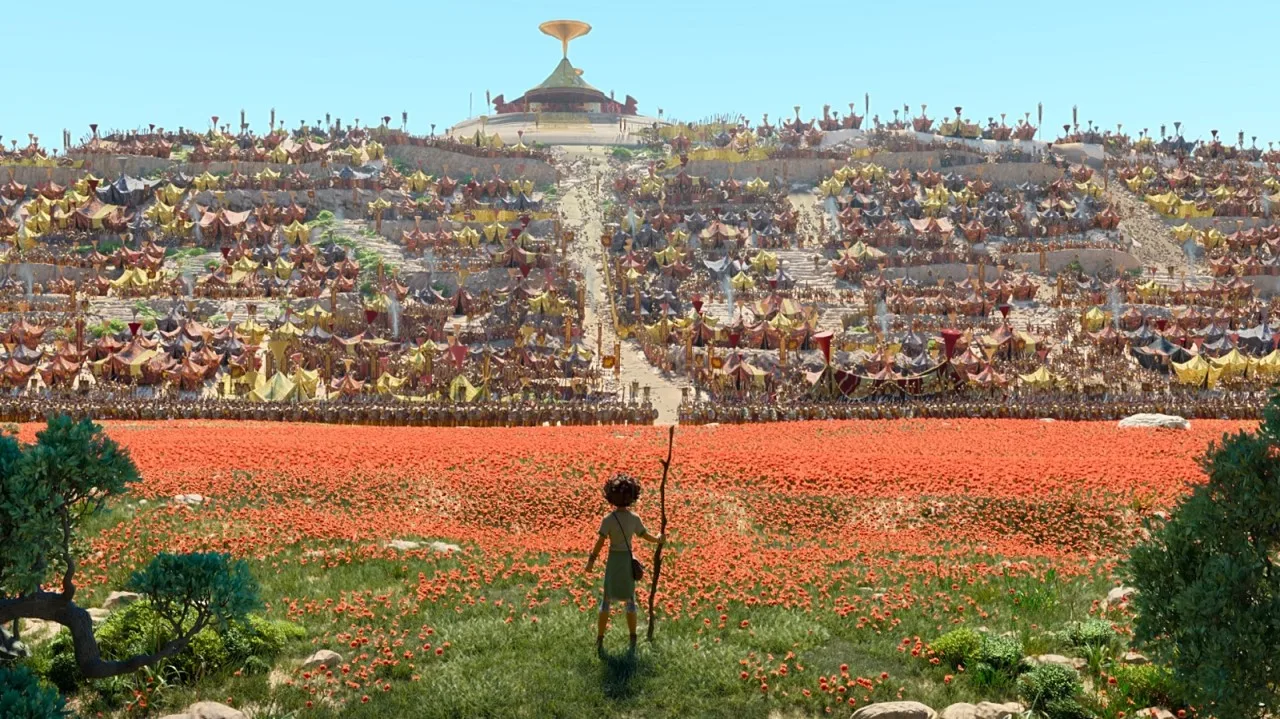
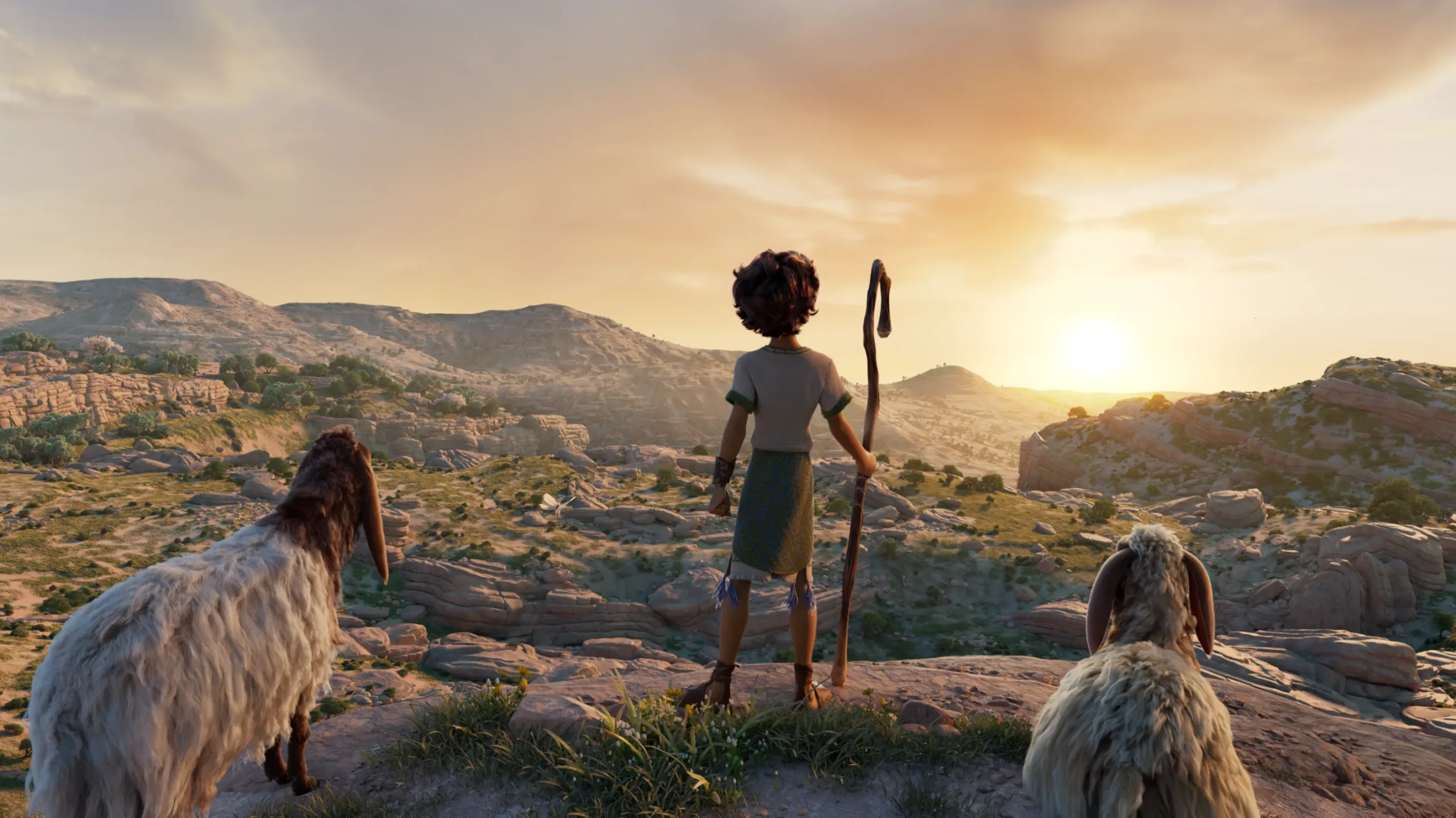
Sunrise Studios achieves something rare: animation that feels tactile. Sunlight glints on the Jordan River’s surface; dust motes drift through Samuel’s humble home. Goliath dominates through chilling design, pale skin stretched across elongated bones, eyes carrying an old malice. His first step lands like a seismic punctuation mark, both visually and sonically.
Intimate grace notes sit nearby: oil tracing young David’s cheek during the anointing, the lamb Shira nuzzling his hand. Color becomes theology. Warm golds surround David’s moments of trust; Saul’s chambers sink into icy blues as paranoia tightens its grip. This chromatic language echoes historical religious art, the kind where hue served as a moral compass. Medieval illuminators understood what modern animators sometimes misplace: light can function as doctrine you can see.
Character design speaks in its own dialect. Samuel’s rounded frame signals approachability, a gentle correction to stiff religious archetypes. Saul sharpens over time, shoulders hunching, jawline hardening like stone. His transformation recalls Caravaggio’s chiaroscuro saints, bodies shaped by inner weather. Environmental detail lands with obsessive care: woven fabrics show individual threads catching light; water in desert oases ripples with physics-defying weight. Gibeah’s construction sites hum with laborers hauling timber, sweat glistening on skin, a quick detail that drags myth down into human toil.
Minor flaws surface. Battle sequences occasionally stutter, trading fluidity for scale. Philistine warriors arrive with limited distinction, their menace compressed into snarls and spears. The loss of nuance feels familiar in an uncomfortable way. Hollywood has a long habit of sanding antagonists into faceless threats, from Philistines to modern geopolitical stand-ins, and that habit shows up here as narrative shorthand.
Also Read





Still, recurring motifs hold the spectacle together. Light pierces literal and spiritual darkness. David stands small before Goliath’s bronze armor, a visual metaphor for faith facing overwhelming force. The frames carry intention. Sunrise Studios seems to remember a lesson from Disney’s golden age: grandeur lives inside quiet attention. A sheep’s wool catching dawn light can carry the same weight as a giant’s shadow.
Voices in the Wilderness
David’s duality drives the cast. Brandon Engman voices the shepherd boy with restless sincerity; Phil Wickham’s mature David carries quiet strength. The script, though, keeps him on a single track. His faith stays unwavering, a compass that never swings. That steadiness flattens his arc. Courage appears, and the cost stays off to the side.
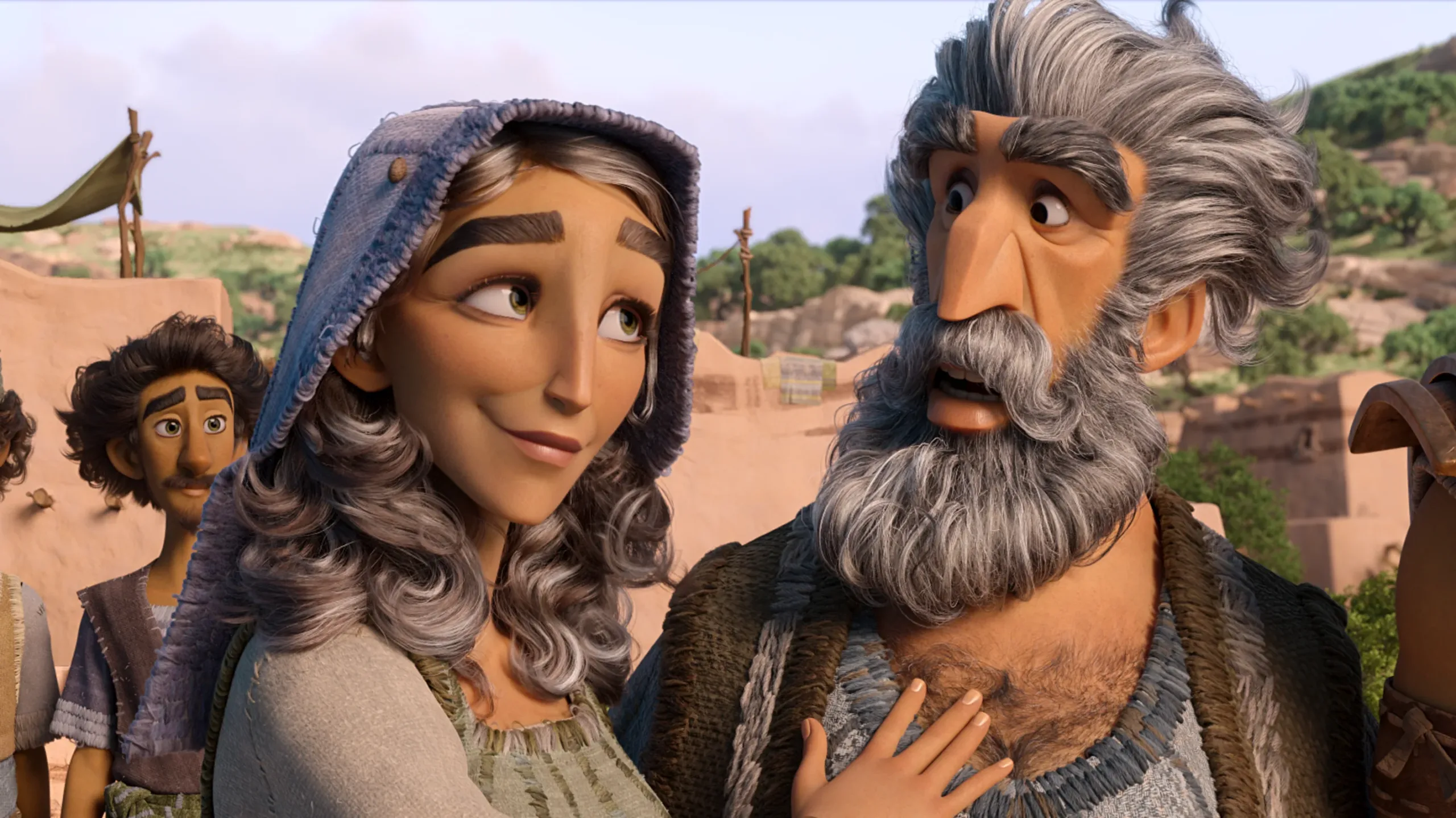
His brothers function as foils, and Nethanel’s frantic snacking turns into forced levity that crowds out the family bond. Miri Mesika’s Nitzevet shines briefly in the song titled “Tapestry,” her maternal wisdom carried by melody, then she fades from the story. (A wasted opportunity. Biblical mothers like Hannah or Bathsheba shaped kings. Nitzevet’s reduction to a single musical passage feels like theological minimalism dressed in a pretty tune.)
Supporting characters salvage depth. Adam Michael Gold’s Saul becomes a study in quiet unraveling. His initial weariness registers, then a flicker of hope arrives when David’s lyre calms his mind, followed by a chilling slide into tyranny. His final moments carry tragic weight. Gold gives Saul a kind of Shakespearean gravity, whispered prayers followed by sudden rages, devotion turning into threat.
Mark Jacobson’s Jonathan offers poignant loyalty, torn between father and friend. Their farewell scene, wordless and heavy with unsaid promises, sits among the film’s finest moments. Jonathan’s choice to prioritize friendship over dynasty invites a comparison to historical figures like Marcus Aurelius, where Stoic ideals met the brutal machinery of power and started to crack.
Antagonists falter. Kamran Nikhad’s Goliath terrifies through voice and presence, a cinematic giant whose final realization that he fights God lands with chilling simplicity. Asim Chaudhry’s King Achish drifts toward caricature, mincing and preening, draining the Philistine threat of credibility. The Amalekites remain faceless raiders, another missed chance for moral ambiguity.
This flattening of enemies points to a cultural habit: we simplify adversaries so we can avoid the harder truths. Saul’s paranoia reads as human; Achish plays like a cartoon villain from a Cold War propaganda reel. David himself suffers from excessive virtue. His lack of doubt makes him harder to recognize than flawed leaders like Henry II or Churchill. Heroism without internal struggle can start to resemble propaganda, even inside a story built on faith.
Psalms in the Key of Now
Music propels David, with uneven results. “Adventure Song” captures youthful yearning with real effectiveness. “Tapestry” soars, threading Psalm verses into a mother-son duet about purpose. Joseph Trapanese’s score swells grandly during battle, yet its themes rarely linger in memory. Wickham and Mesika’s vocals lift spiritual moments without tipping into saccharine. The Saul lyre scene works beautifully, melody functioning as balm for a fractured mind.
Sound design immerses: sheep bells chime softly; Goliath’s footsteps echo like distant thunder. The silence before his roar becomes palpable dread. This auditory craftsmanship recalls biblical epics like The Ten Commandments, where sound carried divine presence more powerfully than dialogue.
Weaknesses emerge in tone. Nethanel’s “Please not the food!” gag shatters tension during a raid. The moment lands as a jarring misstep, like finding a knock-knock joke inside Schindler’s List. Climactic songs preach where they need to emote, leaning on doctrine at the expense of catharsis. The finale’s anthem about trusting God feels unearned because David never truly wavers. Dialogue sometimes sinks beneath orchestral waves. A battle cry disappears under brass.
The imbalance reflects the film’s central struggle, inspiration competing with instruction, confidence competing with trust in the audience. The best moments understand this. The worst moments forget. Modern worship music’s influence is visible in the construction of the songs, favoring congregational singability over tight narrative integration. “Follow the Light” invites comparison to Moana’s “How Far I’ll Go”: one serves theology, one serves character. Both approaches have value, and only one tends to stick after the credits.
Threads of Power and Paranoia
Narrative structure wobbles at the midpoint. Goliath falls early, and Saul and David’s conflict feels rushed in the back half. Bathsheba’s absence sanitizes David’s later moral failures, a choice that removes necessary darkness from the larger story. Compression succeeds elsewhere. Samuel’s anointing scene conveys divine weight in under two minutes through visual symbolism, the oil’s slow drip, David’s trembling hands.

The Ziklag raid adapts scripture with clarity and visceral energy. Humor and horror collide with rough edges, sheep antics arriving near Saul’s darkest hour. This tonal whiplash resembles scripture itself, where David dances before the Ark and later orders executions. The film flinches away from that complexity.
Faith portrayal shows restraint in key places. David sparing Saul’s life speaks louder than sermons. Saul’s mental decline avoids easy melodrama, presenting fragility with a human face. Goliath’s defeat happens offscreen, respecting young viewers while preserving impact. Modern echoes ring out in uncomfortable ways. Saul’s obsession with power mirrors contemporary leaders clinging to fading relevance through paranoia and spectacle. David’s humility reads like an antidote. The film sidesteps harder questions, though.
Philistine motivations remain unexplored, and the portrayal of Philistines as faceless aggressors skips historical context where empires like Assyria treated Israel as a rebellious province. David’s political acumen fades as spiritual beats take priority. A late “trust crisis” arrives without groundwork. The finale’s Christ imagery appears abruptly, like a theological footnote added at the end of the page. This points to a tension inside faith-based storytelling: scriptural fidelity pulls one way, cinematic momentum pulls another. David leans toward fidelity, and the story pays a price.
A New Loom for Sacred Stories
David matters beyond its flaws. It shatters expectations of faith-based animation. Sunrise Studios shows that spiritual narratives can carry artistic ambition while holding onto doctrinal integrity. The film keeps its focus on scripture and emotion, leaving pop-culture winks outside the frame. Children can grasp David’s courage facing Goliath. Adults can recognize Saul’s corrosive envy. The PG rating balances intensity, Goliath’s shadow looming large while violence stays implied. That calibration brings to mind The Prince of Egypt, a film that trusted younger audiences with weighty material.
This release lands during cultural arguments about power, and it offers a model of leadership rooted in service rather than spectacle. David’s reluctance to rule feels radical in an age of celebrity politicians. At the same time, dialogue occasionally betrays the setting. Modern phrases like “I know, right?” jar against ancient hills and break immersion. Thematic depth sometimes gives way to plot momentum.
Jonathan and David’s farewell resonates; Nethanel’s snack gags do not. The film’s crowdfunded origins, including $50 million raised, signal a significant shift. Independent voices can produce visually ambitious, theologically thoughtful animation outside Hollywood’s system. The pattern echoes Renaissance patronage, merchants funding art that nudged against ecclesiastical control.
David is imperfect. Its existence still signals change. It avoids Disney’s reflexive individualism. David’s heroism grows from submission to a higher purpose, not self-discovery. Families looking for substance without cynicism will find rare space here. Sunrise Studios has made a statement about craft and conviction, and the industry will have to respond. The giant of low-budget faith cinema lies felled. Something new stands on the field now, a commitment to technique married to belief, and that marriage can inspire viewers tired of hollow spectacle. In a world where algorithms feed personalized illusions, David tells an ancient story with fresh eyes. Its flaws feel human. Its ambition feels holy. And sometimes, that is enough.
The animated musical David arrived in theaters across the United States on December 19, 2025. This production from Sunrise Animation Studios and Angel Studios offers a high-definition, song-filled retelling of the biblical shepherd’s rise to the throne of Israel. Audiences can currently experience the film on the big screen, with domestic distribution handled by Angel Studios, known for their unique crowdfunding and “Pay It Forward” ticketing models.
Full Credits
Title: David
Distributor: Angel Studios
Release date: December 19, 2025
Rating: PG
Running time: 115 minutes
Director: Phil Cunningham, Brent Dawes
Writers: Brent Dawes, Phil Cunningham, Kyle Portbury, Sam Wilson
Producers and Executive Producers: Phil Cunningham, Jacqui Cunningham, Steve Pegram, Tim Keller, Rita Mbanga
Cast: Phil Wickham, Brandon Engman, Adam Michael Gold, Brian Stivale, Mark Jacobson, Miri Mesika, Asim Chaudhry, Lauren Daigle
Director of Photography (Cinematographer): Charl Collocott
Editors: Tom Scott
Composer: Joseph Trapanese
The Review
David
David succeeds as a technical showcase for Sunrise Animation Studios, proving that faith-based media can finally match the visual polish of major secular houses. While the script occasionally leans on modern slang and safe tropes, the tragic portrayal of King Saul and the impressive scale of the Goliath sequence offer genuine cinematic weight. It is a capable, if slightly sanitized, musical that prioritizes emotional resonance over historical grit.
PROS
- Goliath’s chilling, psychologically layered design
- Gold’s tragically human King Saul
- Tactile environmental animation (water, fabrics, light)
- Psalm-integrated songs with emotional sincerity
CONS
- David’s unchanging faith eliminates character growth
- Caricatured Philistine antagonists
- Jarring modern dialogue in biblical context
- Second-act pacing collapse post-Goliath