

























![Kingdom Hearts Collection [I-III] Review](https://gazettely.com/wp-content/uploads/2026/10/Kingdom-Hearts-Collection-I-III-1-360x180.webp "Kingdom Hearts Collection [I-III] Review: KHII Holds Steady as Newer Entries Fluctuate 37")





Mohammad Sawwaf’s feature-length documentary Gaza’s Twins, Come Back to Me takes the sprawling, brutal headlines of the war and holds them against the intimate, devastating experience of a single family. First planned as a short film, the expanded feature charts the severe toll of the conflict that began in late 2023.
Set in northern Gaza, the film introduces Rania and her taxi-driver husband, Akram, inside a landscape that steadily falls into ruin. Their story turns on an almost unimaginable break in the ordinary rhythm of family life: Rania gives birth to twins, a boy and a girl, in a hospital that functions as a war zone.
The infants are rushed south for medical care, separated from parents who remain trapped in the north. Sawwaf looks past the relentless news cycle and shapes a portrait of everyday struggle, where survival, hope and the dream of reunion fill each day. The film tracks Rania and Akram’s attempts to move through physical obstacles and bureaucratic systems to see their babies again. The documentary studies a personal fight for family that unfolds inside large-scale destruction many viewers usually encounter as distant headlines.
The Architecture of the Family
The film’s narrative design grows from the idea of family as an extended, flexible network that tries to adapt to trauma. The first blow is severe. Rania is eight months pregnant with triplets and loses one infant at birth; the surviving twins arrive prematurely and move to a facility near Rafah. Three painful months pass before the parents manage to locate the babies. At that point, the film shifts its attention to Nisreen, Rania’s sister, who has fled south and steps into the immediate, demanding role of guardian.
This structural choice creates a divided focus that reflects the splintered texture of daily life in wartime. Rania and Akram in the north see their children only through a phone screen, an image that carries heavy emotional weight. At the same time, the film settles into Nisreen’s crowded, displaced household. The camera attends to small, practical routines: changing nappies, heating bottles, watching over one twin who needs specific care because she is severely underweight.
Determination appears entirely through behaviour and circumstance. No one delivers grand speeches. Strength comes through the simple, constant, loving effort to keep fragile lives stable amid near-total ruin. The family’s shared insistence on care functions as a form of character development, and the architecture of the story mirrors that commitment.
Cinematography of Ruin and Grace
Gaza’s Twins, Come Back to Me treats its setting as a visceral character. The film opens with footage of an aerial bombardment so close it shakes the camera, and that first image fixes a raw, high-stakes visual language. The cinematography refuses softening filters on northern Gaza. Rubble fills the frame, masonry piles high, and buildings lean at unsafe angles on broken foundations. The place appears as unfiltered devastation.
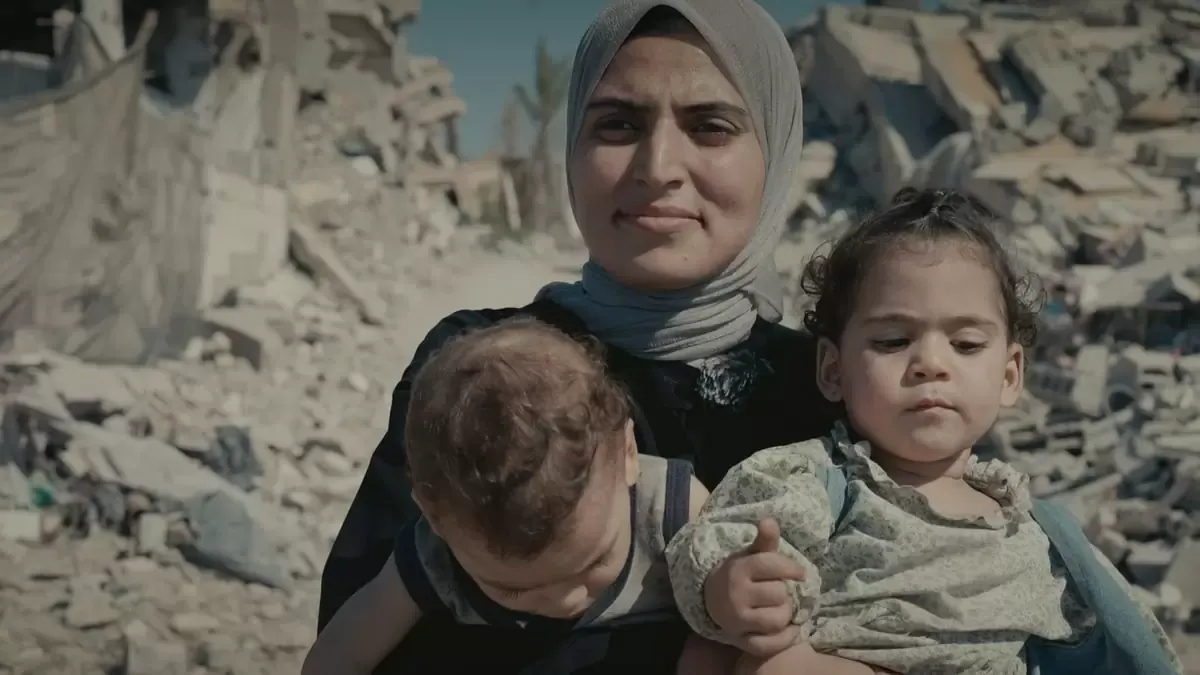
This landscape frames the repeated uprooting of Nisreen’s family. We see the tiring, spirit-sapping routine of dismantling a temporary tarpaulin shelter for the fifth time. The quiet frustration of Nisreen’s husband as he carefully saves the removed nails, which carry real market value, becomes a sharp detail in a world where basic materials equal survival.
Against these images, Ali Helnwein’s gentle, mood-focused score, coloured by Arabic tones, gives a fragile sense of calm. That musical line supports stretches of unacted observation, most powerfully during the eventual reunion, and heightens the emotional weight of those scenes. The film positions devastation as an inescapable frame for human endurance, stripped of spectacle.
Resilience as the Core Theme
Sawwaf shapes the film as an affirmation of resistance and the continuation of life. The themes that surface again and again are family solidarity, improvisation, love and deep emotional stamina. The documentary avoids overt political debate and lets resignation, persistence and care carry the emotional argument.
This steady tone allows flashes of humour and tenderness to rise inside the bleakness. The camera follows the family as they search for herbs among ruins or lingers on the soft cooing around a happy baby. These small scenes form the moral center of the film. As a critic who appreciates films that find grace in challenging material, I feel a strong response to this approach.
The power of Gaza’s Twins, Come Back to Me rests in its close, unscripted attention to the tenacity of mothers and extended families. The film leaves abstract commentary behind and offers a shared sense of human suffering paired with a basic, persistent need for connection. That enduring spirit forms the film’s final message.
Gaza’s Twins, Come Back to Me is a documentary that intimately follows the struggle of a Palestinian family separated by conflict. It premiered internationally at the International Documentary Film Festival Amsterdam (IDFA) in November 2025. The film chronicles the story of Rania, who gives birth to premature twins in a Gaza hospital during the 2023 conflict, only for the infants to be evacuated south while she remains trapped in the North. As of today, December 8, 2025, the film had its Dutch broadcast premiere on NPO 2 on December 4, 2025, and can be streamed in the Netherlands via NPO Start or NPO Plus. Other viewing platforms and wide distribution releases are anticipated in 2026.
Full Credits
Title: Gaza’s Twins, Come Back to Me
Distributor: Al Jazeera, IDFA (Festival Premiere), NPO (Dutch Broadcaster)
Release date: November 2025 (World Premiere at IDFA)
Running time: 96 minutes
Director: Mohammed Sawwaf
Writers: Mohammed Sawwaf
Producers and Executive Producers: Mohammed Sawwaf, Salah Alhaw, Ibrahim Al-Otla, Sylvia Sahawneh, Renko Douze, Hasse van Nunen, Fiona Lawson-Baker, Mohammed Al Hamadi
Cast: Rania, Akram, Nisreen
Director of Photography (Cinematographer): Mohammed Sawwaf
Composer: Ali Helnwein
The Review
Gaza's Twins, Come Back to Me
Gaza's Twins, Come Back to Me is an essential piece of cinema that reframes a major global tragedy through an intensely personal lens. Director Mohammad Sawwaf achieves a balance between the raw chaos of war and the quiet, enduring strength of family. It is a profoundly moving, technically adept work that champions human connection and resilience over despair. The film succeeds by placing simple acts of care at the moral heart of overwhelming devastation.
PROS
- It succeeds in shifting the narrative from political headlines to the specific, lived experience of one family.
- The film includes raw, unvarnished footage of the war zone that provides an immediate, powerful sense of place and danger.
- It effectively uses unacted, documentary footage to create moments of genuine, heartrending emotion without manipulation.
- The tone emphasizes family solidarity, love, and the determination to keep life going, offering a necessary counterpoint to loss.
- The sound design, particularly the gentle, Arabic-inflected soundtrack, enhances the emotional tone effectively.
CONS
- Due to the documentary style, the film relies heavily on circumstance and action to convey character, which may leave some viewers wanting more explicit personal reflection or background context.
- The prolonged separation means the key relationship—mother to twins—is often mediated by a phone screen, which is dramatically effective but can feel emotionally restrained at times.
- For some viewers, watching such raw footage of ongoing suffering may create a necessary but profoundly uncomfortable viewing experience.







