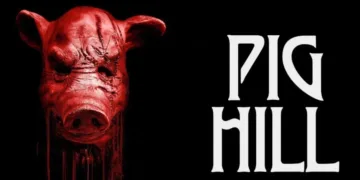
















Intermittent, animalistic snorts and grunts cut through the soundscape of Meadville, Pennsylvania, where the legend of the “pig people” hangs over the town like a cold, foul truth that shapes generational fear. Kevin Lewis’s latest feature, Pig Hill, steps directly into this corrupted folklore, leaving behind the camp sensibilities of his previous work and embracing a severe, ugly aesthetic.
The narrative tracks Carrie (Rainey Qualley), an aspiring writer consumed by the local myth, whose fixation sparks a dangerous investigation as the count of missing women quietly rises. Lewis fixes the film in unrelenting dread from the outset.
The film treats its task as a cinematic ordeal that draws on the brutal, unvarnished shock cinema of earlier decades, playing an outlandish premise with stark seriousness and an austere absence of humor. Pig Hill presents a descent into the kind of secrets small communities bury alive, histories that take root in silence and grow monstrous beneath the surface.
Atmosphere of Grotesque Indifference
Pig Hill constructs its atmosphere through sheer shock and an aesthetic of the grotesque, leaning into visceral impact while traditional suspense recedes into the background. The film’s deliberate saturation in disturbing imagery defines its identity and fuels debate about its purpose.
Lewis turns to taboo subjects and extreme violence with an aggressive, uncompromising hand. The material remains relentlessly heavy, refusing to turn away from profoundly difficult content, including instances of assault and depravity that shape the viewing experience into something arduous.
This stylistic choice splits the audience. Some viewers may see a determined effort to channel the brutal, unvarnished spirit of older horror subgenres; others are likely to read the approach as overtly exploitative, with graphic content that erodes any chance for genuine, steadily mounting tension. The film’s obsession with such unpleasantness functions less as a vehicle for fear and more as a test of the viewer’s tolerance, creating an experience that repels as much as it arrests.
The narrative’s tonal inconsistencies sit alongside several sharp technical merits that deepen the film’s sense of decay and terror. Sound design plays a central role in generating dread. The intermittent, animalistic snorting and grunting associated with the fabled “pig people” lend an immediate, visceral eeriness to the environment, affirming the repulsive nature of the legend long before the full horrors emerge. Visually, the cinematography supports this mood, capturing the grimy, uncomfortable texture of the locations. The aesthetic reinforces a persistent impression that something foul and ancient festers within this landscape.
A significant problem grows from the film’s uncertain sense of pacing and identity. The first hour adopts a slow-burn rhythm, carefully establishing the mystery and building the principal characters in a manner that echoes an investigative thriller. That carefully measured approach collapses in the final third, where the film accelerates into a messy, brutal torrent of exposition and violence.
The rushed shift produces a jarring tonal break that undercuts the film’s cohesion. The story strains to reconcile its ambition to create a layered, character-focused mystery with a drive to serve as an intense, gore-oriented endurance test. The result feels fragmented, unable to satisfy viewers looking for either a taut mystery or a coherent exercise in shock.
Narrative Woven with Trauma and Legend
The primary narrative engine follows Carrie’s investigation into the local disappearances, framed by her personal project to write a book on the Pig Hill legend. This pursuit intertwines with her own emotional landscape. She contends with estrangement from her husband and the continual work of managing the pill addiction of her brother, Chris (Shiloh Fernandez). Personal trauma becomes the springboard for uncovering a wider communal horror.

The connection between Carrie and Chris provides a central emotional line. Their sibling bond reads as convincing, even as the performances occasionally carry a certain stiffness. This relationship gains another layer with the return of Andy (Shane West), a friend who comes back to town after his own series of losses.
The growing connection between Carrie and Andy produces some of the film’s quieter and more sincere moments, supported by an easy, natural chemistry. The film lays solid groundwork for these characters, so the mystery unfolds against a backdrop of familiar human frailty.
The core mystery creates an absorbing sense of corrupted local history. It uses the urban legend of the “pig people” to suggest a deeper, more pervasive sickness within Meadville. The anticipated third-act twist, which sharply recontextualizes the source of the horror, arrives with heavy foreshadowing and loses strength for viewers experienced with mystery structures.
Lewis avoids concluding the film with simple splatter. The finale aims for a horrific, emotionally charged resolution, with the mystery closing on a note of psychological devastation. The film presents the horrific, hidden truths behind urban legends and ties terror above all to the dark secrets of a community. Gratuitous shock often crowds out the subtle exploration this theme requires.
Directorial Intent and Casting Challenges
Kevin Lewis directs with a clear, straightforward vision that signals his understanding of the horror genre’s many expectations. His commitment to playing the material straight, refusing the easy route of camp or self-aware humor for an intrinsically wild storyline, marks a deliberate choice. This refusal to soften the material presses the viewer to confront violence and depravity directly. His direction occasionally lacks the command required for the most intense passages, especially during the film’s heaviest, most demanding sequences, which sometimes feel unfocused or uncertain and miss the sharp precision needed for such explosive content.
The heavy subject matter calls for complex, nuanced performances that the main cast does not always meet. Rainey Qualley’s work as Carrie remains competent, and she grows into the role as the runtime progresses, yet early scenes sometimes register as wooden, short of the emotional urgency the narrative demands. A hypnosis sequence exposes this shortfall most clearly, landing in unconvincing fashion.
Shiloh Fernandez’s turn as Chris leans toward excess, signaling emotional and plot developments earlier than the script requires. The supporting ensemble works to lift the material, yet the writing often hems these performances into a single, limited register. The actors establish the basic contours of their characters, but the script’s intensity and the erratic pacing keep any of them from reaching a fully memorable or deeply impactful presence, leaving the acting effective only at a functional level. The cast labors against a demanding, inconsistent framework.
Pig Hill is a horror feature directed by Kevin Lewis, known for Willy’s Wonderland, and is adapted from the novel Pig by Nancy Williams. The film delves into the dark urban legend of the “pig people” in Meadville, Pennsylvania, a myth that intertwines with a series of mysterious disappearances. It had its World Premiere at FrightFest on August 23, 2025. The film is set to be released on Digital and Video on Demand on December 9, 2025. Following this, a physical media release is scheduled for January 13, 2026, and the film will begin streaming on the SCREAMBOX platform on March 10, 2026.
Full Credits
Title: Pig Hill
Distributor: Cineverse, Concourse Media (Worldwide Rights)
Release date: December 9, 2025 (Digital and Video on Demand)
Running time: 100 minutes (1 hour 40 minutes)
Director: Kevin Lewis
Writers: Jarrod Burris (screenplay), Nancy Williams (novel Pig)
Producers and Executive Producers: Maty Schiff, Ted Watts Jr., R.A. Mihailoff (Producer)
Cast: Rainey Qualley, Shane West, Shiloh Fernandez, R.A. Mihailoff, Tammy Pescatelli, Emma Kotos, Kirby Griffin, Jason Baker, Kyle Roberts
Director of Photography (Cinematographer): Tyler Eckels
Composer: Émoi
The Review
Pig Hill
Pig Hill is a tonally confused, deeply unflinching horror film that sacrifices suspense for unrelenting shock. Its commitment to playing a truly grotesque premise straight is a defining, divisive choice. While it features effective sound design and attempts to build an engaging small-town mystery around the trauma of folklore, the narrative is ultimately hindered by inconsistent pacing, an over-reliance on exploitation, and uneven performances. It appeals primarily to viewers with a strong appetite for brutal, old-school shock cinema.
PROS
- The unsettling use of snorting and grunting significantly enhances the atmosphere and dread.
- The director maintains a serious, non-camp tone throughout, treating the outlandish material with stark gravity.
- The initial mystery surrounding the local legend and rising number of disappearances is absorbing.
- The relationship between Carrie and Chris is established well, providing a believable emotional anchor.
CONS
- The film frequently opts for gratuitous exploitation over genuine tension or fear.
- A slow-burn start gives way to a rushed, messy final act, creating tonal fragmentation.
- Key cast members, particularly in high-emotion scenes, are sometimes wooden or over-the-top.
- The film struggles to balance its identity as a character-driven mystery with its desire to be a brutal gore-fest.
- The third-act narrative turn is easy for seasoned horror viewers to anticipate.