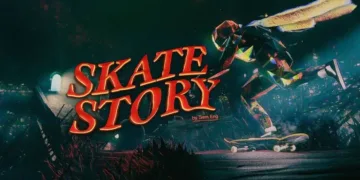








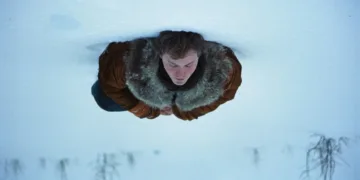






A demon made of glass and pain stays awake, unable to rest. This strange, striking premise powers Skate Story, an adventure that trades familiar skateboarding templates for a sharply focused, stylish experience. The Skater lives in permanent wakefulness under the harsh light of the moon that hangs over their underworld. Relief comes with a single condition: the moon must be eaten.
To pursue that cure, the Skater enters a compact with the Devil, who provides the only tool that matters here, a board. From that first push, the route runs through a warped, chimeric version of New York City, built on psychogeography and surreal irony. A strong audiovisual identity and a precise sense of personality give the game an immediate pull and a reality that feels self-contained. The whole premise and presentation show how powerful tightly focused, art-driven design can be when every element serves a single idea.
The Kinesthetic Language of Progression
The mechanical framework of Skate Story turns the emotional charge of this world into something you read through control inputs and rhythm. The design leaves behind the exhaustive trick catalogs of traditional arcade skateboarding games and treats movement as the main language of interaction. Skating feels tight and deliberate, grounded in street fundamentals.
Learning starts with the ollie and powerslide, then adds layers of difficulty through spins, reverts, and more complex tricks. The control scheme favors instinct and feel from the player over hyper-precise, simulation-style inputs. This concentrated focus creates a steady learning curve that rewards practice with a clear sense of flow as moves connect and recombine.
Combos carry narrative weight. Tricks link together to build score, measured as Souls. Each run reaches a tipping point with the stomp, a timed press that banks the accumulated Souls. The stomp has a double role as both score modifier and a form of metaphysical combat. High-value strings of tricks turn directly into damage against the game’s moons, celestial objects, and demonic opponents. Boss encounters reshape the arena into vivid, synchronized stages where landing tricks feels like an act of resistance.
Success depends on managing momentum, trick choice, and timing so that mechanical fluency produces visible consequences in the world. Because the Skater is made of glass, every collision shatters them in spectacular fashion and reinforces how punishing the pursuit can feel. Progression flows directly from this expression of skill, since Souls act as currency at a gift shop that sells new components and stickers, concrete rewards tied to how well you skate.
Geometry, Narrative, and Psyche
The game’s visual language is tightly bound to its story. A lo-fi crystalline presentation turns the Skater’s glass body into a prism for light, then answers every mistake with a sharp explosion of fragments. This look gains strength from extensive post-processing work, including convincing camera shake, film grain, and translucent, spectral scenery. The distortions and deliberate roughness generate unease and a sense of dream logic. The intensity of the effect can be demanding, and some players may experience motion sickness.

The setting operates as environmental storytelling through psychogeography. The underworld appears as a warped, chimeric New York, a clear departure from a familiar picture of a fiery pit. Cafes, bodegas, and laundromats sit shoulder to shoulder with infernal architecture, with crimson ribs jutting from concrete and structures shaped by the Devil’s Geometry. This mixture supports the game’s themes of pain, exhaustion, and identity, hinting that this hell reflects the bureaucratic absurdities and existential miseries of everyday life.
The narrative reads like a postmodern fable. It follows a push to resist a controlling reality, the Devil’s Geometry, through constant motion. The script holds together tones of cosmic portent, cruel intent, and surreal irony without losing its footing. A small group of eccentric NPCs, including a demonic penguin and a talking pillow creature, add dry, absurd humor through their conversations.
That humor keeps the darker material from smothering the experience. The writing style stands out as well. The narration arrives as a longform poem that often bends grammar and structure. This approach suits the game perfectly and deepens the sensation of a world that feels recognizable and completely alien at the same time.
Synaesthesia and Structural Pacing
Sound design is a central part of the game’s synaesthetic effect. A stylish soundtrack, with contributions from the band Blood Cultures, fits the visual and narrative mood. The music moves between pounding synthetic rhythms and quiet, aching passages. During high-intensity sections, environmental lighting and visual effects often fall in step with the score, which gives the impression that the city and the track are moving to the same beat. Skating feels like an audio-visual performance, a step beyond a purely mechanical task.

The structure relies on concise pacing. The adventure runs for roughly seven hours across nine chapters. Levels favor short, sharply defined challenges that move quickly between demanding skate courses and striking set pieces. That rhythm builds toward a closing sequence known for its bold audiovisual ambition, where the presentation jumps to a cosmic scale.
The skating itself feels strong. The linear path occasionally turns small mistakes into sharp breaks in momentum when an unseen obstacle causes a sudden stop. Another structural constraint comes from the absence of an easy way to revisit earlier skate spots after you finish them. Players who want to return to previous areas and refine their lines face a progression path that moves in a single direction and rarely looks back.
The Review
Skate Story
Skate Story is a profoundly personal, deeply stylish art piece that excels at translating existential pain into physical flow. While its linear structure and specific visual intensity may not suit every player, the tight skating mechanics successfully merge with the ambitious narrative. The game delivers a spectacular audiovisual experience that is both absurdly funny and thematically rich, establishing a strong, original identity.
PROS
- Stylish, singular aesthetic.
- Flow-state skating mechanics.
- Excellent soundtrack integration.
- Unique narrative premise and humor.
- Visually spectacular boss sequences.
CONS
- Visual filters may cause motion sickness.
- Linear structure limits area revisitability.
- Occasional minor collision bugs.