


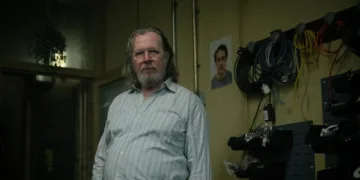

























Debt behaves like gravity in cinema, a pull that drags a protagonist downward until logic starts to warp. Sattam, played by Mohammed Aldokhei, lives inside that crushing field. He is a serial entrepreneur with a portfolio made of collapsed dreams and aggressive creditors. The film introduces him as a man cornered by the predatory math of a loan shark named Abu Atiq. The repayment deadline is absolute. The consequences of failure feel bodily.
Panic arrives dressed as strategy. Sattam sketches a plan defined by cowardice: he will stage his own abduction and squeeze a ransom from his estranged, wealthy father. The narrative then swerves with blunt force. The self-kidnapping curdles into a patricidal conspiracy. Sattam decides to kidnap the patriarch himself. That pivot, from hunted man to hunter, locks in the film’s central tension.
Amine Lakhnech directs this Saudi Arabian feature as a study in escalation, where every “solution” breeds a worse problem. The premise plays as absurd. The motivations sit in bleak economic reality. The film draws a stark binary in Sattam’s world: the son’s crushing poverty beside the father’s hoarding. The film plays as comedy. The ground beneath it stays terrifying, rooted in a man who has run out of options.
A Symphony of Incompetence
The film works inside the crime-comedy lane, summoning the frenetic, kinetic energy of a Guy Ritchie caper, with the usual hyper-competence absent. These criminals distinguish themselves through a profound inability to commit crimes.
The kidnapping of Sulaiman plays as a messy, amateurish disaster that spills across the screen. Sattam recruits Yacob, a foil played by Yazeed Almajyul. Yacob contributes panic, and the enterprise never finds steadiness. Their interplay becomes the comedic engine. We watch them fumble disguises and logistics, their ineptitude serving as a grimly funny comment on ambition.
The pacing mirrors the characters’ anxiety. Scenes rush forward with a breathlessness that mimics a panic attack. The rhythmic acceleration pushes the audience to accept the escalating stakes without pausing to scrutinize the logic. A clerical error transforms a ransom demand of 300 thousand riyals into 300 million, a mistake that propels the narrative from a localized family dispute into a chaotic spectacle.
The humor relies heavily on situational irony and the universal language of the plan gone wrong. Some dialogue beats carry cultural nuances that can remain opaque to an international viewer. The physical vocabulary of failure needs no translation.
The film balances genuine tension with ridiculous execution. The threat of violence lands as real. Laughter follows from Sattam’s transparent attempts to avoid it, pathetic in their desperation. The audience gets tugged in two directions at once, clenching through the danger while the scheme collapses in plain sight, a neat little trick of timing and pressure.
The Existential Drifter and the Patriarch
Mohammed Aldokhei delivers a performance that anchors the film in a specific emotional reality. Sattam is a morally questionable figure, willing to terrorize his own parent for solvency. Aldokhei imbues him with a pathetic dignity that pulls empathy into the frame. He fits the noir archetype of the doomed man, reimagined for a farce.

Desperation registers as a constant, vibrating frequency of anxiety, rarely rising to a shout. He is a loser, and his refusal to accept his fate gives him a tragic dimension. It is hard to watch a man sprint from consequence to consequence and still believe he has choices, which is exactly the point: the film stages free will as a performance, then lets the mask slip.
Yazeed Almajyul, as the accomplice Yacob, provides the necessary counterpoint. Sattam functions as the architect of their doom. Yacob becomes the unwitting bricklayer, stealing scenes with reactions that highlight the absurdity of their predicament. The father, Sulaiman, played by Abdulaziz Al-Sokayreen, offers a performance of rigid stoicism. He reads as an immovable object facing Sattam’s unstoppable force of bad ideas, a figure built from silence and stubbornness. In noir terms, he is the wall the protagonist keeps punching, convinced the next hit will open a door.
The film casts Sattam as the black sheep, a stain on the family honor. The screenplay also suggests the family itself is flawed. The father is a miser who values currency over kin. The siblings sit in judgment, their moral superiority unearned. This dynamic sharpens the social observation, and it plants the story in an ethical gray zone where sympathy keeps shifting.
The inclusion of Sattam’s daughter serves as the emotional ballast. She is the human cost of his failures, the reason his desperation carries necessity alongside self-interest. Her presence prevents the film from dissolving into pure cynicism, even as it keeps a steady eye on how damage passes downward.
Neon Noir in the Urban Desert
Director Amine Lakhnech turns away from the dusty, sepia-toned aesthetic often lazily applied to regional cinema. He presents a visual landscape that feels modern and urban. The cinematography uses the harsh, artificial glow of supermarket fluorescents and the sterile, cold lighting of luxury interiors to frame the action. This is a world of surfaces and reflections, where faces look trapped behind glass and money feels like architecture.
The camera moves with a fluidity that suggests a higher budget, lending the production a slickness comparable to international streaming standards. The setting becomes a character in its own right, a modern Saudi Arabia defined by highways, commerce, and the stark division of wealth. Shadow and light do their noir work here, pushing the image toward a contemporary chiaroscuro, with clean lines that still feel slightly expressionistic in their severity.
The editing is sharp, often cutting on movement to maintain a high-velocity narrative flow. It creates a visual rhythm that matches the frantic internal state of the protagonist, and it keeps the audience’s perception tuned to urgency. The film occasionally reveals the limitations of its resources during the more action-oriented sequences. Certain practical effects or stunts lack the tactile weight of a blockbuster, feeling slightly weightless or staged. These technical shortcomings rarely break the immersion.
The sound design works hard to bridge the gap, using audio cues to ratchet up the tension when the visuals soften. The music underscores the comedic beats without sliding into cartoonish excess. Lakhnech treats the farce with the seriousness of a thriller, letting shadow, light, and tempo suggest that the darkness keeps closing in, even while the characters keep tripping over their own feet.
The Fakenapping is a Saudi Arabian crime-comedy that premiered globally on Netflix on December 11, 2025. Produced by the prominent studio Telfaz11 and directed by Amine Lakhnech, the film follows the chaotic journey of a failed entrepreneur who attempts to solve his financial ruin by kidnapping his own wealthy father. It features a notable cast of Saudi talent, including a guest appearance by football legend Saeed Al-Owairan. You can currently stream the movie exclusively on Netflix.
Full Credits
Title: The Fakenapping
Distributor: Netflix
Release date: December 11, 2025
Rating: TV-14
Running time: 85 minutes
Director: Amine Lakhnech
Writers: Abdulaziz Alessa, Ahmed Amer
Producers and Executive Producers: Abdullah Orabi, Telfaz11
Cast: Mohammed Aldokhei, Yazeed Almajyul, Abdulaziz Al-Sokayreen, Saeed Al-Owairan, Abdullah Aldrees, Khaled Hweijan, Abrar Faisal
Director of Photography (Cinematographer): Mohamed El Hadari
Editors: Mohammed Al-Fahad
Composer: Amine Lakhnech, Abdullah Orabi
The Review
The Fakenapping
The Fakenapping is a frenetic, culturally specific farce that navigates the intersection of desperation and incompetence with slick visual flair. While it occasionally stumbles over its own ambition and some uneven action sequences, the charismatic lead performance by Mohammed Aldokhei and the sharp, observational humor make it a compelling watch. It is a modern, neon-soaked comedy of errors that proves desperation is a universal language, even if the dialect is distinctly Saudi.
PROS
- Mohammed Aldokhei balances pathos and comedy effectively.
- Amine Lakhnech’s direction offers a modern, high-contrast urban aesthetic.
- The film moves with a kinetic energy that prevents boredom.
- The shift from self-kidnapping to patricide adds a fresh layer to the heist genre.
CONS
- Some stunts and effects feel lightweight or budget-constrained.
- The escalating stakes sometimes strain credibility.
- Certain comedic nuances may not land for international audiences.