




























Taghiyev: Oil arrives like a declaration of intent, the first shot in Zaur Gasimli’s cinematic tetralogy. Azerbaijan has positioned it as its official submission for the 2026 Academy Awards, and the film wears that assignment on its sleeve. National prestige sits in the frame like a permanent piece of set dressing. The scale reaches for something the local industry seldom attempts, a blockbuster-epic posture that wants to turn history into cultural inheritance with a glossy seal of approval.
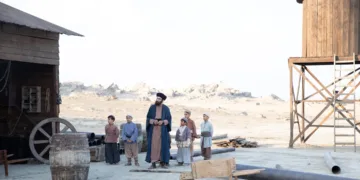
The structure leans on a classic framing device, the kind that signals gravitas before a character even speaks. We begin in 1922. The Soviet era has arrived. Zeynalabdin Taghiyev, now elderly, lives in seclusion (Qurban Ismayilov plays him with the stillness of someone already halfway archived). He feels like a remnant left behind after the parade has moved to a different street. Into this quiet purgatory walks Jerry Thompson, a fictitious American journalist hunting for the story of the former tycoon. The interview becomes the hinge. The film turns the page.
Memory takes over. We land in the 1870s. Parviz Mamedrzaev plays the younger Taghiyev, a mason by trade and an entrepreneur by temperament. He stares at dry earth and reads a future in it, while everyone around him sees emptiness. The stakes arrive fast. He risks his reputation. He gambles his meager capital. His peers see barren land. He sees liquid power waiting under the surface. A national myth needs an origin story. This one brings a shovel.
The Prophet in the Boardroom
Mamedrzaev gives Taghiyev the stillness of an icon. He keeps the performance controlled, dignified, almost devotional. The usual cinematic vocabulary for capitalism’s birth, all frantic gestures and sweaty urgency, stays out of reach here. Taghiyev moves like a man convinced that history has already written his name. That approach has a cost. It also has a strange kind of power.
The script treats Taghiyev with extreme caution. Internal fissures never appear. Doubt barely registers. Stumbles feel like they have been edited out before filming began. The character turns symbolic, a figure designed for a pedestal. I admired the discipline at first, the refusal to turn ambition into tantrum. Then the absence of human friction started to feel like varnish, the kind applied to monuments so weather cannot touch them.
Conflict shifts outward by necessity. Manaf Dadashov plays a local religious cleric who stands in opposition. The role reads thin, a caricature of dogmatic resistance. A story that wants a philosophical duel gets a simplified obstacle. The cleric functions like a signpost that reads “Old World,” and the film keeps moving.
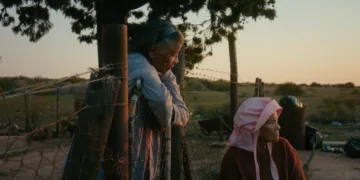
The emotional mechanics wobble in a more damaging way. The screenplay introduces the death of Taghiyev’s wife and expects grief to bloom on command. The bond has not been established. Intimacy never arrives in a form that makes the loss sting. The death lands as plot movement, not tragedy, and the film keeps marching. Strangely, the most persuasive tension comes from the mud.
Workers demand wages. They are tired. They are hungry. Taghiyev asks them to feed on faith. They want bread. The clash becomes tactile, class-level, and deeply familiar to any society that has ever tried to pay people in promises. (A small invention of mine: “hunger-realism.” This film brushes against it, then returns to ceremony.)
Drilling for the Soul
Drilling becomes a metaphor for spiritual testing. The act is physical, grimy, repetitive. The film treats perseverance as a moral imperative, a form of character purity measured in hours, pain, and patience. Extraction becomes ethics. The ground becomes a judge.

This plays like myth-making for the Azerbaijani state. The narrative suggests national progress depends on collective belief in a singular visionary. People must trust the leader while the earth refuses to yield. Unity becomes the price of prosperity. The idea carries the weight of many historical projects that demanded solidarity, then used solidarity as a tool of discipline. Revolutions love their legends. States love founders. Cinema loves to give both a face.
The film frames the cleric-versus-capitalist conflict as past-versus-future. Skepticism occupies one side. Industry occupies the other. The smokestack and the derrick receive the film’s allegiance with little hesitation. Gasimli directs these thematic collisions with restraint. The tone stays sober. Operatic excess never shows up, and melodrama fails to gain entry. I respected that restraint. Then the restraint started to act like a sedative.
Urgency drains away. The story asks the viewer to observe from a respectful distance, like a visitor in a museum gallery reading placards. That distance can feel like seriousness. It can also feel like hesitation, as if the film fears the mess of lived experience more than it fears boredom.
A paradox appears: the film wants to mythologize labor, and it also keeps labor at a safe, composed remove. It keeps choosing reverence. Reverence has limits.
The Visceral and the Slow
The craftsmanship deserves real praise. Production design recreates 19th-century Baku with tactile precision. Costumes look lived-in. Sets suggest wood and stone. Plywood and paint never come to mind. The world feels convincing, built to be inhabited rather than admired from behind a rope.
Cinematography finds beauty inside the industrial grotesque. The drilling sequences hit with visceral force. Machinery carries weight. Muck coats workers. The camera emphasizes the physical toll of pulling wealth out of the earth, and those images give the film its harsh materiality. The symbolism works best here because the body is involved. The moral fable gains muscles.
Pacing remains the hurdle. The story moves with a heavy gait. Scenes extend past their natural life. The rhythm hints at television serialization. Cinema’s tighter economy stays at a distance, and the narrative flow sometimes stagnates.
Then the release arrives. Oil gushes from the well. Black rain fills the screen. The payoff is visual, blunt, and satisfying in the most primal way. It validates the patience the film demands, even as part of me resents how much patience it demands.
Rovshan Agayev stands out among the supporting cast. He brings grit to the ensemble, the kind of human texture the protagonist sometimes lacks. In a film committed to national iconography, that grit feels like a small act of rebellion. Or maybe it is simply life, leaking in through the cracks the monument-builders missed.
Taghiyev: Oil is a historical biographical drama produced by the Baku Media Center. It serves as the first installment in a planned tetralogy dedicated to the life of the renowned Azerbaijani philanthropist and oil magnate Haji Zeynalabdin Taghiyev. The film chronicles his rise from a mason to an industrial visionary during the oil boom of the 19th century. It premiered at the Heydar Aliyev Center in Baku in November 2024 and was subsequently selected as Azerbaijan’s official entry for the Best International Feature Film at the 2026 Academy Awards. While international streaming availability is currently limited, it has been distributed theatrically in Azerbaijan and select Central Asian regions.
Full Credits
Title: Taghiyev: Oil
Distributor: Baku Media Center
Release date: November 7, 2024
Running time: 104 minutes
Director: Zaur Gasimli
Writers: Ismayil Iman, Asif Isgandarli, Zaur Gasimli
Producers and Executive Producers: Arzu Aliyeva, Orman Aliyev, Orkhan Huseynov
Cast: Parviz Mamedrzaev, Qurban Ismayilov, Nurlan Murselzade, Yusif Gasimli, Natavan Hajiyeva, Manaf Dadashov, Rasim Jafar, Elshan Rustamov
Director of Photography (Cinematographer): Vladimir Artemyev
Editors: Asgar Rahimov
Composer: Etibar Asadli
The Review
Taghiyev: Oil
Taghiyev: Oil succeeds as a visual monument but struggles as a human drama. It is a work of immense technical skill and national pride, weighed down by a script that prefers hagiography to complexity. The pacing tests patience. Yet, the final visual payoff and historical immersion offer a respectable experience. This film builds a solid foundation for the saga. Future chapters must simply allow the man to bleed as freely as the earth he drills.
PROS
- Immersive 19th-century production design
- Visceral cinematography during the drilling sequences
- Dignified, prophetic performance by Parviz Mamedrzaev
- Strong thematic focus on perseverance and spiritual testing
CONS
- Pacing is often sluggish and feels televisual
- The protagonist lacks internal conflict or human flaws
- Emotional subplots, specifically regarding the wife, are underdeveloped
- The antagonist feels like a caricature rather than a genuine threat