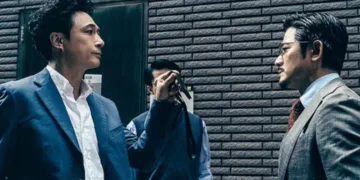























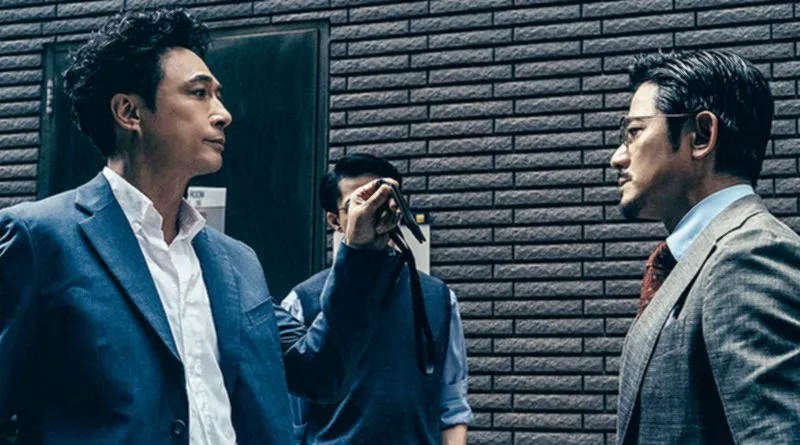

Alan Mak, a key figure in modern Hong Kong crime cinema thanks to his co-direction of Infernal Affairs, returns with Under Current, a thematic sibling to his 2019 feature Integrity. The story opens with a gesture pitched between Greek tragedy and PR disaster: Yeung To (Simon Yam), CFO of a major charitable foundation, hangs himself above the stage during a gala, his shirt bearing a plea for vindication scrawled across it. This staged self-destruction, witnessed by benefactors, hurls barrister Ma Ying-fung (Aaron Kwok) into a scandal that mixes philanthropy with embezzlement and money laundering.
Ma’s firm represents the crooked charity, and his attempt to reclaim professional virtue pushes him to investigate the missing funds. His path intersects with that of police investigator Or Ting-pong (Francis Ng). Their uneasy collaboration forms the procedural spine of the film. Mak sets up an ethical inquiry: how do we assign moral responsibility inside institutions that feed on public trust while hollowed out by greed? The film suggests that accountability hides in blind spots, where legal language and corporate ceremony meet.
Narrative Density and the Logic of Guilt
The screenplay, written by Mak with Lam Fung, leans hard on Curran Pang’s parallel editing, which keeps the crowded, dialogue-driven material afloat. The cutting moves between Yeung To’s earlier schemes and the present-day investigation led by Ma and Or, creating a layered structure that mirrors financial crimes built on time and distance. The method is functional and trades surprise for clarity.
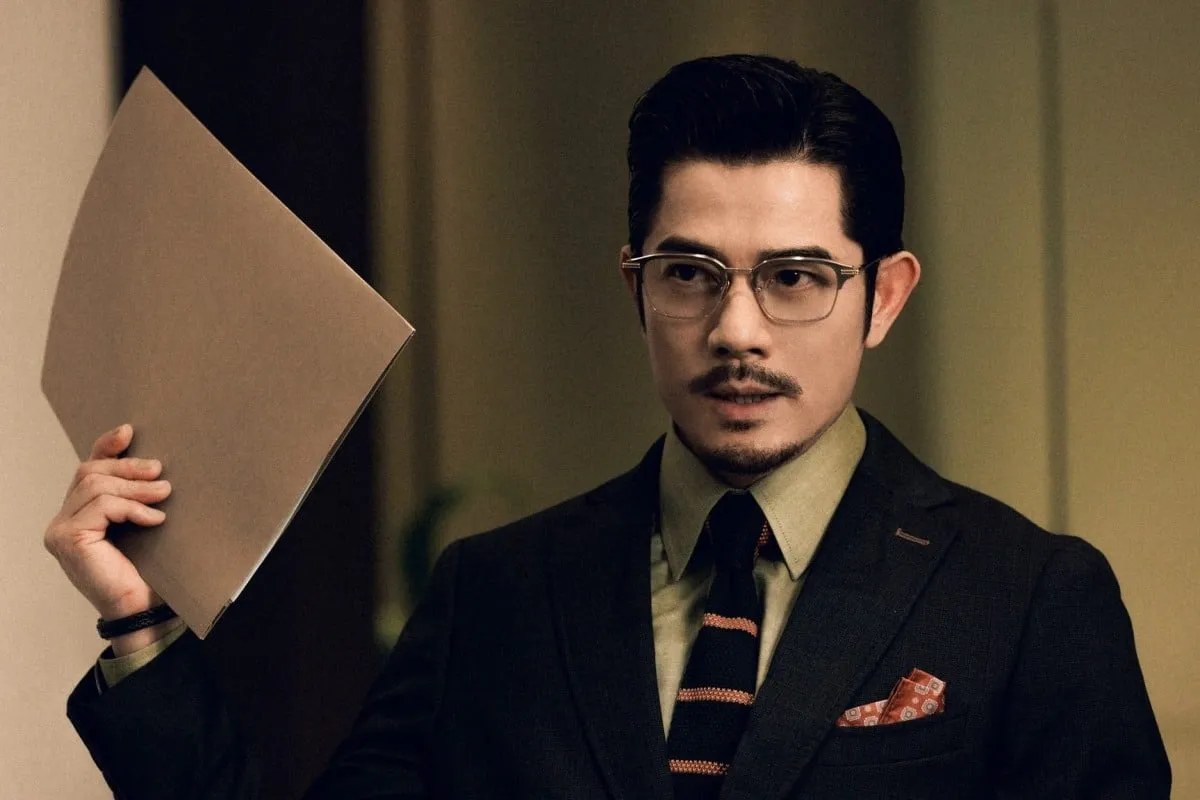
The true puppet master appears very early: Ko Sing-man (Alex Fong), the foundation president, arrives on screen as an almost theatrical emblem of greed. Once this is laid out, the central mystery loosens. The script begins to rely on what could be called “narrative accretion,” a piling up of subplots, from drug trafficking to early-onset dementia, that makes the pacing uneven.
The later sections expose the frailty of this structure. The film leans on twists that aim for shock and instead erode the internal logic that once held the situation together, leaving the main plot clouded where it seeks emotional impact. Ma’s involvement goes beyond professional obligation. He moves through the case with a private burden: a previous courtroom victory for an accused rapist ended with the victim’s suicide.
This earlier outcome shadows his work, turning every legal maneuver into a kind of penance. The recurring childhood flashback designed to explain Ma’s rigid sense of justice feels like one explanatory device too many. It tries to construct a mythic origin story for his conscience, a moral origin-point pinned to a single memory, and the film never quite integrates this with the rest of his behavior.
The Cast of Moral Contrasts
The star-heavy ensemble gives the drama a certain authority. Aaron Kwok anchors the film as Ma Ying-fung, the disciplined barrister whose stern exterior signals a mind occupied with guilt and justice. Francis Ng’s Or Ting-pong works as a tonal foil.
Or moves through scenes with an easy, almost casual charm that frequently brushes up against comedy. The tension between grave subject matter and Or’s lighter touch sometimes creates an interesting dissonance, sometimes simply clashes. The film struggles to harmonize the severity of the crimes with the looseness of Or’s attitude.
Veteran performers carry many of the most memorable beats. Alex Fong gives Ko Sing-man the slick assurance of an elite figure who treats charity like a stage set. Felix Lok, in his brief turns as underworld figure Mr. Kah, brings a quiet, unnerving presence that lingers.
Attempts at humor land less gracefully. A gag built around a disgruntled law firm employee feels misplaced, undercutting the grim atmosphere. The scenes shared by Ko and the calm yet intimidating Mr. Kah stand out. These tight, focused exchanges of power and threat create a clarity of purpose that often eludes the wider plot.
Haze, Hyper-Kineticism, and the Retro-Thriller
Kenny Tse’s cinematography shapes a striking visual scheme. Many images carry a soft, hazy texture that suggests corporate smoke screens and ethical fog, an almost literal blur laid over the story of financial corruption. The effect works as a visual echo of the moral vacancy that runs through the narrative. Curran Pang’s polished transitions across timelines keep the story legible, an essential service for a script so tangled.
The film reaches toward the high-energy era of Hong Kong crime thrillers, and Li Chung-Chi’s action choreography partially answers that call. An early set-piece that throws Or against a hired assassin delivers sharp, physical momentum, with a kinetic intensity that recalls a more hard-edged tradition. The later confrontation between Ma and the same killer lacks that force.
The climactic hand-to-hand fight leans heavily on wire work, trading away the feel of bodily impact for showy movement. The craft level remains high, yet these stylistic decisions hold the film at a distance from the rough texture that defined its predecessors. By the end, the visual haze no longer feels like atmosphere; it mirrors the film’s own scattered thematic focus, a cloud of style hanging over a story still searching for clarity.
The Hong Kong crime thriller Under Current (Nèi Mù) is a dramatic exploration of corruption and conscience, directed by Alan Mak. The film follows a principled barrister who teams up with a police officer to investigate a money laundering conspiracy that unfolds after a highly public and sensational death at a charity gala. Under Current had a day-and-date theatrical release in several territories, including Hong Kong and the United States, on December 6, 2025. You may be able to find it on streaming platforms following its theatrical run.
Full Credits
Title: Under Current (Nèi Mù / 內幕)
Distributor: Emperor Motion Pictures, Beijing Super Lion Culture Group, Chinalion Film Distribution, Brilliant Pictures
Release date: December 6, 2025
Running time: 117 minutes
Director: Alan Mak
Writers: Alan Mak, Lam Fung
Producers and Executive Producers: Tin Kai-man, Jason Siu
Cast: Aaron Kwok, Simon Yam, Francis Ng, Alex Fong, Felix Lok, German Cheung, David Chiang, Asano Nagahide
Director of Photography (Cinematographer): Kenny Tse
Editors: Curran Pang
The Review
Under Current
Under Current stands as a stylish, well-cast example of the modern Hong Kong crime thriller. It features strong star power and some brilliantly tense dramatic moments, particularly among the supporting villains. However, the film struggles under a convoluted script, uneven pacing, and an eventual sacrifice of narrative logic for excessive, unnecessary plot twists. It is a moderate diversion that fails to fully capture the thematic nuance of its genre predecessors.
PROS
- Clever use of parallel editing (past/present) to manage complex exposition.
- Strong, effective performances from the veteran supporting cast (Felix Lok, Alex Fong).
- Visually striking hazy cinematography creates an abstract atmosphere.
- Directly explores themes of institutional corruption and personal guilt.
CONS
- Choppy pacing due to too many disparate subplots.
- The tonal mixture of serious crime drama and light comic relief is often uneven.
- Final act's action is hampered by an over-reliance on wire work.
- Later plot twists are convoluted, detracting from the central moral interrogation.