



























Imagine a legendary monster hunter planted in a graveyard, with the apocalypse hanging in the air, and his attention fixed on something smaller. He is thinking about a missing litter of pups. Silver Bullet opens on that tension. A vampire named Reggie has used a massive bone to lure the hero’s dogs into the dark, leaving you with one companion: a bloodhound named Silver.
The story hook lands fast because the rescue goal feels personal, and the game treats it that way. Its world is built from retro shadows and cartoony gothic charm, like a haunted holiday special pulled from an old 16-bit console. As a 2D arcade shooter, it keeps the setup lean and pushes you straight into action. The spaces are crowded with dangerous demons and skeletal remains, and the pace aims directly at the reflexes of anyone who grew up with arcade pressure.
Each stage circles back to the same driving objective: reclaim the stolen dogs. The horror reads playful in presentation, yet the stakes still feel sharp because the emotional link is so clear. You move through a ghost-filled landscape with a simple purpose, fixing a cruel wrong one encounter at a time. Fight through Reggie’s army. Find the puppies. That clarity becomes the fuel that keeps you pressing forward.
Precision Combat and Canine Reinforcements
The shooting in Silver Bullet demands precision immediately. Spraying shots in a vague direction does not carry you through a screen full of threats. The game leans on a crosshair system that recalls a classic light-gun experience, where cursor placement becomes the entire relationship between you and the enemies. You move the cursor, put it directly on a target, and only then do you deal damage. That requirement turns every shot into a decision, which changes the emotional texture of the firefights. Panic still exists, yet the game keeps asking for control.

Movement supports that pressure in a way that feels carefully matched. Van Helsing runs left and right to slip incoming projectiles, and a dedicated dodge button gives him a cleaner escape tool when the screen gets crowded. The dash maneuver is a survival option that also adds physicality to the combat. It lets you break through certain obstacles, and it can destroy weaker enemies in your path. That small layer of impact helps the action feel tactile instead of purely about aim.
Defense adds another skill check through parrying. If you tap the correct button while standing still, you can deflect bullets, and melee attacks from ghouls can be turned away the same way. The timing demand rewards careful reading of enemy rhythms, and the risk is obvious because the input asks you to commit to stillness for a moment. Silver, the bloodhound, functions as your special weapon during these fights. Your special bar builds through enemy kills, and once it is ready, you can launch Silver to carve a path through threats.
The strike hits hard, deals massive damage, and carries a reward loop: enemies hit by Silver drop bonus items. Those items vanish quickly, so the game adds a brief sprint of greed and urgency right after the hit. Power-ups show up often, handing you temporary firearms that spike your output for a short window. They matter because enemy groups can swell to the point where standard shots feel stretched thin.
Difficulty ramps quickly across the run, and survival starts to depend on how well you layer these systems: precise crosshair placement, movement discipline, well-timed parries, smart special usage, and quick decisions about when to chase drops. The combat takes on a tactical feel because every button press has weight, and the game keeps proving that mistakes cost you space, time, and safety.
Diverse Trials and Hybrid Puzzles
Silver Bullet offers six primary stages, and each one shifts the way you engage with the core loop. Some sections push you forward automatically, which raises the tension by forcing aim under sustained pressure. Other levels open up movement, letting you reposition, find safer pockets of space, and return fire with more deliberation. That structural variety keeps the pacing from flattening out, and it helps the game avoid the numb repetition that can hit arcade shooters that rely on a single rhythm for too long.
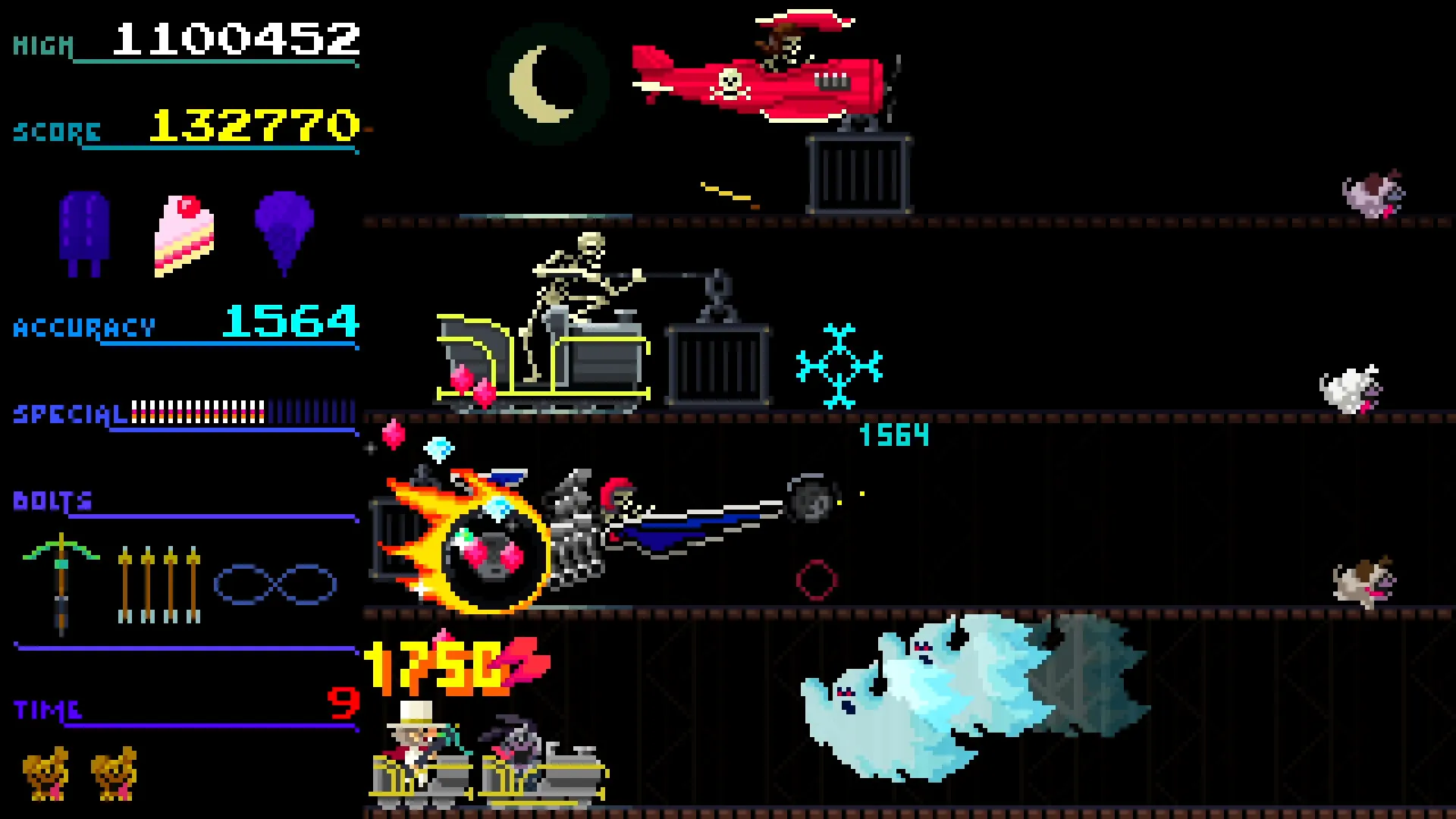
Between the main stages, bonus games show up as short, intense trials. They are built as reaction tests with a twist, and they land as little spikes in the run’s tempo. One may ask you to hit specific targets in sequence. Another can feel like a frantic shooting gallery that demands clean decisions at speed. They are hard to master, and that difficulty supports the score-driven identity of the game by giving you more places to sharpen execution.
Boss encounters sit at the top of the challenge curve. You face a giant fiery skeleton towering over the hero, and you fight an undead dinosaur that brings its own sense of heavy threat. These bosses fill the screen with intricate bullet patterns, turning the fight into a study of cycles and openings. Their attacks are complex enough that focus becomes part of the mechanical demand, and progress comes from learning the pattern language each one speaks. Boss variety stands out here because each encounter feels like a fresh aiming puzzle built around your crosshair system, with new shapes and timings to decode.
The unlockable Terror Blocks mode shifts the perspective again. It blends shooting with block-matching, asking you to fire at falling shapes to clear the screen. It runs on its own scoring logic, and the change reads fresh because it reassigns your precision skill from enemy bodies to puzzle shapes.
Some stages even carry visuals that echo classic puzzle games, giving your eyes a break from constant demon crowds while keeping the hands-on challenge intact. Across the run, the game keeps changing the rules of the environment to keep you alert. One moment you are tearing through a graveyard, another you are moving through a strange factory, with inventive enemy patterns that keep you reacting instead of settling into autopilot.
Control Choices and the Score Chase
The long-term pull of Silver Bullet comes from systems that feel deep and punishing in equal measure, and a big part of that starts with control choice. The twin-stick setup lets you aim and move simultaneously, which creates the most freedom for dodging bullets while keeping your crosshair active. It also puts heavy demand on the shoulder buttons, since many actions live there, and that layout can feel awkward once fights turn chaotic.
Classic mode pares things back and leans into a more traditional feel. It ties crosshair movement to firing in a way that can feel natural, yet it restricts how much you can reposition while aiming. That trade-off matters, because it shapes both survivability and the ceiling for high-score play.
Scoring revolves around the accuracy meter. Hit targets and your point multiplier climbs. Miss shots and the meter drops immediately. Take damage and your final score suffers, which puts emotional pressure on precision even when the screen is loud with threats. High scores feed directly into the online leaderboards, and that context frames every run as practice for cleaner execution.
Gold coins drop through the stages, and you spend them in a shop between levels on permanent upgrades that change how your run develops. Bullseye makes the accuracy meter rise faster, and it also makes the meter fall faster when you miss. Dogenstein increases how often you can use your special attack. These upgrades can swing survival odds, especially once difficulty ramps into the later stages.
The game is built around a one-credit clear goal, with a full run clocking in at about 35 minutes. Extra lives are scarce and show up only at specific waypoints, which keeps tension high because safety nets rarely appear. Every error feels expensive, and that pressure suits a shooter that asks for deliberate cursor placement in the middle of chaos.
Input flexibility supports the chase, letting you play with an arcade stick or a mouse and keyboard, which can change how the crosshair feels in your hand. The real hook becomes the pursuit of a perfect run: learning the stages, internalizing boss cycles, managing upgrades, keeping accuracy stable, and returning again to master the systems that the game keeps stacking in front of you.
The Review
Silver Bullet
Silver Bullet succeeds as a focused arcade experience. The high difficulty and reliance on precision aiming create a satisfying loop for players seeking a challenge. Its visual charm and eccentric story offer enough personality to stand out. While the controls present a steep learning curve, the depth of the scoring systems ensures long-term engagement. It is a polished gem for fans of old-school shooters.
PROS
- Rewarding precision combat mechanics
- Engaging and varied boss designs
- Deep scoring and multiplier systems
- Charming retro gothic aesthetic
CONS
- Significant difficulty spikes for casual players
- Complex control schemes require practice