
























![Kingdom Hearts Collection [I-III] Review](https://gazettely.com/wp-content/uploads/2026/10/Kingdom-Hearts-Collection-I-III-1-360x180.webp "Kingdom Hearts Collection [I-III] Review: KHII Holds Steady as Newer Entries Fluctuate 37")





This new NBC comedy arrives as another project from the team behind landmark sitcoms like 30 Rock, and it uses that pedigree to aim its jokes at a very current target: the business of public redemption. The series follows Reggie Dinkins, a former NFL Most Valuable Player whose career collapsed two decades ago after a self-inflicted gambling scandal. Now he lives in a comfortable New Jersey house overseen by his ex-wife, Monica, and he treats comfort as a temporary state.
Reggie wants his name restored, his image polished, and his place in the Hall of Fame secured. He hires Arthur Tobin, an award-winning filmmaker whose own career is in freefall. Reggie wants a glossy tribute that airbrushes the past. Arthur wants a rough, vérité-style documentary that can rebuild his credibility. The premise plays like a sitcom engine, and it also reads as a comment on an industry that sells reinvention as a subscription perk.
Desperation as a Common Language
The show’s tension comes from two competing visions of the same story. Reggie chases a manufactured legacy. Arthur chases an “authentic” document that can reopen doors for him. Reggie is written as a lovable man-child stuck in the varnished memory of his glory years. He talks in malapropisms and wide-eyed declarations, and he can still land sudden flashes of grounded insight.
That mix becomes part of the critique: his blindness to the weight of his gambling history reflects a modern sports-media climate that treats scandal as a branding problem with a marketing solution. Reggie assumes that an Oscar-winning filmmaker equals instant legitimacy. Accountability becomes a line item that never makes the budget.
Arthur supplies a different kind of self-deception. He carries the fallout of a public breakdown and the kind of professional self-sabotage that turns “serious artist” into a punchline. At first, he leans hard into pretension, framing Reggie as material and treating the project as a personal resurrection. His fastidious, “white-room” sensibility collides with Reggie’s loud, Brooklyn-rooted energy. The dynamic taps into a familiar comedic tradition, and it also gestures at how culture gets packaged for prestige: British theatricality meeting the bombast of American sports celebrity, each side reading the other as a problem to solve.
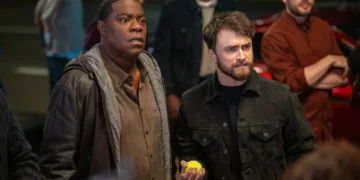
As the season moves forward, the chemistry between Tracy Morgan and Daniel Radcliffe grows past the easy “Odd Couple” rhythms and starts to feel like something more revealing. Their connection becomes a study in shared desperation, two men with damaged standing trying to borrow legitimacy from each other. The scripts sidestep an endless loop of bickering and instead spend time on what happens when disgraced figures recognize a common predicament: the spotlight moved on, and the gatekeepers did not send a forwarding address.
The Labor Behind the Legend
Reggie and Arthur fixate on the documentary’s vanity project, and Monica emerges as the person doing the real work of keeping the house, the brand, and the future intact. She represents the often-invisible labor done by women tasked with managing the chaos orbiting “great” men. The writing frames her as a former high school sweetheart who became a business-savvy manager, treating Reggie’s rehabilitation like a corporate campaign with deliverables.

That choice reframes the familiar sitcom spouse role. Monica reads as a strategist, not a scold, and her ambitions include owning an NFL team. In a series preoccupied with image repair, she becomes the clearest example of competence that rarely receives the same cultural celebration as charisma.
The household functions as a living archive of Reggie’s past and a warning label for his future. Rusty, the ex-teammate in the basement, plays the tragic-comic version of the athlete who never left the locker-room mindset behind. Goofball antics cover a deep loneliness, and his presence sits there as a cautionary mirror for Reggie’s own stagnation. Carmelo, Reggie’s son, brings a Gen Z skepticism that reads like cultural whiplash made domestic. He watches his father with weary parentification, and that dynamic highlights a generational shift in how celebrity is processed: less awe, more exhaustion, more fluency in the mechanics of a public persona.
Brina, Reggie’s younger fiancée, adds another angle on that family pressure cooker. She moves through a home run by an ex-wife and a son close to her age, and the writing uses that discomfort to complicate the “trophy wife” shorthand. Brina is presented as someone trying to find belonging inside a family defined by a legacy that existed long before she entered the frame. The domestic tension reflects changing ideas about blended families, and it places those private negotiations under the added stress of public scrutiny and reputation management.
Satirizing the Content Industrial Complex
The series works as a pointed parody of the athlete-doc trend that streaming platforms have turned into a familiar genre product. It targets the “Last Dance” aesthetic where the subject holds final approval, and it finds comedy in the fantasy that a person can control a narrative the public already remembers. Reggie’s attempts to rewrite a history that millions watched in real time land as farce, and the show links that farce to a cultural moment where celebrities treat “my truth” as a substitute for verifiable events. The satire stings because it recognizes how easily media ecosystems reward confidence and polish, even when the underlying story remains unresolved.
Fake archival footage delivers some of the strongest laughs and a sharp piece of commentary. The cutaways hint at Reggie’s ill-advised rap phase and strange commercials for questionable products, and those fragments sketch him as a once-ubiquitous figure in American pop culture. The joke has teeth: the entertainment machine is happy to monetize a personality for cheap gain, and it drops that same personality fast when trouble arrives. The show frames exploitation as routine, then uses sitcom timing to make the routine visible.
The mockumentary form is handled with a self-aware wink that keeps nudging at the genre’s built-in voyeurism. The unseen camera crew becomes a participant even when the logic strains, including the pointed question of why they film Monica’s private dates at all. The series treats those gaps as part of the joke, turning format inconsistency into commentary on how “reality” gets manufactured. Arthur’s polished high-definition aesthetic sits next to raw handheld “behind the scenes” material, and that split keeps underlining the distance between the image Reggie wants and the life he actually lives.
Pacing the Path to Redemption
The comic rhythm shifts after the first two episodes. The pilot carries the weight of a dense setup, and later episodes give the ensemble room to breathe. Characters start to shed their early caricature edges, and the writing reaches for more dramatic undercurrents, especially the fear of being forgotten. That fear gives the comedy a pulse. The laughs start to feel tied to character need, not just joke volume.
The dialogue stays joke-dense, built around quick sparring and absurdist asides associated with the show’s producers. Arthur can drift into film-theory critique, and the next beat can swing to Reggie dropping a bafflingly specific Muppet reference. That high-low register matches contemporary media life, where prestige language and meme language share the same feed and the same attention economy. The pacing stays aggressive, asking the viewer to keep up with cultural references and physical comedy as if speed itself were part of the format’s identity.
The season’s spine is a familiar struggle narrative reframed for the age of digital accountability. Reggie and Arthur chase fame and a second chance, and the show places that chase in a world that rarely offers clean reentry. The writing suggests redemption does not come from a slick documentary or a clever rebrand.
It comes from vulnerability, and both men treat vulnerability like a career risk. By grounding the arc in mutual failure, the series takes a sharper, more human angle than the glossy sports-doc templates it targets, and it hints at where televised storytelling may keep heading: comedy that feeds on the systems shaping public identity, then turns those systems into the punchline.
The Fall and Rise of Reggie Dinkins premiered with a special pilot sneak peek on January 18, 2026, immediately following the coverage of the NFL divisional playoff game on NBC. The series is the latest project from the acclaimed creative team behind 30 Rock, focusing on a disgraced former football star attempting to repair his public image through a documentary. Following its early debut, the show is set to begin its regular Monday night broadcast schedule on February 23, 2026. Viewers can watch the series live on NBC or stream new episodes the following day on the Peacock platform.
Full Credits
Title: The Fall and Rise of Reggie Dinkins
Distributor: NBC, Peacock
Release date: January 18, 2026
Rating: TV-14
Running time: 30 minutes
Director: Rhys Thomas
Writers: Robert Carlock, Sam Means
Producers and Executive Producers: Robert Carlock, Sam Means, Tina Fey, David Miner, Tracy Morgan, Eric Gurian, Rhys Thomas, Jerry Kupfer
Cast: Tracy Morgan, Daniel Radcliffe, Erika Alexander, Bobby Moynihan, Precious Way, Jalyn Hall
Director of Photography (Cinematographer): Charlie Gruet
Editors: Kyle Gilman
Composer: Jack Grabow
The Review
The Fall and Rise of Reggie Dinkins
The series provides a sharp deconstruction of the modern image industry. While the pilot feels slightly scattered, the growing chemistry between the leads and the strong presence of the supporting cast anchor the narrative. It offers a thoughtful look at fame and the hidden labor behind public redemption. By grounding the humor in character desperation, the writing avoids the traps of standard sports comedies. This is a smart entry for the network lineup that rewards viewers who stay past the opening episode.
PROS
- Dynamic chemistry between the lead actors.
- Subversive character arc for Monica as an ambitious manager.
- Effective satire of the current sports documentary trend.
- Fast-paced, high-density joke writing.
CONS
- The pilot episode struggles with clunky exposition.
- Early episodes lean on familiar sitcom archetypes.
- Occasional lapses in the logic of the mockumentary format.







