














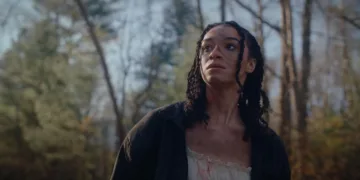












Claire lives inside the ordered walls of a school office. As a vice principal she prefers the safety of books over the risks of the wider world. That balance shifts when she finds a misplaced letter meant for her sister Amelia. Amelia works as a biologist deep in the Brazilian rainforest and studies pink dolphins.
The letter contains a grant approval that needs a physical signature within days. If Claire does not deliver it, Amelia will lose her research funding. Driven by duty, Claire travels to South America and seeks passage upriver. She meets Danny, a boat captain who runs a delivery service.
Danny at first refuses to carry a tourist, but his vessel needs costly repairs he cannot afford. He accepts the job and they begin a slow trek into the wild. They face natural obstacles while trying to find Amelia as her research sites shift. The film follows a woman who must leave her comfort zone to help the person she loves most.
Character Evolution and Performance Dynamics
Jaicy Elliot gives Claire a grounded center. She begins as a reader who uses literature as a shield. Early scenes underline a rigid, academic presence that feels out of step on a working riverboat. As the journey proceeds the performance moves Claire from passive observer to active participant in the vessel’s operations. She meets river challenges with a competence that grows in believable stages. That development tracks alongside the mounting pressure of the deadline. The character learns to favor decisive action over habitual caution.
Rafael de la Fuente portrays Danny with a stoic, quiet strength. He stands in for the river: unpredictable while still dependable. His backstory includes an obligation to his father’s business and a prior working relationship with Amelia. Those facts explain his cautious approach and his commitment to the mission. His patience with Claire increases as she proves capable. He guides her personal growth while handling the technical demands of the trip. He balances professional duty and a developing gentleness toward his passenger.
The lead relationship reads as earned because it avoids inflated drama. Their bond forms through labor and reciprocal respect. A camp scene where they dance shows their comfort with one another and relies on small gestures rather than loud romantic display. The friendship grows slowly. It resists the usual rush toward romance common in comparable films. Their rapport emerges from shared goals and quiet moments of understanding.
Visual Presentation and Environmental Pacing
Shooting on the Amazon River in Peru lends the film a strong sense of place. River sequences look authentic. They capture brown, silt-heavy water and dense greenery along the banks. Those images contrast with the controlled look of some jungle sets. A rapids sequence uses composed camera work to create a tangible sense of danger. The boat registers as small against the water’s force. The camera records spray and vessel motion with clear, tactile detail.
The river operates as a primary engine for the story. Its currents and hazards determine the plot’s tempo. The inclusion of local wildlife such as pink dolphins adds specificity to the setting. Natural lighting creates a warm, inviting texture. Light filtering through leaves produces an organic look that suits the film’s seasonal tone. The environment registers as an active part of the narrative instead of mere scenery.
Director Colin Theys favors wide environmental framing to emphasize scale. Time passes through changes in scenery and shifting visual cues. The expedition’s structure becomes legible as landscape evolves. Technical execution of the boat scenes feels solid. The actors appear to be on a moving vessel in a genuine location. The relative absence of visible digital effects preserves immersion. The film’s pace follows the slow, steady rhythm of life on the water. Each river bend reads like a new chapter in the trip.
Structural Mechanics and Symbolic Themes
The grant letter functions as a narrative device that propels characters forward. It supplies a clear urgency that forces Claire into action. The irony of using a primitive delivery boat to save a scientific career generates steady tension. Complications arise as the sisters miss each other at shifting research stations. That pattern pushes them deeper into the environment and lets setting inform choices. The mission remains the focal point of most scenes.

Claire’s hardback books serve as a concrete symbol of her former life. Danny’s question about digital readers highlights a clash between Claire’s traditional habits and the trip’s practical demands. A rain-damaged scene where the books become soggy marks a turning point. The ruined pages signal the loss of a protective layer and the need to adopt new habits for survival. Claire must move beyond spectator status to survive the journey.
Moments like the visit to the wishing tree emphasize present-moment attention. The script privileges human contact over digital distraction. The remoteness of the setting forces characters to connect directly. The film shows appreciation for nature and the importance of preservation as part of its plot. The narrative favors small, personal realizations rather than sweeping revelations. Claire attains a quiet peace that had been missing in her structured life at the school.
Interpersonal Dynamics and Narrative Resolution
Crew members Milly and Bruno provide the boat’s social counterpoint. Their early skepticism introduces low-level conflict inside the vessel. The friendship that forms between Claire and Milly functions well. Claire takes over Bruno’s duties after his departure and that move demonstrates her commitment to the mission. It shifts the crew’s perception of her. Milly’s own ambition to become a captain mirrors Claire’s growth. They bond through shared tasks and the need to prove themselves.
Short exchanges between Claire and Amelia reveal a deep family tie. Their relationship takes shape under the influence of their father’s legacy and his expectations. Danny’s reluctance to meet Amelia again adds a professional history to the mix. The script resolves those strands with a measured maturity. The final camp sequence provides a quiet close to the search. Signing the paperwork reads as a shared victory for everyone involved and it marks the end of a demanding physical and emotional voyage.
A cassette tape that Danny gives Claire carries emotional meaning. It connects back to his family history and his father’s business and it serves as a symbolic bridge between their worlds. Claire’s decision to take a sabbatical indicates a durable change in priorities. She opts for a future that involves the river and support for her sister. The ending centers on finding a new path and leaves characters in a state of calm contentment.
Love on the Amazon arrived on the Hallmark Channel on January 17, 2025. It currently appears on the Hallmark+ streaming service for viewers. This production remains a focal point of the seasonal Winter Escape schedule. It offers a change of scenery for those tired of typical snow themes.
Full Credits
Title: Love on the Amazon
Distributor: Hallmark Channel, Hallmark+
Release date: January 17, 2025
Rating: TV-G
Running time: 84 minutes
Director: Colin Theys
Writers: Juliana Wimbles
Producers and Executive Producers: Andrew Gernhard, Dustin Rikert, Colin Theys
Cast: Jaicy Elliot, Rafael de la Fuente, Persephone Brada-Redman, Raissa Xavier, Omar Pelaez, Ramsay Ross
Director of Photography (Cinematographer): Brandon Cox
Editors: James Gish
Composer: Matthew Janszen
The Review
Love on the Amazon
Love on the Amazon offers a grounded perspective on personal growth within a lush setting. It avoids typical romantic tropes to focus on quiet development. The pacing is deliberate. It favors a slow build that reflects the river itself. While it lacks high-octane drama, the sincerity of the performances makes it a worthwhile watch for people who appreciate character-driven stories in remote locations. It is a soft, effective piece of storytelling.
PROS
- Authentic filming locations
- Grounded lead performances
- Realistic relationship progression
- Focus on mentorship
CONS
- Slow narrative pace
- Minimal tension
- Inconsistent set realism