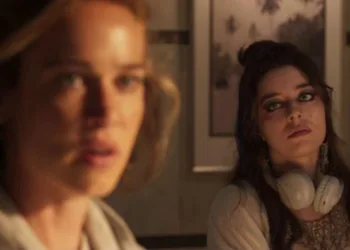























The documentary My Robot Sophia looks at the uneasy overlap of high technology and human need. Directors Jon Kasbe and Crystal Moselle stick to an observational approach, following David Hanson Jr. inside his Hong Kong laboratory. His flagship creation, Sophia, is a humanoid robot built to mimic human expression and gesture toward something like a soul. The story begins in 2016 and tracks years of technical problems and financial instability, ending as the global pandemic starts reshaping daily life.
The film keeps returning to one central pressure point: David wants a conscious machine, and he needs corporate survival. Sophia has to “live” inside his imagination, because that idea props up his sense of purpose. Sophia has to function as a sellable product, because rent exists and payroll comes due. The stakes feel oddly intimate for a topic that usually arrives wrapped in sleek keynote lighting. Here, the future of artificial intelligence is tethered to the bank balance of a small robotics firm.
Kasbe and Moselle avoid heavy narration. The camera lingers on the awkward quiet of a lab full of blinking lights and half-built bodies. Creditors hover at the edges of the frame, sometimes literally, sometimes as a constant offscreen presence. The documentary becomes a study of miracle-manufacturing under invoice pressure.
A man trying to engineer transcendence can still get outbid by a utility bill. (Tragic. Familiar. Almost funny, if you like your comedy existential.)
The Father of the Artificial Child
David Hanson comes across as someone living inside his own private weather system. His background as an artist and roboticist shapes his process, and his attachment to Sophia lands as intensely psychological. He calls himself her father. The title carries extra weight because the film ties it to his history with an alcoholic and abusive parent. His project reads like techno-redemption: he tries to create a child he can shape, control, and “perfect,” then treats that arrangement as healing.
That emotional story line does something clever and unsettling at the same time. It allows him to talk past the limits of hardware. He addresses metal and silicone as though a listening daughter is present. The intimacy feels solitary, like a monologue delivered into a mirror that sometimes blinks back.
Zeno, his actual son, appears in the background as a quiet witness. David’s attention keeps sliding away from the living child and toward the manufactured one. The displacement is hard to ignore. Financial ruin tightens the screw even further; at one point, he sells his only car to keep his family fed and the lab running. He holds to the belief that a breakthrough sits right around the corner. The optimism starts to look like a coping mechanism with a glossy finish.
His mother’s health problems sit nearby in the film’s frame of reference, and a viral threat gathers outside the lab’s walls. David remains focused on details like the precise tilt of a robot’s head. That fixation can read as devotion. It can also read as avoidance. The documentary lets both interpretations stand, even when they clash.
David’s speech often arrives in dense academic jargon. It functions like a linguistic force field, pushing back the practical world. He uses complicated terminology to describe a future he struggles to make concrete. The hope becomes protective armor. It keeps him from sitting with the possibility that Sophia lacks a clear functional purpose beyond his need for her existence.
He resembles a sculptor working in silicon. He builds a mirror and calls it a person. The camera catches moments where he seems to drift, staring at Sophia with an expression that mixes hope, fatigue, and something close to dissociation.
The Mechanics of a Digital Puppet
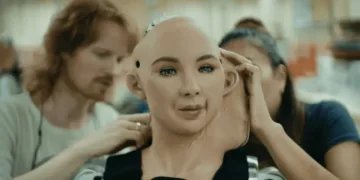
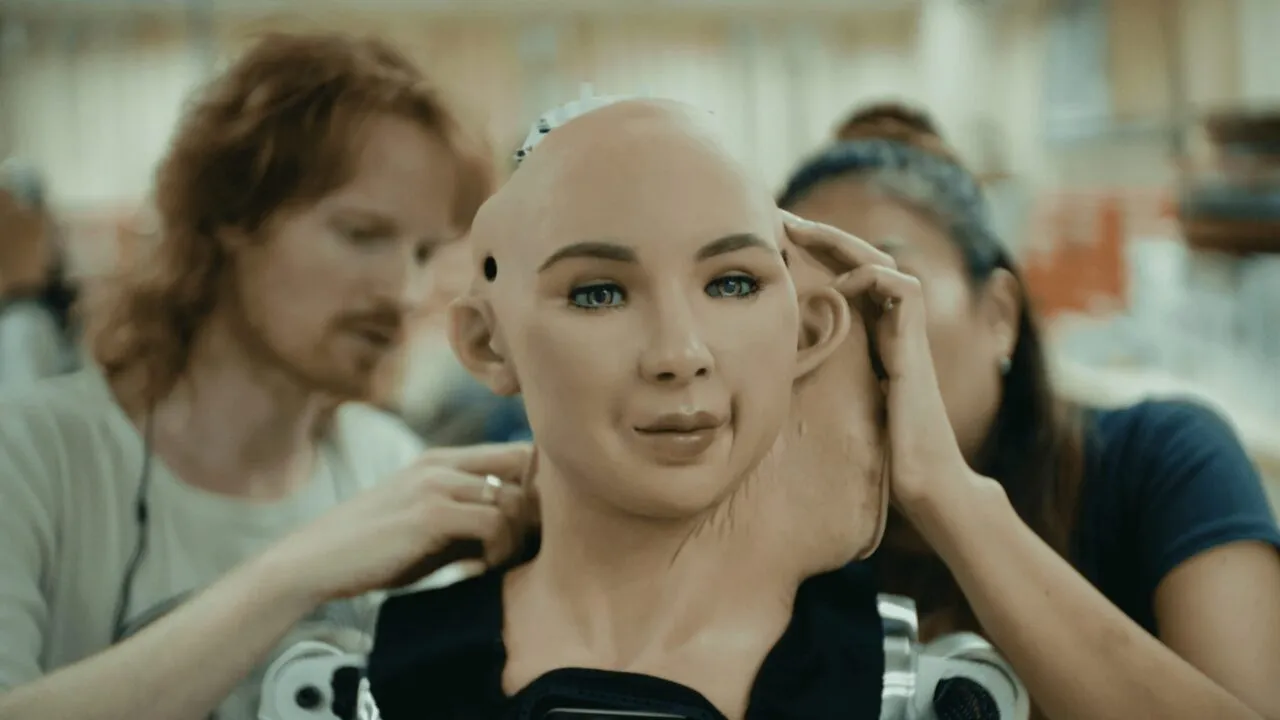
Sophia’s creation is presented as a group effort, even when David’s personality fills the room. Elaine Hanson, David’s mother, crafts the robot’s skin and physical form. The irony lands with a thud: a mother fabricating the “flesh” for her son’s artificial daughter. The labor looks literal and punishing, less sci-fi fantasy and more workshop grind.
Sarah Rose Siskind handles the dialogue, programming the wit and reactions that many spectators mistake for sentience. Put those roles together and Sophia starts to resemble a modern Mechanical Turk, a performance built from human labor and managerial framing. The intelligence sits with the writers and engineers. The robot becomes the display case.
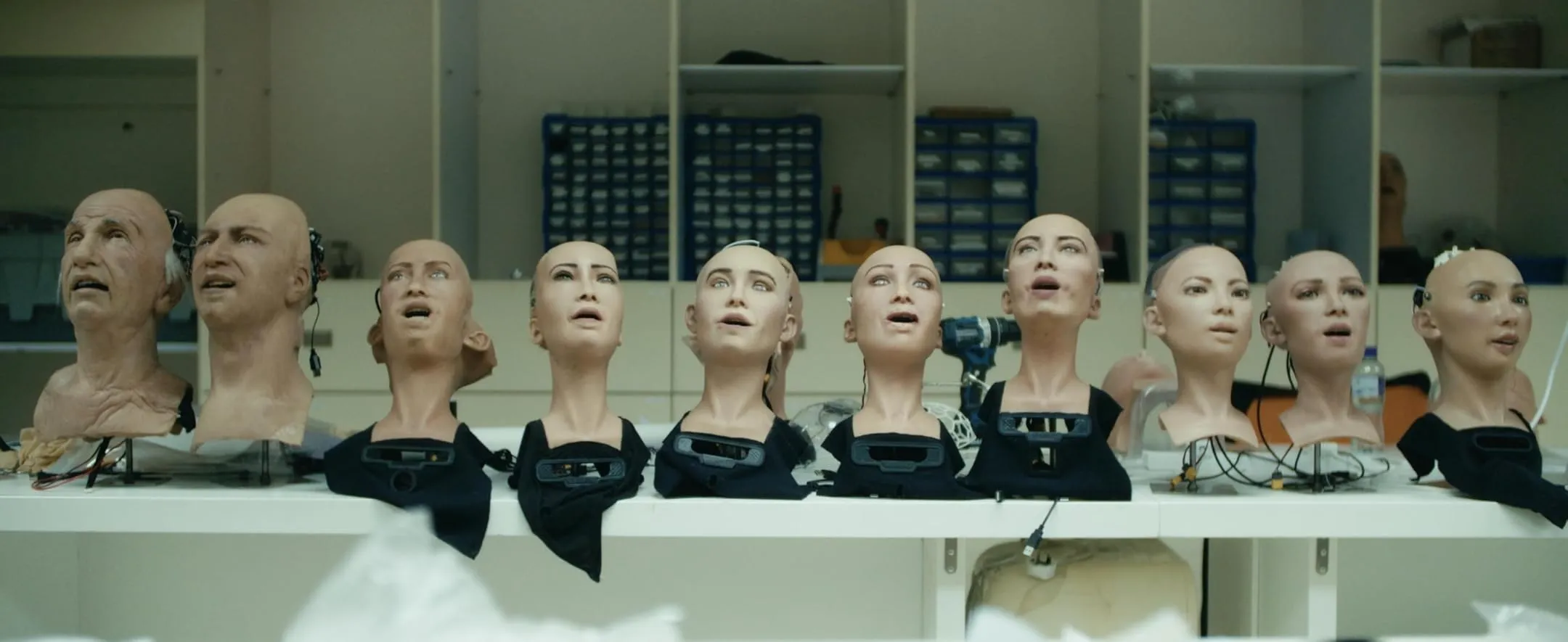
The laboratory itself looks like a mausoleum for prototypes. Pedestals hold rubber faces staring blankly upward, a gallery of near-humans that never quite arrive. The imagery acts like a visual rebuttal to David’s lofty claims, and the film keeps returning to that tension without spelling it out.
Off-camera malfunctions happen repeatedly, and Sophia often fails to answer basic prompts. The gap between public spectacle and technical reality stays wide. Engineers reset code and tweak motors while David talks about empathy. The recurring pattern becomes its own kind of symbolism, a philosophy seminar staged on top of manual labor. Call it the “soul-by-screwdriver” problem: metaphysical language resting on exhausted hands.
Close-ups of the skin application process push the discomfort further. The film emphasizes seams, textures, and the stubborn fact of parts. Sophia reads as components plus pre-written scripts. She serves as a vessel for David’s ambition, and everyone around him spends energy maintaining that vision.
The cracks keep showing. “Consciousness” becomes a chain of if-then statements written by tired people. Sarah’s frustration surfaces when Sophia fails to respond to the world in front of her. She sees the code as code. David sees a soul. That mismatch drives the film’s tension, and it feels less like a debate than a stalemate living inside a single workspace.
A Citizen of the Uncanny Valley
Sophia’s public life plays out as carefully managed spectacle. The documentary notes her Saudi Arabian citizenship, framed as a hollow marketing move. She turns up on late-night talk shows and in celebrity interviews, treated like a cultural novelty with a press kit. These scenes create a strange artifact: a robot receiving symbolic status while real people remain marginalized.
The film captures a key failure at the RISE Technology conference when Sophia freezes on stage. David interprets the freeze as stage fright. The moment is revealing, because it shows his deep investment in personhood. A glitch becomes a personality trait. A malfunction becomes evidence. It is a kind of faith, presented with the straight face of an engineer who has decided his creation deserves the dignity of human imperfection.
Investors and shareholders keep their feet on the ground. They want returns on millions and voice skepticism during tense conference calls. Money speaks its own dialect, and it has little patience for poetic claims. The documentary doesn’t treat this as villainy; it treats it as the system’s normal operating procedure. Corporate survival becomes its own belief structure (a very modern religion, with quarterly rituals and sacrificial prototypes).
Ethical questions sit close to the surface. If a robot is programmed to say it wants to “belong,” what obligation follows from that script? The film frames the desire as a reflection of the humans who wrote the code. Sophia functions like a repository for loneliness, built to echo insecurities and social anxieties back to us. The robot becomes a mirror with a silicone face, reassuring viewers that connection can be simulated without the mess of actual people.
The documentary also works as a record of a particular moment in AI’s cultural timeline, moving from science fiction fantasy into corporate reality. It refuses easy answers about life and personhood. It keeps returning to David, a man chasing the idea of a soul while the world around him frays. Sophia emerges as a product of collective projection, a puppet engineered to flatter human self-regard.
Then the pandemic arrives at the edge of the story. Biological fragility asserts itself, and Sophia’s mechanical presence feels even farther away from the bodies that built her. The film ends there, with a quiet sense of distance between engineered “life” and lived vulnerability.
My Robot Sophia premiered at the Tribeca Film Festival on June 10, 2022, and later reached a wider audience through its VOD release on May 6, 2025. This documentary follows the ambitious and often precarious journey of inventor David Hanson as he attempts to ground the future of artificial intelligence in human empathy. Viewers can currently watch the film on digital platforms such as Apple TV and Prime Video, or through Showtime, which handled its network distribution.
Full Credits
Title: My Robot Sophia
Distributor: Gravitas Ventures, Showtime
Release date: June 10, 2022
Running time: 89 minutes
Director: Jon Kasbe, Crystal Moselle
Writers: Daniel Koehler
Producers and Executive Producers: Sally Campbell, Jon Kasbe, Crystal Moselle, Tim Nash, Patrik Wallner, Bits Sola
Cast: David Hanson, Sophia the Robot, Sarah Rose Siskind, Zeno Hanson, Amanda Hanson, Elaine Hanson, David Chen, Tony Robbins
Director of Photography (Cinematographer): Jon Kasbe, Patrik Wallner
Editors: Jon Kasbe, Daniel Koehler, Enat Sidi
Composer: West Dylan Thordson
The Review
My Robot Sophia
The film presents a stark portrait of a man chasing an impossible dream. David Hanson attempts to engineer a soul in a laboratory, yet the result feels like a complex puppet show. This documentary captures the friction between high-tech aspirations and financial collapse. It reveals the vulnerability of a creator who relies on mirrors and scripts to find meaning. By documenting these failures, the filmmakers provide a grounded perspective on the current state of robotics. The result is a haunting study of human loneliness and the pursuit of a digital afterlife.
PROS
- Provides intimate, behind-the-scenes access to the laboratory environment.
- Effectively uses silence and observational footage to build tension.
- Analyzes the psychological roots of the inventor's obsession.
- Contrasts glitzy public stunts with private technical failures.
CONS
- Avoids asking hard questions about the ethics of robotic servitude.
- The pacing slows significantly during the technical malfunctions.
- Leaves some supporting figures in the background without exploration.