














![Kingdom Hearts Collection [I-III] Review](https://gazettely.com/wp-content/uploads/2026/10/Kingdom-Hearts-Collection-I-III-1-360x180.webp "Kingdom Hearts Collection [I-III] Review: KHII Holds Steady as Newer Entries Fluctuate 37")




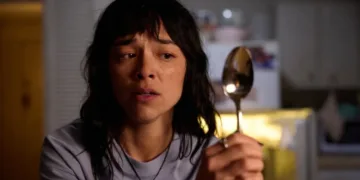
The grey ash is cold and lifeless against her fingertips, and it pulses with a promise no amount of willpower can cash. Hana, a Japanese-Australian medical student in Melbourne, stands in the clinical hush of her university lab, considering a transgression that reads like sacrilege. Her days have become arithmetic: calories refused, binges buried in darkness, the body treated as something to outsmart.
She finds The Grey, a diet pill with the aura of a whispered legend, then uses her own research to verify what the myth is made of. The capsules contain human remains. Disgust arrives, then gets filed away behind need. Hana starts harvesting the ash of Big Bertha, a cadaver assigned for study rather than consumption, and takes the dead into her living body one capsule at a time.
As Hana shrinks, the world turns up its volume. The woman she is literally eating follows her home. The haunting begins as a faint disruption in a mirror, a blink-and-miss-it wrongness, then grows into a physical occupation of Hana’s space. Hana reads the changes as self-renewal, a shedding of the person who failed to keep control. The film treats it as replacement. What looks like victory on a scale becomes a preface to psychological erasure, a slow exchange of personhood for a smaller outline. Hana trades humanity for profile, still unaware that the dead resist being made convenient.
The Architecture of Displacement
The supernatural material operates like a body given form to a mind at war with itself. Big Bertha appears in warped reflections, caught in the curved sheen of polished metal, in the kettle’s surface, in the bend of a chrome faucet. The choice carries the same violence as body dysmorphia: perception fractures, and the reflection insists on its own reality.

The haunting follows the logic of the hungry ghost from Buddhist tradition, condemned to endless, agonizing appetite. Hana becomes a contemporary version of that figure, emptied out in pursuit of a shape that earns approval while the spirit stays starved.
The wellness industry takes the role of antagonist with a clean smile. Digital feeds and sterile gyms frame self-worth as a transaction completed through reduction, a life measured by what can be stripped away. Alanya embodies that aspirational chill: pure surface, curated health, a person shaped into performance. Hana’s decision to ingest human remains lands as a learned response, drilled in by a culture that frames the body as a project requiring any price.
The film pins a moral collapse to that lesson. Human dignity slips behind the pursuit of a single aesthetic, and the story mourns a woman convinced that losing her humanity is an acceptable exchange for losing weight. The system around her rewards disappearance, and the haunting feels like the end-point of a life built for the gaze of others. Hana starves her soul and feeds a ghost that keeps demanding.
The Weight of Expectations
Midori Francis brings remarkable physical precision to Hana’s unraveling. She catches the exact moment relief curdles into fear, when weight loss stops reading as liberation and starts reading as pursuit. Her body language changes with the film’s progression: slumped and guarded, then sharpened into brittle confidence, then drained into total exhaustion.
The performance roots that decay in a family history of extremes. Hana’s mother is slender and exacting, offering criticism in place of care. Her father exists as a silent, obese presence, tucked into the shadows of the family home. Together they form a double threat, the twin terrors that steer Hana toward self-destruction.
Josie, her peer, offers steadiness and a grounded perspective. Hana treats that kindness like a hazard. The film shows how an internal crisis can turn genuine connection into something intolerable, a mirror held too close. The isolation sharpens through Hana’s fixation on Alanya. Her attraction plays as a tangled mix of romantic desire and a desperate wish to wear Alanya’s life like skin.
Alanya stops being a person in Hana’s eyes and becomes a target, a finish line, a blueprint for survival. That distortion makes the descent feel locked in place. Hana cycles through the same logic: every move toward an ideal self drags her farther from her actual life. Relationships become casualties in a private war. Help surrounds her, and she remains sealed off. The transformation reads as solitary violence carried out with careful hands.
The Sensory Toll of Consumption
The film’s aesthetic stays clinical and oppressive, refusing the genre’s usual gloss. Charlie Sarroff shoots with a scuzzy color palette that leaves the Melbourne landscape perpetually cold, a place that never warms to its inhabitants. Shadows frame Hana in tight geometry, giving the sense of an environment slowly tightening its grip.
That visual pressure meets an auditory design built to punish. Robert Mackenzie’s soundscape fixates on the grotesque mechanics of eating. Chewing is amplified until it feels like an assault, intimate and invasive. The ghost’s footsteps land with heavy, wet thuds, a constant reminder of the physical weight Hana has discarded and the weight she has invited back in another form. The sounds press into the body of the viewer, designed to feel like intrusion.
Practical effects keep the horror anchored in matter. Big Bertha’s manifestations rely on tactile prosthetics that resemble sagging, grey flesh, something that could belong in a morgue report. The realism pushes the supernatural toward the register of medical complication, a nightmare with clinical texture.
The film shifts from a quiet examination of academic pressure into frantic, nightmarish haunting, and the pacing accelerates as Hana’s physical presence diminishes. The final act swells into sensory overload, leaving the impression of having witnessed a slow, agonizing ritual of self-consumption. The world contracts with Hana until hunger fills the remaining space. Then the silence arrives, colder than any scream.
Saccharine made its premiere on January 22, 2026, within the Midnight section of the Sundance Film Festival. This Australian horror feature follows a medical student who takes extreme risks to alter her physical appearance. The film is available for viewing on the streaming platform Stan in Australia. Audiences in North America can access it through IFC Films and Shudder following their acquisition of the distribution rights.
Full Credits
Title: Saccharine
Distributor: Maslow Entertainment, IFC Films, Shudder, Stan
Release date: January 22, 2026
Running time: 112 minutes
Director: Natalie Erika James
Writers: Natalie Erika James
Producers and Executive Producers: Anna McLeish, Sarah Shaw, Natalie Erika James, Ben Morgan, Nate Bolotin, Todd Brown, Pip Ngo, Maxime Cottray, Timo Argillander, Andrea Scarso, Cailah Scobie, Alicia Brown
Cast: Midori Francis, Danielle Macdonald, Madeleine Madden, Robert Taylor, Showko Showfukutei, Annie Shapero, Emily Milledge, Anna Adams, Lisa Crittenden, Lucy Goleby, Maya Arielle
Director of Photography (Cinematographer): Charlie Sarroff
Editors: Sean Lahiff
Composer: Hannah Peel
The Review
Saccharine
The final result is a disturbing exploration of the physical and spiritual cost of conformity. While the film occasionally stumbles under the weight of its own metaphors, the combination of Midori Francis’s precise performance and the repulsive, tactile sound design creates a sensory experience that is impossible to ignore. It is a grim, necessary look at the ways we consume ourselves to satisfy a world that prefers us invisible.
PROS
- The use of tactile prosthetics makes the haunting feel grounded and physically repulsive.
- Midori Francis captures the tragic shift from desperation to spiritual erasure with immense skill.
- The "anti-ASMR" approach creates a genuine sense of physical discomfort that enhances the horror.
CONS
- The script occasionally loses focus by attempting to tackle too many social issues at once.
- The transition from a slow-burn medical drama to high-concept horror feels slightly abrupt in the final act.
- Certain plot developments and metaphors feel a bit too obvious, leaving little room for ambiguity.