
























![Kingdom Hearts Collection [I-III] Review](https://gazettely.com/wp-content/uploads/2026/10/Kingdom-Hearts-Collection-I-III-1-360x180.webp "Kingdom Hearts Collection [I-III] Review: KHII Holds Steady as Newer Entries Fluctuate 37")





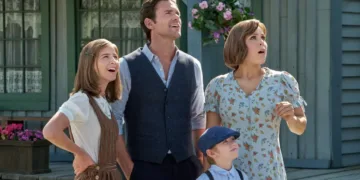
The longevity of this series points to a steady appetite for moral clarity that feels increasingly scarce in contemporary TV. It offers a refuge from the speed and suspicion that many streaming dramas treat as default settings. Season 13 opens by treating domestic calm as something that can crack without warning, even in Hope Valley. Elizabeth Thatcher now sits at the center of the town’s emotional life. She remains a schoolteacher, framed as a figure shaped by early twentieth-century virtues.
Hope Valley, Alberta, keeps leaning into a carefully built nostalgia, a place where hardship gets answered through neighbors, meetings, and shared labor. Elizabeth returns after a summer in Cape Fullerton, having spent months with her mother-in-law, Charlotte Thornton. Nathan Grant and the children have been with her. That homecoming carries warmth, then gets cut short by fear when Little Jack receives a diabetes diagnosis.
The premiere uses that medical pressure to argue for local infrastructure as a form of care, then stages the town’s growing contact with modernity as both promise and disruption. The show keeps its gentle cadence, choosing patience over shock. In an era where attention often gets treated like prey, that calm tempo becomes a statement: kindness, here, stays valuable.
Medical Progress and the Labor of Community
Little Jack’s health crisis gives the season a clear historical foothold. The script stresses that diabetes was terminal before the early 1920s, then turns that reality into a high-stakes ticking clock. A child’s future hinges on access to a new medicine. Insulin arrives as modern science reaching a remote Canadian settlement, and the show ties that idea to physical work rather than abstract optimism.
The clinic’s construction becomes a practical puzzle with real needs: a generator, refrigeration, and the systems that allow medicine to function outside a big city. Hope Valley’s path toward modern life shows up through hauling, building, wiring, and problem-solving. The writers linger on the labor required to make “progress” real. The town’s effort reads like a communal pledge, a structure raised through shared strain and shared affection, a place meant to keep a child alive.
That sense of grounded effort runs into organized labor on a larger scale. A railroad strike in Toronto creates an immediate barrier, leaving the medical inspector unable to travel. The strike echoes post-war labor movements, and its presence pulls the series closer to the realities that nostalgia often smooths away. Hope Valley can build a clinic, yet it still depends on systems beyond its control.
Elizabeth is pushed toward a painful decision: leaving the community would mean losing the network that holds her up. The town responds with fierce loyalty. They built the clinic themselves, and they treat it as a promise made to a neighbor, not a civic project you can postpone.
Nathan breaks the impasse with a bold choice, arranging for a pilot to fly the inspector to Hope Valley. The moment plays like a pivot point in the show’s sense of time: horses still define the town’s rhythms, and now an airplane arrives as a practical tool. It lands as clean cinematic heroism, rooted in a simple need. The inspector reaches the town. The clinic receives its license.
The separation threat dissolves. The series reinforces a core message through action rather than speeches: combined effort can protect a family, and ingenuity can meet a medical emergency. The plot frames survival as a collective responsibility, with the clinic standing as proof of communal security.
Matriarchal Approval and New Foundations
Season 13 also shifts its romantic focus into stability. Elizabeth and Nathan read as settled partners, operating as a blended family with a shared domestic rhythm. Nathan has fully stepped into the role of father figure to Little Jack, and the premiere treats that adjustment as a sign of maturity. The characters move through commitment and routine, building a life that looks less like a chase and more like a home.
Charlotte Thornton’s return carries the show’s memory with her. She connects the present to the late Jack Thornton, and her presence turns Nathan’s role into something that must be seen and judged, not simply declared. She watches how he shows up for her grandson, and her approval becomes a major narrative hinge.
The past and present find space to exist side by side without sparking an open wound. Her warning to Nathan, “not to mess this up,” lands with humor and tenderness, functioning as a kind of permission slip for the audience. It gives the season emotional clearance to move forward while keeping the earlier history in view.
In the political lane, Lucas Bouchard takes a separate route. As Governor, he fixates on legacy and office, sharing workspace with Edie Martell. Their scenes become one of the premiere’s lightest pleasures. Lucas presents himself as a logic-first man, and Edie’s plain advice, “don’t work too hard,” throws him off balance. He treats it like a riddle, then carries it to Lee for analysis. It is a small comic engine that also reveals vulnerability: power does not translate into ease with intimacy.
The subplot captures the awkwardness of early courtship through misunderstanding and overthinking, and the town’s attention becomes part of the dynamic. Hope Valley watches these pairings closely because relationships function as social glue. Private emotions become public curiosity, creating accountability alongside belonging. People in this town rarely carry feelings alone, and the series frames that as both comfort and pressure.
Conservation and the Irony of Progress
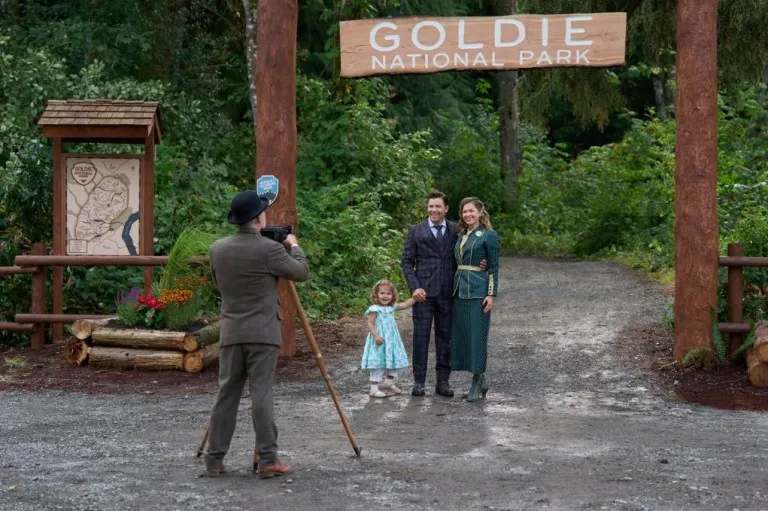
Modernization keeps shaping Hope Valley’s civic identity, and the premiere folds environmental thinking into that shift. Leland Coulter introduces Goldie National Park, tying it to early twentieth-century conservation ideals and a desire to protect land for future generations. The park stands as an emblem of planned progress, and it also brings friction to the surface. A.J. McGinty, described as a traditional rancher, sees the park as a threat to his livelihood. His view of land leans toward industry and use, and the conflict mirrors historical tensions in the Canadian West, where preservation and extraction collide.

The show threads those big themes through smaller, character-driven disputes. Rosemary Coulter expands her influence by opening a new playhouse, then bristles when the local paper labels it a vanity project. Her anger reads as pride and principle, a refusal to be reduced to a caricature while she tries to bring culture into a place frequently described as wilderness. Even the town’s everyday objects begin to signal change. A traffic light arrives, an unmistakably modern device planted among horses and dirt roads. The choice plays with irony: order arrives through technology, and the town still moves at a pace that makes the device feel slightly premature.
The children become active participants in this civic moment through their essays for the park’s welcome pamphlet. Allie finds her voice through the assignment, realizing how much the land matters to her. Her writing expresses attachment, belonging, and identity shaped by place. The pride spreads across the community, a shared feeling that they are building something that will outlast them. Hope Valley is portrayed as caught between eras, with the rugged past still visible and the organized future pressing in through infrastructure, policy, and public projects. The tension remains part of the town’s texture, not a problem solved in a single episode.
Redemption and the Generational Shift
The premiere also signals how casting decisions can carry thematic weight. Abigail Stanton’s return is treated as an event, with Lori Loughlin coming back to the role after a long absence. The choice connects directly to the season’s interest in forgiveness and second chances, aligning the show’s internal themes with a visible act of reinstatement. Abigail is framed as beloved, and her presence restores a missing piece of the town’s social circle, completing the sense of communal wholeness that the series prizes.
Minnie Canfield steps into a new responsibility by managing the schoolhouse, and the story gives her the burden that comes with taking over for someone like Elizabeth. Minnie feels the pressure of Elizabeth’s reputation, and the plot uses that anxiety to talk about leadership as labor, not status. Joseph supports her steadily, and the children’s eagerness to help reinforces Hope Valley’s faith in education. Teaching becomes civic work, and the schoolhouse reads like one of the town’s moral engines, a place where values get practiced rather than preached.
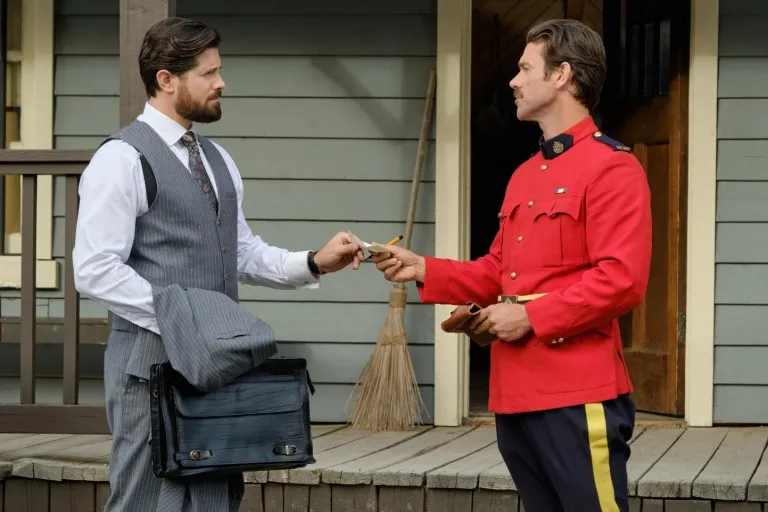
Younger characters point toward continuity. Oliver, a Mountie cadet hungry to prove himself, bonds with Allie, and those connections suggest the series is preparing the next wave of protectors and community-builders. The show keeps its wholesome tone and its TV-G rating, with explicit content absent by design.
That creative posture speaks to where the series positions itself inside modern television: it offers a clean, orderly space at a time when cynicism sells easily. The visual presentation supports that promise. Costumes and sets carry a polished, high-budget look, crafting a romantic version of the past that prioritizes beauty and control over grit. The series plays like visual comfort food, building Hope Valley as a protected space, a town framed as sheltered from history’s roughest edges.
The Fragility of Peace and the Coming Storm
The premiere closes by snapping from celebration into danger. The clinic’s success is interrupted when smoke rises from the national park, arriving at the exact moment Hope Valley seems most secure. Fire becomes the season’s opening natural threat, testing the community’s resilience in a way that infrastructure cannot fully contain.
Allie and her friends are in the woods setting trail markers, and the flames trap them, putting the next generation in immediate peril. Nathan and Thomas ride into the smoke with the clear intent to save their children. Oliver joins them, ignoring orders to stay at the visitor center. The choice defines him as he crosses from trainee to protector in a single, decisive act.
Suspicion creeps in around the cause. The fire may not be accidental, and the earlier conflict with McGinty points toward a darker possibility, introducing betrayal into a town that prefers trust. The episode begins with the warmth of return and ends with the threat of destruction, keeping the season’s moral comfort tied to real risk.
Hope Valley’s peace reads as something maintained through action and unity, and the cliffhanger makes that expectation concrete: the town’s people will have to protect their children and the legacy they are trying to build, with the wilderness pushing back against every attempt to tame it.
The thirteenth season of When Calls The Heart premiered on the Hallmark Channel on January 4, 2026, marking a significant milestone for the network’s longest-running scripted drama. Set in the early 1920s, the new season follows Elizabeth Thatcher and the residents of Hope Valley as they navigate the complexities of modernization, including the arrival of the town’s first stoplight and the opening of Goldie National Park. Viewers can watch new episodes weekly on Sunday nights on the Hallmark Channel, with next-day streaming available exclusively on the Hallmark+ platform.
Full Credits
Title: When Calls The Heart Season 13
Distributor: Hallmark Channel, Hallmark+
Release date: January 4, 2026
Rating: TV-G
Running time: 42–45 minutes
Director: Neill Fearnley, Peter DeLuise, Siobhan Devine
Writers: Lindsay Sturman, Elizabeth Stewart, Derek Thompson, Allie Rock
Producers and Executive Producers: Erin Krakow, Michael Landon Jr., Brian Bird, Eric Jarboe, Jimmy Townsend, Lindsay Sturman, Brad Krevoy
Cast: Erin Krakow, Kevin McGarry, Jack Wagner, Pascale Hutton, Kavan Smith, Chris McNally, Andrea Brooks, Viv Leacock, Natasha Burnett, Amanda Wong, Ben Rosenbaum, Hyland Goodrich, Jaeda Lily Miller
Director of Photography (Cinematographer): Sven Boecker, David Dolsen
Editors: Nicole Ratcliffe, Charles Robichaud
Composer: John R. Graham
The Review
When Calls The Heart Season 13
The thirteenth season of this series remains a bastion of sincerity in a cynical television market. By grounding high-stakes drama in medical progress and environmental preservation, the show manages to evolve without losing its gentle identity. The community-driven narrative provides a comforting sense of continuity, and the return to Hope Valley feels earned rather than forced. While it occasionally leans into historical sanitization, its commitment to moral clarity and mutual support is undeniably effective. It continues to be a masterful example of wholesome storytelling.
PROS
- Strong focus on community and collective resilience.
- Meaningful character growth for Elizabeth and Nathan.
- Effective use of 1920s technological shifts as plot points.
- High production value creates a beautiful visual world.
CONS
- Historical accuracy is often sacrificed for aesthetic.
- Subplots regarding romance can feel formulaic.
- Antagonism from certain characters feels predictable.
- Pacing remains slow, which may not suit all viewers.







