

























![Kingdom Hearts Collection [I-III] Review](https://gazettely.com/wp-content/uploads/2026/10/Kingdom-Hearts-Collection-I-III-1-360x180.webp "Kingdom Hearts Collection [I-III] Review: KHII Holds Steady as Newer Entries Fluctuate 37")




The humid air in rural Arkansas hangs like a physical substance, and Travis Dent moves through it with the slow drag of someone carrying his own weather system. He fronts a local band called The Cuticles. Offstage, he keeps himself in a kind of voluntary quarantine at a dive bar named The Shire, pouring cheap liquor over the memory of a best friend who has died. His days loop: play a set, drink, repeat. The film treats this as a small-town calamity with a familiar shape.
Then the story folds in a newer kind of wreck. Nick, a music executive with a freshly ruined reputation, shows up in town after a social media “artist” attached to his name is exposed as a total fraud. Nick tried to ride the viral machine and ends up ground into powder by it. It is the modern version of the old cautionary tale: a man builds a career on a system built to chew careers up.
Travis and Nick read like two species of cultural leftover. Travis belongs to the classic self-immolating rock myth, still smoldering in the corner. Nick comes from the New Media age of artifice, a casualty of the same attention economy he believed he could manage.
Their paths cross at Shakey Grounds, a coffee shop run by Mel. The place becomes their practical base of operations and their symbolic gathering point, the spot where comeback fantasies get organized into something that resembles a plan. The film frames their meeting as two different failures searching for one shared road to some form of salvation, personal or professional. The dynamic has the blunt poetry of the broken leading the blind.
The Cobain Complex and the Weight of Presence
Eric Nelsen plays Travis with grief that sits on the skin. It carries a near-religious heaviness, the kind that turns a person into a walking memorial. He wears an aesthetic that echoes the Pacific Northwest grunge era, pushing a “Cobain-style” aura of gifted misery without turning it into cosplay.
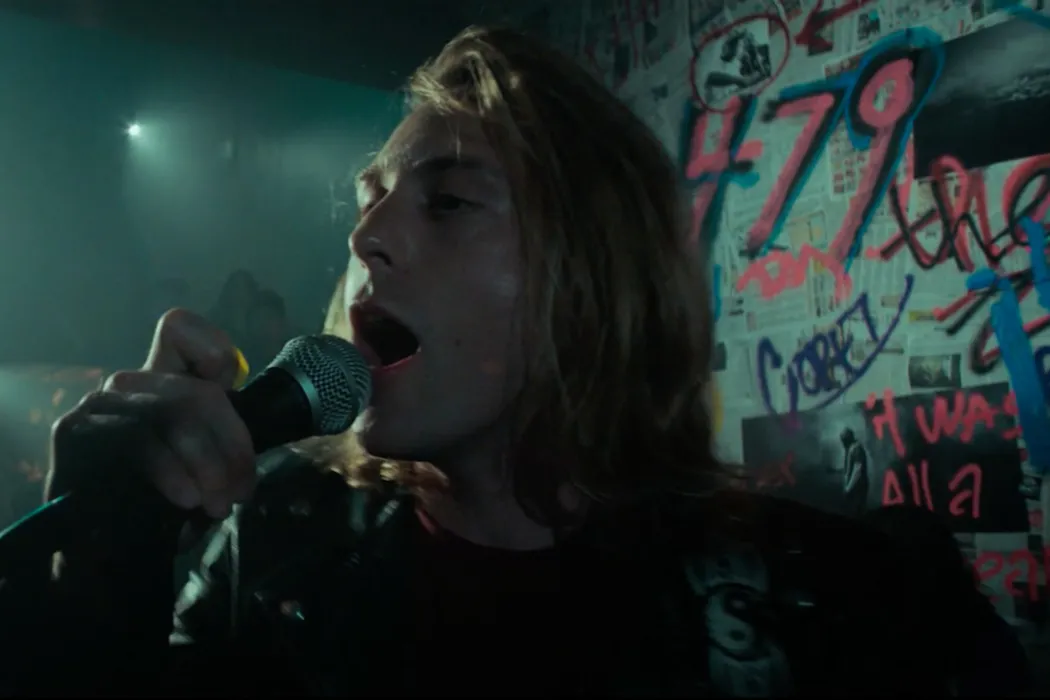
Nelsen gives Travis real creative heat, and he also makes clear how little internal scaffolding exists to keep that heat from burning down the rest of his life. The performance trades in what I’ll call pain-ticity (a made-up unit of measurement for suffering that gets converted into artistic credibility, at a rough exchange rate).
That pain-ticity has cultural baggage. The film leans into a society trained to treat male collapse as proof of authenticity, a distorted sacrament of rock history where the self becomes the sacrifice and the audience calls it “truth.” It is both persuasive and a little exhausting, which may be the point. The mythology sells. The mythology also destroys.
Ella Cannon steps in as Mel, and her presence recalibrates the story’s moral math. She acts as the band’s manager and the local voice of reason, played with a firmness that refuses the one-note “nag” stereotype. Mel burns with purpose. She also understands logistics, which in this film functions like a superpower. Her character stands for the labor behind the art, the person scraping genius off the floor so the show can start on time.
Bernz and Matthew Gumley, as the other members of The Cuticles, register more as reverberations than fully drawn people. They are there for rhythm and texture, serving as the architecture around Travis’s very public unspooling. The film’s choice to invest so heavily in the singular “tortured artist” figure, while leaving the rest of the group in softer focus, mirrors a cultural habit: worship the individual and let the collective fade into supporting décor. The band starts to feel less like a brotherhood and more like a maintenance crew for one man’s myth.
Music Video Aesthetics in the Heartland
Director Michael Garcia brings a sleek visual intelligence that signals a background in music videos. The cinematography carries a surprising level of craft for a production of this size. Shots feel composed with intent. Light becomes a mood barometer, swinging from the harsh, clinical glare of a morning hangover to neon-wet shadows during late-night performance scenes. The camera keeps telling you that these emotions matter, even during moments when the script seems to be catching its breath.
The Arkansas locations supply a sense of unvarnished reality. The film lingers on the stillness of small-town life, where the stakes inflate because there is so little else competing for attention. The spaces become externalized psychology, a physical landscape shaped to hold internal damage. The narrative can drift, and the frame keeps its composure.
There is a strong sense of place anchoring the more melodramatic turns. The venues look dusty and lived-in, the kind of rooms where dreams get parked and ignored. Garcia stages a visual conversation between ambition and environment: glossy camera precision set against the grit of a rural dive bar. The style creates tension that feels intentional, as if the film is arguing with itself in images. It suggests a grand story unfolding inside a very small room, which is, historically speaking, where American myths tend to hatch.
Sonic Dissonance and the Pacing of Redemption
The soundscape poses a curious problem. The soundtrack comes from the hip-hop group ¡MAYDAY! and Michael Summers, and the tracks arrive polished and professional. Then the film places that sheen next to a band that looks and moves like a gritty garage or punk outfit. The result is a recurring visual-audio mismatch that can tug you out of the moment. It turns The Cuticles into a kind of aesthetic chimera, a band with a metal heart and a rap soul. Sometimes that dissonance reads as a sly comment on genre branding in the digital age. Sometimes it plays like the movie tripping over its own shoes.
Practical issues add friction. The mix turns uneven, and musical sequences frequently swallow spoken dialogue. Character beats get harder to catch because the words are literally buried. The script can also stiffen, with lines that sound engineered to move the plot forward instead of revealing the speaker. That mechanical quality lands awkwardly in a story about authenticity, which may be unintentional irony (the cheapest kind, yet still effective).
Midway through, the narrative starts to lose momentum. The film spends a long time inside the recovery process, and the stretch can feel indulgent. A sharper edit could have kept the emotional edge cleaner and the forward motion more urgent. The road to the finale asks for patience, even while many individual pieces remain engaging: the performances, the look, the atmosphere. As a debut, it shows real confidence in short-form visual energy. It also shows how hard it is to stretch that energy across a full feature without letting the middle soften.
Shakey Grounds is an independent rock drama that explores the intersections of grief, addiction, and redemption within the music industry. Directed by music video veteran Michael Garcia in his feature film debut, the story centers on a struggling musician in rural Arkansas who finds an unlikely path to recovery through a disgraced record executive. The film was released digitally by Gravitas Ventures on May 23, 2025. As of today, January 5, 2026, the movie is widely available for streaming and purchase on platforms such as Apple TV+, Google Play, and various other VOD services.
Full Credits
Title: Shakey Grounds
Distributor: Gravitas Ventures
Release date: May 23, 2025
Rating: TV-MA
Running time: 82 minutes
Director: Michael Garcia
Writers: Trace Slobotkin
Producers and Executive Producers: Bernardo Garcia, Jonny Danks, Michael Garcia, Devon Libran, Eric Perez, Gary Dankner, Jack Sattin
Cast: Eric Nelsen, Eric Roberts, Mackenzie Ziegler, Ella Cannon, Jonny Danks, Moses Jones, Kelly Thiebaud, Matthew Gumley
Director of Photography (Cinematographer): Parris Stewart
Editors: Juan Carlos Gonzalez
Composer: Bernardo Garcia
The Review
Shakey Grounds
Shakey Grounds is a visually polished exploration of grief and industry disillusionment that occasionally trips over its own feet. While the lead performances offer genuine emotional weight, the film struggles with a tonal identity crisis between its punk-inspired aesthetic and its hip-hop-heavy soundtrack. Technical flaws in the sound mixing and a stiff script hinder the narrative flow, yet the earnestness of the production remains undeniable. It is a flawed but sincere debut that captures the "pain-ticity" of recovery in the American heartland.
PROS
- Striking cinematography that captures rural Arkansas with a professional, music-video-inspired polish.
- A raw and grounded performance by Eric Nelsen as the grieving Travis Dent.
- Authentic set design and locations that establish a strong sense of place.
- High-quality musical production from established artists.
CONS
- Persistent sound mixing issues where the music overpowers essential dialogue.
- Tonal inconsistency between the band’s visual branding and their musical output.
- Sluggish pacing in the middle act and a somewhat wooden script.
- Underdeveloped supporting characters who lack individual depth.







