

















In the bare bones of 1870 Wisconsin, a township called Friendship hangs on with the reflex of something refusing to die. The frontier here carries the weight of punishment. Sunlight scours the ground. Dust rises and settles again, as if the land is trying to swallow itself.
Jacob Hansen, a Norwegian immigrant and Civil War veteran, serves as the settlement’s single load-bearing beam. He functions as sheriff, pastor, and undertaker, three jobs that ask him to keep order, offer meaning, and bury what meaning cannot save. He holds these titles like talismans, as if duty can keep terror polite.
Then diphtheria slips through the gates. It arrives with the quiet efficiency of a verdict, taking children and elders alike, reshaping daily life into a rotation of fever, prayer, and grief. The horizon offers its own sentence. A massive wildfire begins to stain the sky in bruised orange and ash. Friendship starts to look like a thought experiment conducted by a silent God: How long can one man pretend he can protect a flock from nature’s appetite and heaven’s indifference?
The Tripartite Soul in Crisis
Jacob Hansen’s identity feels stitched together from obligations meant to drown the battlefield’s echo. Protection becomes his private purgatory. He clings to service as a form of atonement for violence that has lost its names but kept its scars. Johnny Flynn embodies this erosion through a vivid physical shift. At first Jacob reads as sturdy and taciturn, a man built from restraint. As the epidemic tightens its grip, he turns into something more skittish and feral, eyes darting, body hollowing out, a guardian learning the posture of a hunted animal.

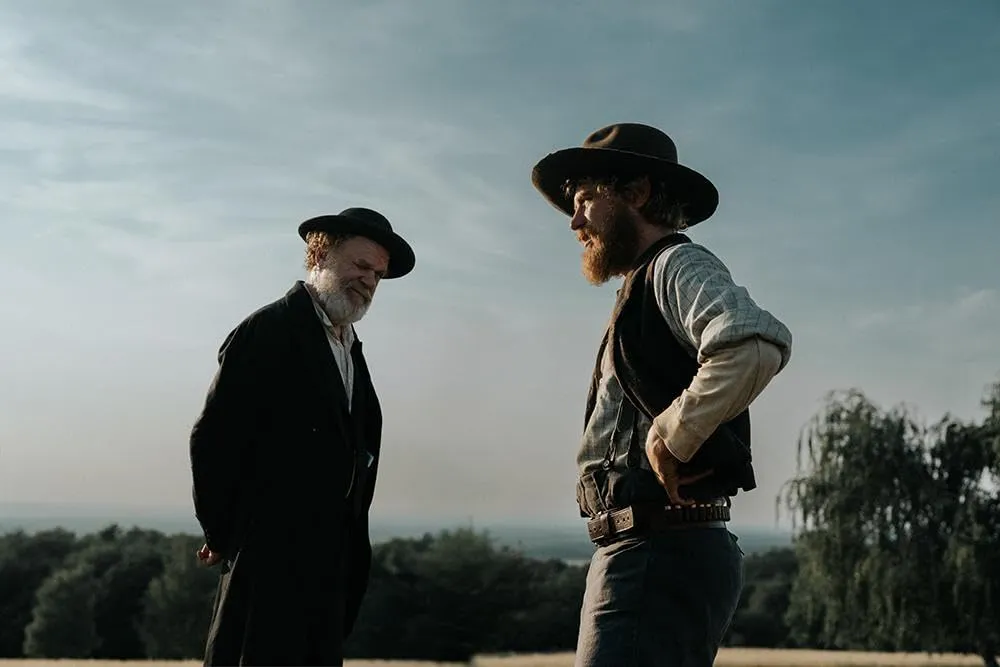
His trauma becomes the lens that bends the town’s crisis into theology. Disease turns into trial. Contagion becomes judgment. The biological facts remain in the room, yet Jacob treats them like symbols that accuse him. Across from him stands the town physician, played by John C. Reilly with a sober gravity that anchors the film whenever Jacob drifts toward martyrdom.
The doctor argues for containment grounded in reason, a practical response to a practical threat. Jacob struggles to live inside that logic. His sense of calling keeps demanding sacrifice, and sacrifice keeps demanding secrecy.
Their relationship carries the kind of tension that can break a settlement. In a place as thinly held together as Friendship, trust functions like infrastructure. The doctor presses for truth. Jacob pulls inward, wrapping himself in a cloak of duty that turns opaque and isolating. Each choice starts to feel like a moral wager placed with other people’s bodies. Marta, Jacob’s wife, supplies the friction his faith requires.
She reads the spreading decay with a clearer eye and urges escape, while Jacob remains fastened to what he considers destiny. Their conflict does not play like melodrama. It plays like a dispute between survival and vocation, between the living world and the story Jacob insists on telling about it.
Jacob’s collapse unfolds as a long surrender, measured in small decisions that compound into catastrophe. He carries authority like a crown forged from necessity, and the metal grows heavier with each funeral. The film watches him bend under it, then continue to bend, as if endurance could become redemption.
A Cinema of Despair and Dust
The film’s visual design builds claustrophobia with the patience of a trap. The Academy ratio compresses the world into a narrow corridor, making each frame feel like a tightening loop around the characters. The camera moves with a controlled, almost predatory calm, studying Friendship as it degrades into mud, glare, and exhaustion. Early scenes sit in parched browns and sickly greys, a drained palette that makes vitality feel like an exhausted rumor.
As diphtheria spreads and the fire advances, the aesthetic turns feverish. A dense red fog begins to take the landscape, tinting the frontier into something unreal, a dreamscape shaped by smoke and panic. The film also adopts a disembodied vantage that hovers above action like a cold divine witness. That gaze suggests judgment, then withdraws into indifference, leaving people to bargain with air and ash.
The physical world carries a splintered tangibility. The sets look built to be touched, then punished for being touched. Wood appears dry enough to catch from a glance. This sense of imminent ignition creates a constant moral pressure: every surface feels temporary, every shelter feels conditional. The score deepens that pressure by refusing the comfort of melody. It pulses. It stutters. It resembles anxious rhythm more than music, echoing shallow breath and the body’s panic when breath starts to fail.
Structurally, the film begins with a lean concentration on survival, each sequence tightening the screws with measured dread. That focus accelerates into a smoke-choked final movement that turns frenzied and close to operatic, as if the narrative itself has inhaled too much ash and can no longer speak calmly. The result is sensory punishment with purpose. You feel the walls closing, then realize the walls were inside the characters first.
The Phantasmagoria of Faith
Diphtheria and wildfire function as twin plagues, pushing human spirit into a crucible and refusing to let it cool. The film pulls heavily from Biblical imagery, framing a world where nature behaves like an instrument of purging, as if the land is rejecting intruders with plague and flame. Jacob experiences the epidemic as interrogation. The town’s suffering mirrors his own unhealed wounds from the war, and he treats each death as both communal tragedy and personal accusation.
A dead soldier arrives, still wearing his uniform, and the image lands like a message from the past that refuses burial. The Civil War returns as a ghost with paperwork, reminding Jacob that history does not end when people decide to stop speaking about it. From there, the film begins to blur the border between external disaster and internal fracture. Reality starts to smear with Jacob’s psyche, and the story drifts toward phantasmagoria, asking the viewer to question the ground beneath the narration.
In the final act, the fires take on a quality that feels both concrete and psychic. We wonder if the apocalypse on the horizon exists strictly as physical threat, or if it has been amplified by a mind buckling under leadership’s strain. The conflict between transparent lockdown and a policy of silence becomes a philosophical battleground. It exposes the arrogance embedded in Jacob’s protector role, the belief that chaos can be mastered through sheer will, secrecy, and sacrifice.
The film keeps returning to a grim idea: in a world ruled by contagion and flame, the ego that insists on control becomes a kind of tinder. Authority burns easily. Faith burns differently. And the question left in the smoke is not comforting. It asks what remains of a man after the duties that defined him begin to collapse, one funeral at a time.
A Prayer for the Dying is a survival thriller set in the late 19th-century American West. It premiered at the 76th Berlin International Film Festival on February 13, 2026, within the Perspectives section. Directed by Dara Van Dusen in her feature debut, the film follows a Civil War veteran in Wisconsin who must defend his community against a deadly diphtheria outbreak and a devastating wildfire. Following its festival run, the movie will be distributed in North America by Quiver Distribution, where it is expected to be available for streaming and theatrical release later in the year.
Full Credits
Title: A Prayer for the Dying
Distributor: Quiver Distribution (North America), Anton, New Europe Film Sales
Release date: February 13, 2026 (Berlinale Premiere)
Running time: 95 minutes
Director: Dara Van Dusen
Writers: Dara Van Dusen (Screenplay), Stewart O’Nan (Based on the novel by)
Producers and Executive Producers: Dyveke Bjørkly Graver, Andrea Berentsen Ottmar, Vicky Miha, Fenia Cossovitsa, Tristan Goligher, Mimmi Spång, Kristina Börjeson
Cast: Johnny Flynn, John C. Reilly, Kristine Kujath Thorp, Gustav Lindh, Chris Slater, Hilton Pelser, Andrew Whipp, Daniel Weyman, David Ganly, Tadhg Murphy, Christopher Rygh
Director of Photography (Cinematographer): Kate McCullough
Editors: Fredrik Morheden, Dimitris Manousiakis
Composer: Beata Hlavenková
The Review
A Prayer For The Dying
The film is a harrowing, visually arresting meditation on the limits of human agency. It captures the suffocating intersection of past trauma and present catastrophe, though its commitment to aesthetic severity occasionally stifles the very emotional truth it seeks to uncover. While the narrative sometimes loses its way in the smoke of its own ambition, the central performances and the sheer, tactile dread of its atmosphere make it a formidable experience. It is a bleak, beautiful interrogation of faith that lingers in the mind like the scent of woodsmoke and ash.
PROS
- Formidable, visceral performances by Flynn and Reilly
- Masterful, claustrophobic cinematography and color work
- Striking, tactile production design and period authenticity
- A bold, genre-blurring transition into psychological horror
CONS
- Aesthetic excess occasionally overwhelms the emotional core
- The pacing in the second act can feel somewhat stagnant
- Dialogue sometimes leans into self-important abstraction
- The shift toward melodrama at the climax may feel jarring