










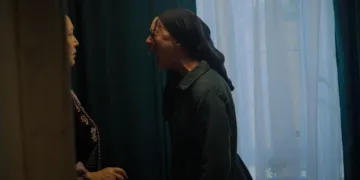
















In a film that follows the claustrophobic tension of his previous work, director İlker Çatak stages quiet devastation through Derya and Aziz. The pair move through Ankara with the ease of people protected by cultural capital: she thrives as a celebrated stage actress, he works as a playwright and university academic. That protection evaporates once the state takes interest, set in motion by Derya’s refusal to flatter a government official and Aziz’s encouragement of student protest in the streets.
The yellow letters of the title arrive with the brisk impersonality of paperwork, functioning like clinical tools designed for demolition. Livelihoods disappear. Social standing dissolves. What remains is a couple learning how quickly “respectability” can be revoked.
Çatak’s formal gambit sharpens that sense of displacement. The film is shot entirely in Germany, letting Berlin and Hamburg play Ankara and Istanbul in plain sight, with German signage and recognizable landmarks left visible. The choice reads as an intentional counterfeit that refuses to pass as seamless realism.
It produces political exile as a feeling before it becomes a plot point, placing the story in a geographic limbo where home looks familiar and wrong at the same time. Authoritarian pressure seeps into private life until a home starts to behave like an extension of state power. The narrative keeps its attention on the downstream consequences of that power, letting harm accumulate through procedure, humiliation, and slow constriction rather than speechifying.
Fractures in the Domestic Sphere
The family’s fall carries them from a spacious Ankara flat to the cramped Istanbul apartment of Aziz’s mother. The move compresses their lives into tighter rooms and tighter tempers, and the new environment brings a suffocating closeness that tests a partnership once defined by balance.
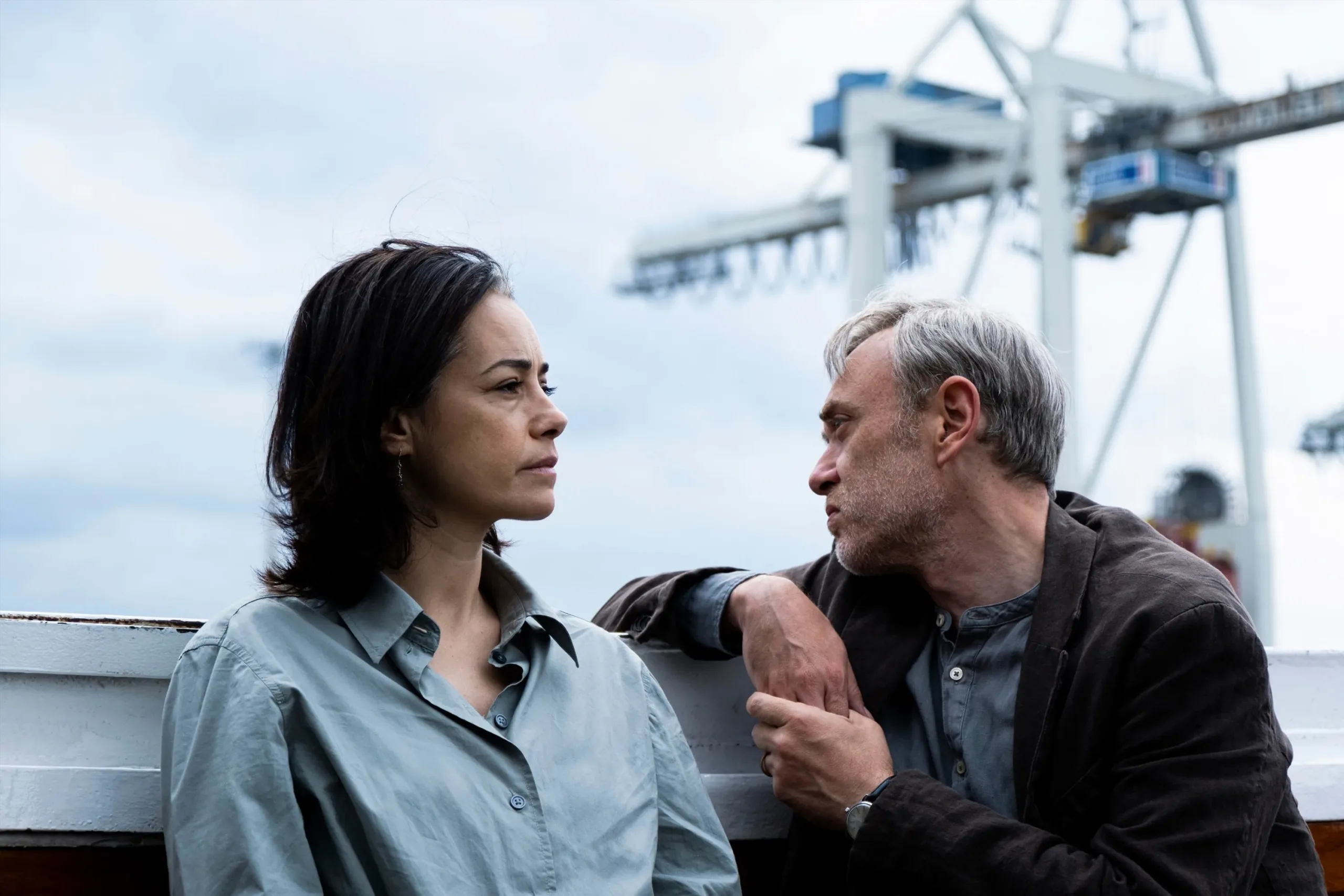
Özgü Namal and Tansu Biçer play the erosion with meticulous control, tracking a shift from mutual regard toward exhaustion and suspicion. Money becomes a constant presence. Silence gains weight. The air between them fills with accusations that never quite reach the surface, spoken through pauses, glances, and small corrections that land like bruises.
Their daughter, Ezgi, watches this change with the stillness of someone collecting evidence without language to process it. Her quiet presence reframes the conflict as generational fallout, the kind that forms when adults turn principles into weapons and survival into a daily negotiation. Visually, the film leans on glass as a recurring motif. Judith Kaufmann frequently frames the couple through windows or reflections, splitting and distorting their images until even shared space looks like separation.
The effect turns the marriage into a series of partitions: two people occupying the same rooms while living inside different pressures. The state’s reach shows itself through intimacy, pushing them into alienation from each other with the same efficiency that removes them from their professions. The household becomes a small-scale version of a national crisis, where basic coexistence demands emotional labor that starts to feel impossible to sustain.
The Burdens of Survival and Hypocrisy
The script refuses to polish Derya and Aziz into sanctified victims. They are presented as inconsistent, flawed people whose ideals collide with the demands of staying afloat. Their secular, progressive self-image strains under practical decisions.
They speak for equality, yet they cling to the possibility of private education for their daughter. Aziz, who does not believe, still goes to a mosque to maintain social appearances. The film treats these contradictions as lived reality, exposing how comfort can make principles feel effortless and how precarity turns ethics into triage.
Pressure pulls them onto diverging tracks. Derya accepts a part in a state-aligned television soap opera, choosing pragmatic self-preservation in a space that carries the state’s fingerprints. Aziz holds to his artistic integrity through work that keeps him mobile and anonymous, driving a taxi while secretly writing a dissident play.
Their split becomes a study in how convictions are weighted under duress: one path seeks stability through compromise, the other through endurance and clandestine creation. Aziz frames the government’s methods through dramaturgy, reading the machinery of repression as performance, a regime acting out legality with theatrical precision to silence dissent.
That theme of performance bleeds into social life, especially during a tense dinner with Derya’s brother, Salih. His patriarchal worldview exposes cultural and religious fault lines that the crisis has dragged into the open. The scene suggests a grim chemistry: state pressure accelerates conflicts that already exist, giving private prejudice and public authoritarianism room to reinforce each other in the same room, over the same table, with the same forced politeness.
Universal Parables and Artistic Defiance
The film’s craft supports its ambition as a parable with global reach, a story that extends past a single place even as it uses specific names and cities. Judith Kaufmann’s cinematography holds the intimate beside the imposing, moving from the fine tremor of hands to the severe geometry of “Berlin as Ankara.”
Marvin Miller’s string-heavy score rises and tightens during moments of bureaucratic absurdity, as the couple are forced to account for vague, unnamed crimes in a kangaroo court. The music does not rescue them from the system; it underlines the system’s capacity to turn language into fog and procedure into punishment.
By embracing the visible artifice of its German locations, the film argues that the erosion of free expression can take root anywhere, under any architecture, behind any flag. The absence of specific political names helps the story function as a Kafkaesque warning about how fragile intellectual freedom can be once institutions decide that ambiguity is a weapon. In the final act, Derya and Aziz reach for agency through art, staging a play titled Yellow Letters and converting their own ordeal into material. The gesture carries a sharp, self-referential charge: apartments can be taken, careers can be confiscated, reputations can be erased, yet imagination remains difficult to annex.
The closing moments hold their power in ambiguity, inviting contemplation of a freedom that still feels constrained. Resistance appears as speech that creates a sense of release inside a world that keeps its walls intact. The film leaves that tension unresolved, letting liberation register as an act that exists alongside confinement, not as a clean escape from it.
Yellow Letters (originally titled Gelbe Briefe) is a poignant political drama that explores the personal cost of state-sponsored persecution. The film recently celebrated its world premiere at the 76th Berlin International Film Festival on February 13, 2026, where it competed for the Golden Bear. Following its successful festival debut, the movie is scheduled for a wide theatrical release in Germany starting March 5, 2026, through Alamode Film. As of today, February 14, 2026, it is currently making its rounds through the international film circuit, and streaming availability on major platforms has yet to be finalized.
Full Credits
Title: Yellow Letters (Gelbe Briefe)
Distributor: Alamode Film, Be For Films
Release date: February 13, 2026
Rating: FSK 12
Running time: 128 minutes
Director: İlker Çatak
Writers: İlker Çatak, Ayda Meryem Çatak, Enis Köstepen
Producers and Executive Producers: Ingo Fliess, Enis Köstepen, Nadir Öperli
Cast: Özgü Namal, Tansu Biçer, Leyla Smyrna Cabas, İpek Bilgin, Jale Arıkan, Yusuf Akgün, Şiir Eloğlu, Eray Eğilmez
Director of Photography (Cinematographer): Judith Kaufmann
Editors: Jan Ruschke
Composer: Marvin Miller
The Review
Yellow Letters
Yellow Letters is a precise, haunting study of how authoritarianism dismantles the private lives of the intellectual class. By embracing a deliberate, self-aware artifice, the film elevates a specific Turkish crisis into a universal parable of displacement. While it occasionally leans into repetitive melodrama, the lead performances carry the emotional weight of a crumbling marriage under state pressure. It is a vital, intellectually rigorous exploration of the price of integrity.
PROS
- Exceptional lead performances by Namal and Biçer.
- Innovative use of German locations to signal exile.
- Deeply nuanced portrayal of moral hypocrisy.
- Striking cinematography and an evocative score.
CONS
- Occasional pacing issues in the final third.
- Some narrative beats feel repetitive or forced.
- Vague political specifics may frustrate some viewers.
- Predictable subplots regarding the daughter.