













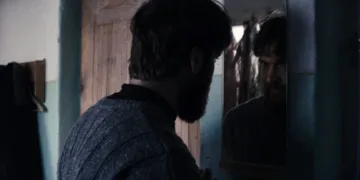











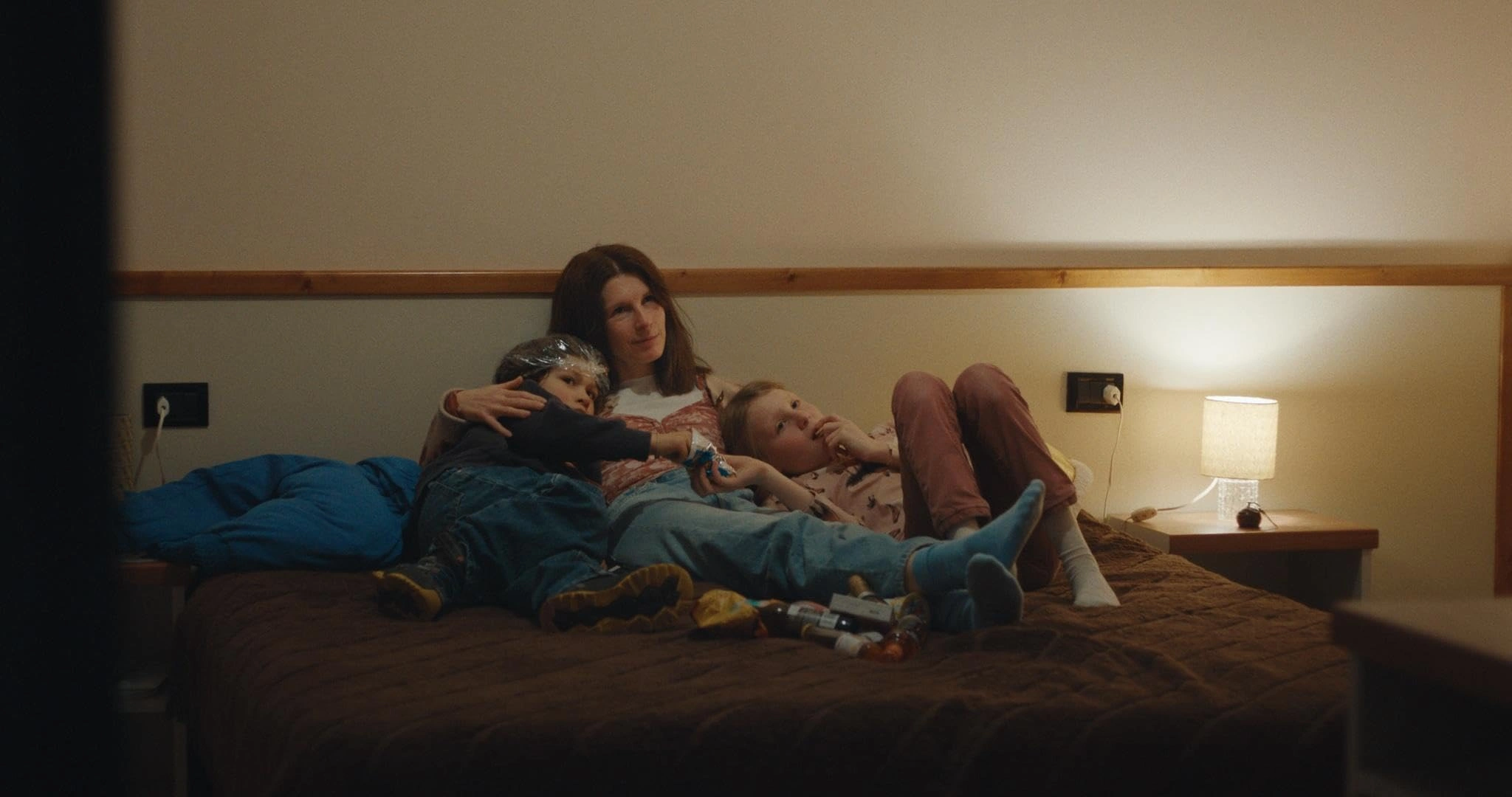

Niki Hofer’s breakfast table contains the entire moral trap of A Happy Family: hard bread, dry cereal, frightened children, and a mother who appears both abandoned and dangerously unprepared. Jan-Eric Mack lets the scene unfold as domestic chaos until the camera pans far enough to reveal a social worker sitting in the corner. Jimmy then announces that they rarely eat breakfast. The observation visit has become an autopsy.
Niki works at a laundry plant, takes weekend shifts at a nightclub, and studies at night. Her wages are being seized to repay 70,000 Swiss francs of debt. Jimmy lacks winter clothes and falls asleep at school. Leonie has begun acting like a substitute parent, supervising her younger brother while Niki works. Poverty has entered every room of the apartment, including the children’s bodies.
Anna Schinz plays Niki with the agitated rhythm of someone who has spent years reacting to emergencies and has forgotten how planning works. Her affection for Leonie and Jimmy is evident. So is the fact that affection has ceased to protect them.
Poverty and Permission
The kitchen fire initially seems to settle the film’s argument. Leonie tries to prepare food while Niki is working, the apartment catches fire, and child protection services remove both children. The machinery of the state has finally arrived, and it arrives after the damage rather than before it. Support, Mack suggests, is available mainly as surveillance. Then Niki explains why she missed Leonie’s calls. Her phone battery was dead because the children had used it for games. She blames them.

That detail changes the equation. Niki’s hardship remains real, yet the film can no longer frame every failure as an economic consequence. She leaves a nine-year-old responsible for a younger child. She attacks a caseworker. She refuses to recognise why the children might need distance from her. At first, I read the placement as institutional cruelty. Niki’s response forced a revision. The system is punitive, and she is reckless. Both ideas fit inside the same film (there is no law against moral complexity).
Mack appears less comfortable with that complexity than Schinz does. The meeting with the caseworkers develops an almost comic rhythm, ending when Niki lunges across the room. A later break-in at their office becomes the first stage of a strange caper. A nightclub colleague helps her locate the children, she deliberately injures herself to escape work, dyes her hair, uses forged documents, and secures a cleaning job at their new school. Call it sympathy laundering: dangerous choices pass through energetic editing and emerge looking like evidence of devotion.
Love as Possession
Schinz resists that laundering. Her performance keeps placing small fractures inside Niki’s confidence. She smiles too quickly when a plan appears to work. Her temper arrives before thought. Her faded pink coat seems chosen for visibility, as if disappearing from her children’s lives would count as a second death. The difficult question is not whether Niki loves Leonie and Jimmy. She does. The question is what her love permits her to do.
She watches them from inside their school, enters their new community under a false identity, and treats their increasing stability as a personal betrayal. Leonie and Jimmy begin receiving regular meals, structure, and calm from Sabine, played by Julia Jentsch without easy villainy. Sabine’s composure matters because it dismantles Niki’s preferred story. The children have not been stolen by a monster. They have been given an ordinary life.
Their growing resistance to Niki supplies the film’s most painful material. Leonie has already spent too long carrying adult burdens. Jimmy begins enjoying pleasures that should never have been scarce. When they pull away from their mother, their choice does not read as rejection. It reads as self-preservation. Niki interprets family as permanent access. The children slowly understand it as safety.
The Argument Goes Missing
Cinematographer Yunus Roy Imer gives Niki’s world a suffocating physical logic. The laundry plant presses fabric under mechanical force. The nightclub surrounds her with pounding sound and artificial light. After the fire, she sits among scorched textiles with a cigarette between her fingers, the ruined apartment finally matching her internal state.
Thomas Kuralti’s score often knows what the screenplay avoids. Ominous music accompanies Niki’s excited pursuit, turning her enthusiasm into a warning. Jimmy’s outdoor birthday party uses slow motion to create a brief pocket of joy, yet the image feels unstable, ready to collapse once normal speed returns.
The move toward Raron opens the frame into mountain landscapes. The air is clearer, the horizons wider, and Niki’s thinking grows narrower. Mack’s direction keeps producing these sharp contradictions. His script keeps stepping away from them.
The final appeal to poverty is true in principle and incomplete in this particular case. Niki has been ground down by debt, exhausted by labour, and treated by public institutions as a problem to process. She has also endangered her children, blamed them for the consequences, and invaded the life that helped them recover. The film approaches this uncomfortable arrangement, pauses, then reaches for harmony. Its happy ending feels less like mercy than paperwork filed under the wrong name.
This Swiss social drama had its world premiere at the Karlovy Vary International Film Festival on July 4, 2026. The story centers on Niki, a struggling mother who, after a domestic accident leads to her children being placed in foster care, assumes a new identity to secretly remain close to them and defy a rigid social system.
Full Credits
Title: A Happy Family
Distributor: C-Films, DCM Film Distribution
Release date: July 4, 2026 (World Premiere)
Running time: 121 minutes
Director: Jan-Eric Mack
Writers: Anna Schinz, Nikita Afanasjev, Eva Kienholz, Jan-Eric Mack
Producers and Executive Producers: C-Films
Cast: Anna Schinz, Julia Jentsch, Michael Neuenschwander, Bettina Stucky, Alireza Bayram, Annalisa Ferriani, Lir Kunkel, Martina Apostolova
Director of Photography (Cinematographer): Roy Yunus Imer
Editors: Benjamin Fueter
Composer: Thomas Kuratli
The Review
A Happy Family
A Happy Family keeps asking who has failed Niki: the welfare system, an economy that converts poverty into punishment, or Niki herself. The honest answer is all three, which the film seems prepared to accept until its screenplay loses its nerve. Anna Schinz preserves the contradiction through a performance filled with affection, resentment, panic, and alarming conviction. Jan-Eric Mack gives her a social drama, then a thriller, then something resembling absolution. The first two belong together. The third feels filed by the wrong department.
PROS
- Anna Schinz’s layered performance
- Strong opening breakfast scene
- Claustrophobic visual design
- Effective industrial soundscapes
- Children’s changing perspective
CONS
- Uncertain moral position
- Implausible identity-thriller turns
- Niki’s actions insufficiently examined
- Forced harmonious resolution
- Poverty argument lacks precision