

























![Kingdom Hearts Collection [I-III] Review](https://gazettely.com/wp-content/uploads/2026/10/Kingdom-Hearts-Collection-I-III-1-360x180.webp "Kingdom Hearts Collection [I-III] Review: KHII Holds Steady as Newer Entries Fluctuate 37")





Baki-Dou: The Invincible Samurai begins from an oddly rich dramatic place for a fighting anime. Baki has already climbed the mountain. His clash with Yujiro gave him the test that defined his life, and what follows is not triumph in any simple sense. It is drift. He trains, he runs, he knocks opponents aside, and none of it seems to matter. The strongest fighter in the room keeps yawning. That image does a lot of work for this season. It turns exhaustion into the story’s engine.
What arrives next sounds ridiculous even by Baki standards, which is part of the appeal. Mitsunari Tokugawa, ringmaster, schemer, and patron saint of catastrophic ideas, bankrolls a project to bring Musashi Miyamoto into the present. The new arc takes a franchise built on bruised flesh and impossible physiques and asks what happens after the hero reaches the goal that shaped his life.
I have always liked stories that pick at the silence after victory. Sports films do it from time to time. So does jazz, in its own way, with the pause after a blazing solo. Baki-Dou finds that same empty beat, then fills it with cloned samurai chaos, dead-serious martial arts myth, slapstick weirdness, and a great deal of blood.
A Slow Burn in a Franchise Built on Impact
The early stretch may catch some viewers off guard. This series has a reputation for force and speed, yet these episodes spend a surprising amount of time with malaise, setup, and uneasy anticipation. Baki’s boredom hangs over the story. Tokugawa’s experiment creeps forward with a grim sort of excitement. Musashi’s arrival is treated less like a punchline and more like a rupture in the world’s logic. That choice gives the season shape. It lets Musashi enter as a full disturbance instead of a novelty fighter waiting for the next bell.
That patience pays off. Musashi comes into modern Japan carrying his own moral frame, his own reading of violence, and his own sense of what battle means. Watching him absorb the present day is some of the strongest material in the season. He is curious, disoriented, and quietly terrifying. The show understands that a man from another age does not need to shout to feel dangerous. Sometimes he only needs to look at the room as if everyone in it has forgotten what combat is.
Still, the pacing does wobble. Exposition can circle the same point a few times too many, and some scenes explain ideas that the animation has already made clear. That habit blunts the impact in places. The second half shifts into a string of tests and confrontations as various fighters step forward before Baki fully takes center stage again. That structure creates anticipation, though it also leaves this first batch with an incomplete feel. As a piece of a longer arc, it works. As a self-contained season, it can feel like a long inhale waiting for the real exhale.
Strength, Spectacle, and a World That Has Lost Its Purpose
For all its absurdity, Baki-Dou has a sharper thematic pulse than its hulking character designs might suggest. The season is about boredom, yes, though boredom here is really spiritual vacancy. Baki has spent years organizing his existence around a single summit. Once he reaches it, life turns flat. That emptiness spreads across the fighter world. Men built like monuments keep searching for a sensation that can wake them up. There is something familiar in that, especially now, when so much modern life feels like repetition disguised as momentum.
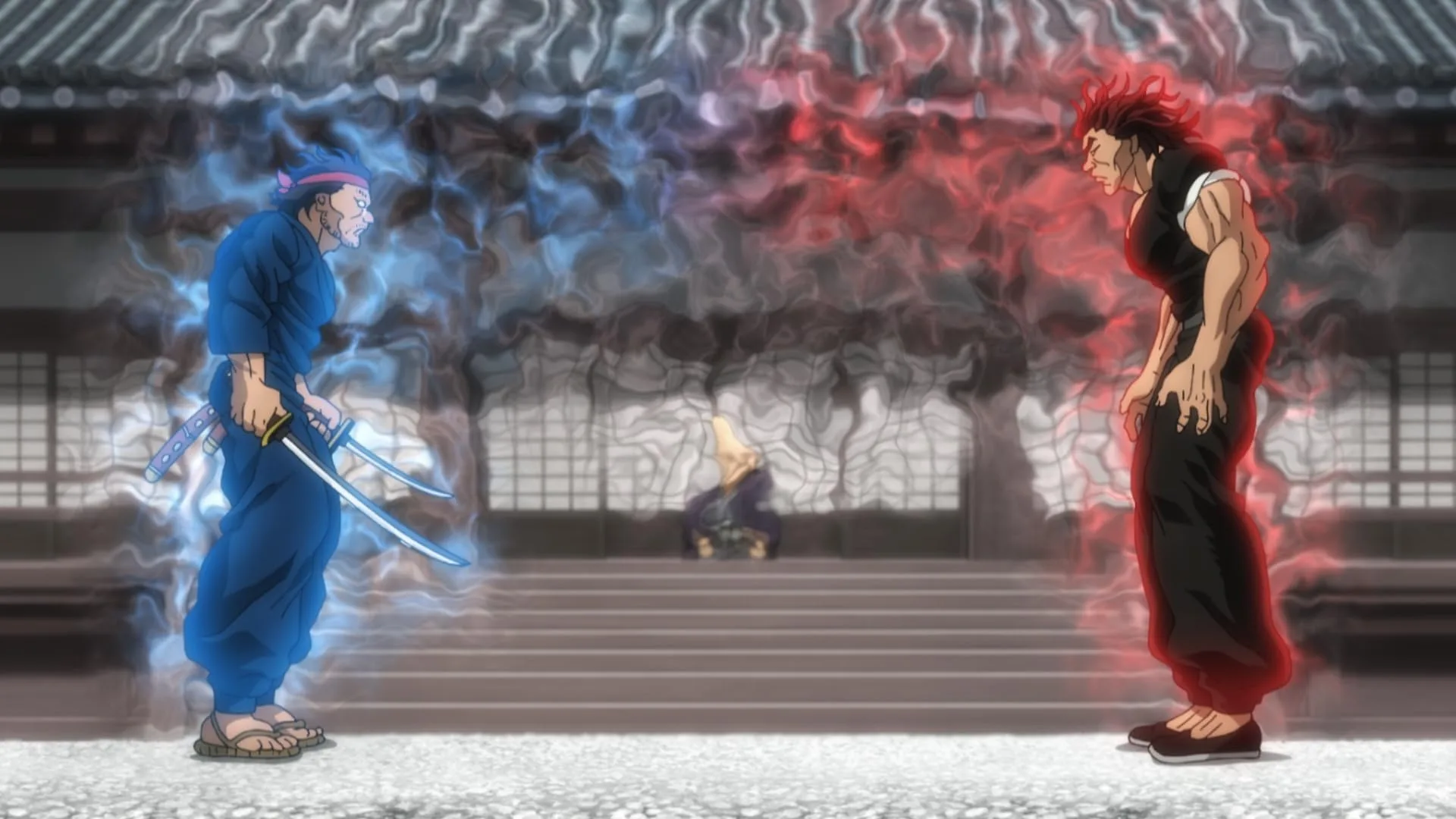
Tokugawa becomes fascinating from this angle. He is the season’s impresario of moral collapse, turning science, vanity, and bloodsport into a single project. His resurrection plan plays like a dark gag, though the series never lets it drift too far from genuine unease. He revives a historical figure for spectacle. He treats a life, a legend, and an entire ethical crisis as programming. That gives the season a cultural sting.
It points toward a world that packages anything, even history itself, as content for an audience that needs a bigger thrill every week. Musashi sharpens all of this. He is not just a threat dropped into the bracket. He is a man with presence, intelligence, and a deeply rooted code that clashes with a modern combat culture built on showmanship, regulation, and celebrity.
His existence forces the rest of the cast to confront a brutal question: if someone from another age can shatter their measure of greatness, what were their standards worth? Baki remains central, though this arc wisely lets other fighters reflect that crisis first. The result is a season that uses exaggerated combat to examine what people do once their strength no longer gives them direction.
Bodies in Motion
The craft side of Baki-Dou is uneven in a way that often suits it. The animation is not lavish. It is functional, rough-edged, and sometimes plain. Yet that hand-drawn harshness fits this world of scar tissue, swollen muscles, and terrifying conviction. A smoother style might sand away the menace. Here, the line work feels like part of the violence.
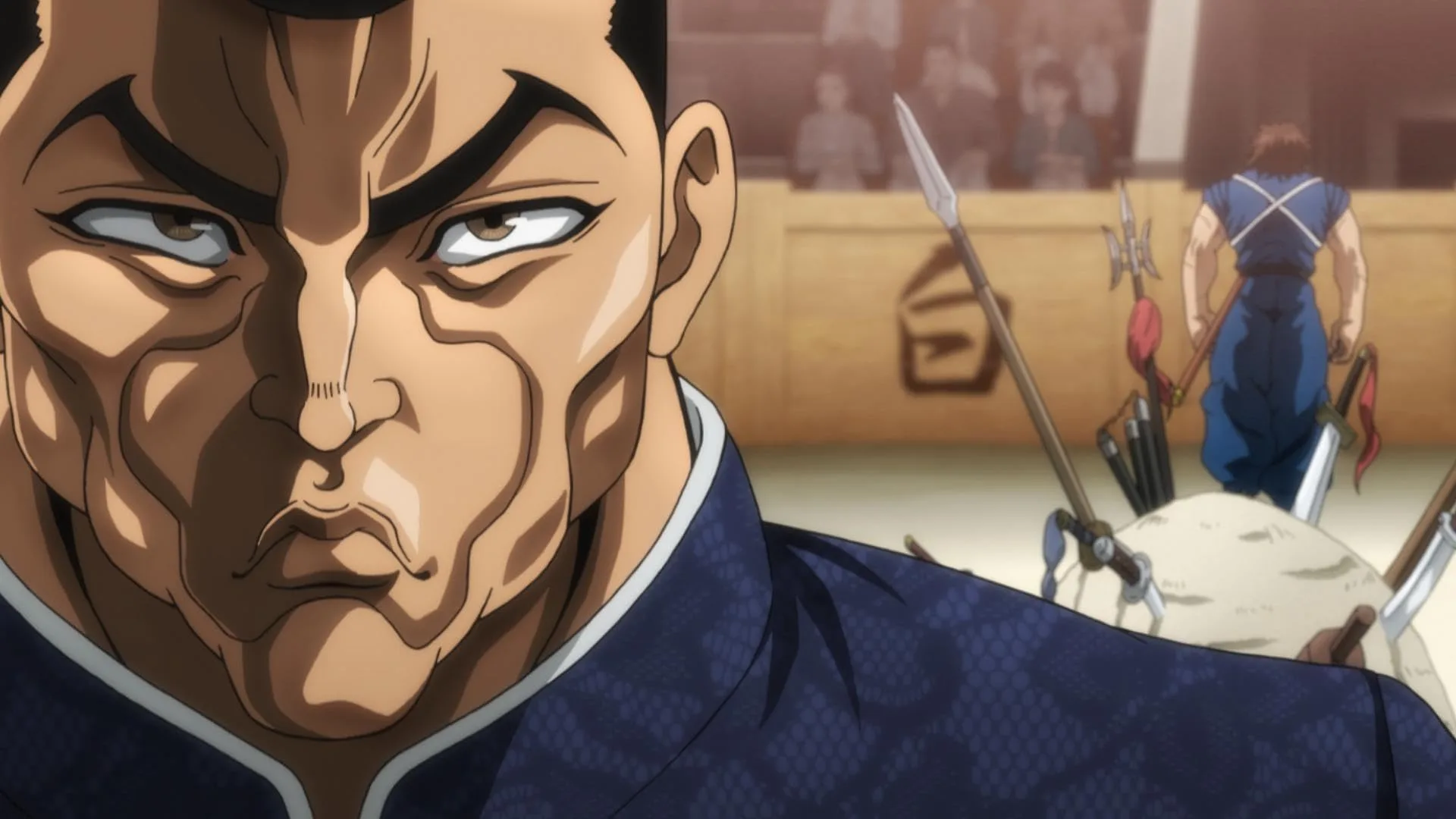
The fights succeed because they are built from detail as much as impact. The series slows movement to show mechanics, timing, and intention. A strike matters because of where it lands, how it lands, and what the fighter imagines before it lands. Musashi’s sword-based aura gives these clashes a fresh charge. He can make opponents feel pain before a clean blow even arrives. That idea lands beautifully in animation, where thought and force can occupy the same frame.
The show still talks too much at times. It has a habit of explaining its strongest images when it should trust them. Yet the action remains gripping because the staging understands menace. Character design helps a lot. These fighters look grotesque, iconic, and instantly readable. Baki’s younger face, set against a wall of monstrous physiques, still gives him an unusual presence. The voice work seals much of it. Musashi carries authority the moment he speaks, while Baki’s detached cool sells the season’s opening mood. Baki-Dou is at its best when absurdity, tactical precision, and raw tension all hit the screen together.
Baki-Dou: The Invincible Samurai premiered worldwide on Netflix on February 26, 2026, serving as the latest high-octane installment in the long-running Baki the Grappler franchise. Following the epic conclusion of the father-son conflict, the story finds Baki Hanma and his fellow underground arena fighters grappling with a period of profound boredom until a secret cloning project successfully resurrects Miyamoto Musashi, Japan’s most legendary samurai. This 13-episode season explores the clash between ancient swordsmanship and modern mixed martial arts. Fans can stream the entire first season exclusively on Netflix, where it is available in both the original Japanese audio and various dubbed versions.
Where to Watch Baki-Dou: The Invincible Samurai Online


Full Credits
Title: Baki-Dou: The Invincible Samurai
Distributor: Netflix
Release date: February 26, 2026
Rating: TV-MA
Running time: 25 minutes per episode
Director: Toshiki Hirano
Writers: Keisuke Itagaki, Tatsuhiko Urahata
Producers and Executive Producers: TMS Entertainment, BAKI-DOU Production Committee
Cast: Nobunaga Shimazaki, Naoya Uchida, Akio Otsuka, Rikiya Koyama, Takuya Eguchi, Takayuki Sugo, Yoshihisa Kawahara, Bin Shimada, Kenta Miyake, Tetsuo Kanao
Director of Photography (Cinematographer): Tatsuo Noguchi
Editors: Yuriko Sano
Composer: Kenji Fujisawa
The Review
Baki-Dou: The Invincible Samurai
Baki-Dou: The Invincible Samurai works best when it turns post-victory emptiness into the fuel for a strange, violent new chapter. Its pacing can drag and its exposition can overstate the obvious, yet Musashi’s arrival gives the series a sharp new charge. The fights still hit with force, and the themes give the bloodshed a stronger dramatic pull than expected.
PROS
- Strong central idea built around boredom after triumph
- Musashi is a compelling new presence
- Inventive fight choreography and tactical detail
- Distinctive character designs
- Themes of purpose, spectacle, and ethics add weight
CONS
- Slow opening may frustrate action-first viewers
- Repetitive exposition
- Incomplete seasonal arc
- Some side bouts feel stronger than the main progression







